Ask ten agencies what a website costs and you will get ten different answers ranging from $500 to $50,000. That range is not dishonest. It reflects how genuinely different website projects are from each other. A five-page service site for a local contractor and a custom ecommerce platform for a growing retailer are both "websites" in the same way that a bicycle and a delivery truck are both "vehicles." The label is the same. The scope, complexity, and appropriate investment are completely different.
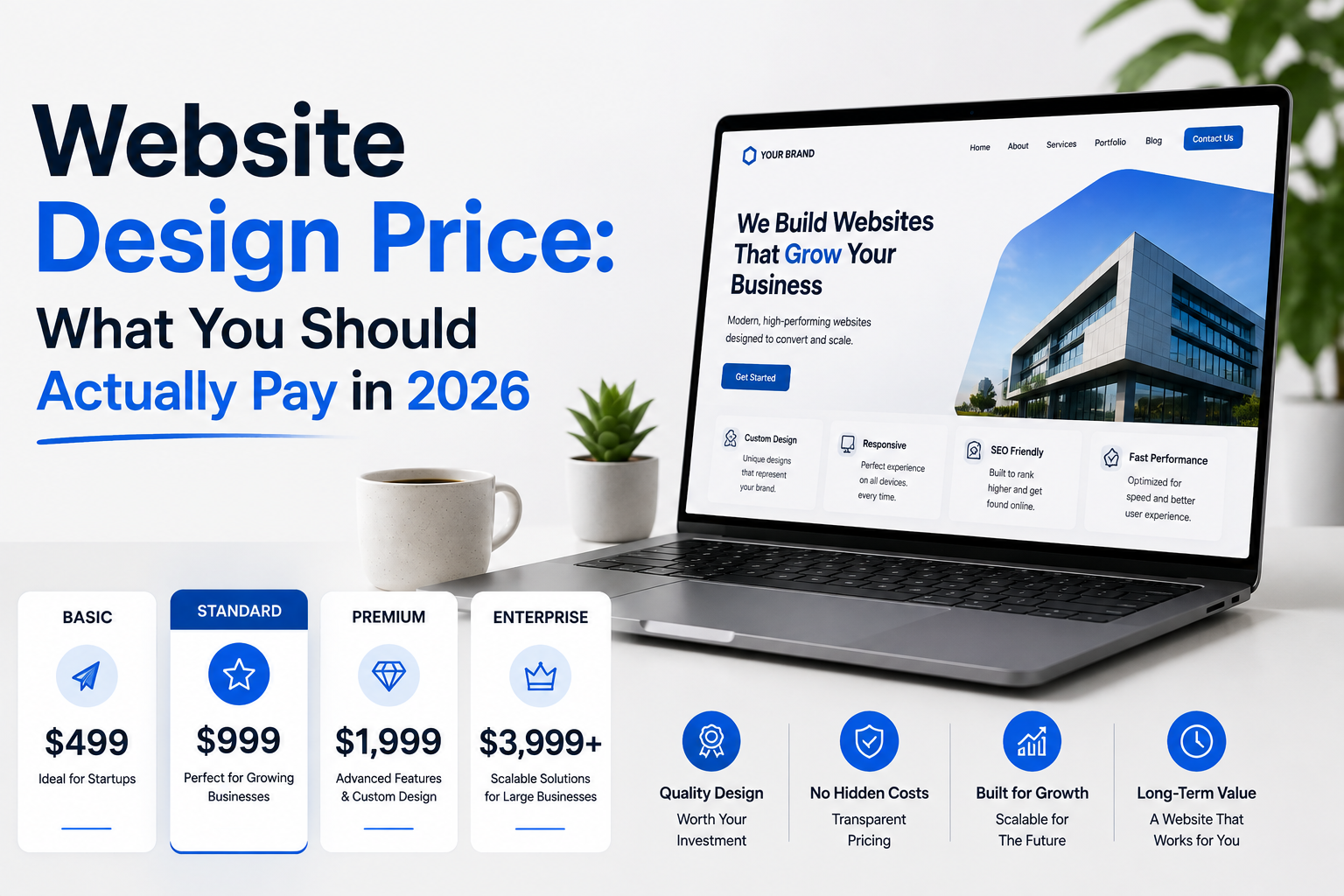
This guide explains what drives website design prices in 2026, what you should expect to pay at each level, and how to evaluate whether a quote you receive is fair. If you want a personalised number based on your specific project, use the Munix Studio website cost calculator to get an instant estimate before you speak to anyone.
Why Website Prices Vary So Much
The primary reason website quotes are so inconsistent is that the word "website" does not describe a specific product. It describes an outcome. Two clients can both ask for a website and be describing projects that differ by an order of magnitude in scope. One needs a clean, static five-page site with a contact form. The other needs a custom platform with user accounts, a booking system, a CRM integration, and a blog. Both will receive a quote for a "website." The prices will not resemble each other.
The second reason is who you hire. A freelancer working alone, a small boutique agency, and a large full-service agency all charge differently for the same output because their overhead, team structure, quality assurance processes, and strategic depth are fundamentally different. A freelancer charging $2,000 for a site and an agency charging $8,000 for the same brief are not both overcharging or undercharging. They are offering genuinely different products in terms of process, accountability, and what happens when something goes wrong.
Understanding these two sources of variation before you request quotes is what prevents you from comparing proposals that are not actually comparable.
Website Design Price by Type: What to Expect in 2026
The most reliable way to frame website pricing is by project type. Each type has a typical scope, a typical timeline, and a typical price range. The ranges below reflect professionally built websites in the US market in 2026, not DIY platforms or offshore one-page builds.
Website Type Typical Price Range Timeline Best Suited For Landing Page $500 to $2,000 1 to 2 weeks Campaign pages, product launches, lead capture Business or Portfolio Site $2,000 to $6,000 3 to 6 weeks Service businesses, freelancers, consultants Blog or Content Site $2,500 to $7,000 4 to 8 weeks Publishers, SEO-driven brands, content businesses Ecommerce Store $5,000 to $20,000 6 to 14 weeks Retail brands, product businesses, DTC companies Web Application $10,000 to $50,000+ 10 to 24 weeks SaaS products, platforms, booking and management tools Corporate or Enterprise Site $15,000 to $100,000+ 12 to 30 weeks Large organisations, multisite setups, regulated industries
These ranges assume a professionally managed project with proper discovery, custom or semi-custom design, mobile-optimised development, and basic SEO setup. They do not include copywriting, custom photography, or post-launch marketing. If you want to map these ranges to your specific requirements before committing to a conversation with an agency, the free website cost calculator lets you adjust for your project type, feature set, and timeline in about two minutes.
The Five Factors That Drive Website Design Prices
Once you understand what moves the price up and down, the wide range in quotes starts to make sense. Five variables account for the majority of the difference between a $3,000 quote and a $15,000 one for what appears to be a similar project.
1. Design Approach: Template vs Custom
Template-based design uses a pre-built layout that is customised with your branding, colours, and content. It is faster and cheaper because the fundamental design decisions have already been made. Custom design starts from a blank canvas and is built specifically for your brand, your users, and your goals. It takes longer, costs more, and produces a site that looks and performs in ways no template can replicate.
For businesses where the website is a primary sales channel, custom design consistently outperforms templates on conversion rates because it can be optimised for the specific user journey rather than adapted from a general-purpose layout. For businesses that need a credible online presence without complex conversion requirements, a well-implemented template is a perfectly reasonable choice.
2. Page Count and Content Volume
Every additional page template requires design time, development time, content placement, and testing. A five-page site and a fifty-page site with the same visual design are not the same project. The first is a well-defined scope. The second is ten times the implementation work even when the design system is shared across pages.
Blog or content-heavy sites also carry additional costs because they require a properly structured content management system, category and tag architecture, search and filter functionality, and in some cases pagination and performance optimisation that a simple business site does not need.
3. Feature Scope and Custom Functionality
Custom functionality is the single biggest price driver on most projects. A basic informational site with a contact form is structurally simple. The moment you add user accounts, a booking system, a payment gateway, a customer portal, an API integration, or any feature that requires server-side logic and data persistence, the scope increases substantially.
Each integration also has ongoing implications. A payment integration requires PCI-compliant implementation and periodic security updates. A CRM integration requires maintenance when either platform updates its API. Features that look small in a brief frequently reveal significant underlying complexity once scoped properly, which is why detailed scoping before pricing is essential for accurate quotes.
4. Platform and Technology Choice
WordPress with a premium theme is faster and cheaper to build than a custom Next.js application. Shopify is faster and cheaper for ecommerce than a custom-built store. The trade-off is always between upfront speed and long-term flexibility. Template platforms and CMS tools reduce build cost but introduce limitations in performance, SEO control, and the ability to implement custom features as your business grows.
Magento website projects, for example, carry a significantly higher price than equivalent Shopify builds because Magento is an enterprise-grade platform designed for complex product catalogues, multi-store setups, and high-volume operations that require specialist development knowledge to implement correctly. Choosing Magento for a store with 50 products is like using industrial machinery to make a single piece of furniture. The tool is capable, but the cost-to-output ratio does not make sense at that scale.
5. Timeline Pressure
Compressed timelines cost more. When a project needs to be completed in half the standard time, it typically requires parallel execution across multiple team members simultaneously, overtime, or both. Agencies that offer rush delivery charge for it explicitly or factor it into the quote. A project with a six-week deadline is priced differently from the same project with a twelve-week deadline, even when the scope is identical.
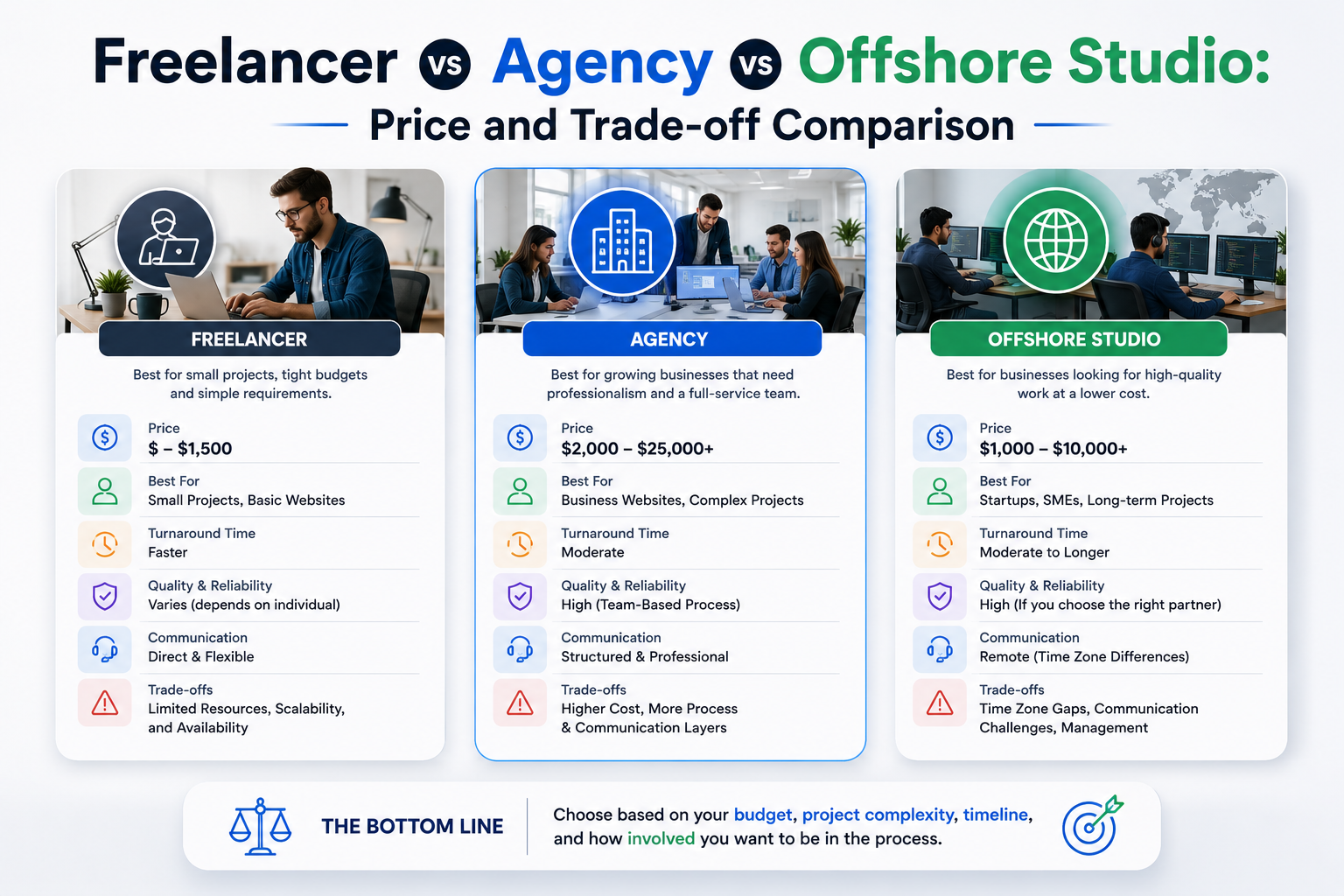
Freelancer vs Agency vs Offshore Studio: Price and Trade-off Comparison
Who you hire matters as much as what you need built. Each provider type has a different cost profile and a different risk profile. Understanding the trade-offs before you start getting quotes prevents you from choosing on price alone and regretting it later.
Provider Type Typical Price Range Strengths Risks Freelancer $500 to $5,000 Low cost, direct communication, flexibility Single point of failure, limited skill breadth, no QA process US Agency $8,000 to $100,000+ Full team, strong accountability, local market knowledge High cost, often outsources work despite local pricing Offshore Studio $1,500 to $15,000 Agency-quality process at significantly lower cost Requires vetting, time zone management, portfolio review Website Builder (DIY) $0 to $500 upfront Fast, low upfront cost, no technical knowledge needed Platform lock-in, poor performance, limited SEO control, recurring fees
One point worth understanding clearly: many US-based agencies marked as "local" outsource a significant portion of their development work to offshore teams while billing at local rates. You are not necessarily getting a locally built product at a locally priced rate. What you are paying for is the US-based account management layer and the agency's brand reputation. Whether that premium is worth it depends on how much you value local relationship management versus the underlying quality of the work produced.
Ecommerce Website Design Price: A Closer Look
Ecommerce websites carry higher design prices than equivalent informational sites because the scope of what they need to do is fundamentally more complex. A product catalogue with filtering, a secure checkout flow, payment gateway integration, order management, customer accounts, email notifications, and mobile optimisation each add development time that does not exist in a standard business site.
A Shopify ecommerce site with a custom theme, standard integrations, and up to 500 products typically costs between $5,000 and $12,000. A custom ecommerce build without a platform like Shopify, or one requiring Magento for enterprise-scale requirements, starts significantly higher, typically $15,000 and above. The average price for an ecommerce website in 2026 from a professional agency is around $8,000 to $15,000 for a mid-size store with standard features.
The ecommerce website price list below shows the typical cost by store complexity and platform.
Store Type Platform Price Range What Is Included Basic store, under 100 products Shopify, WooCommerce $3,000 to $7,000 Theme customisation, payment setup, basic integrations Mid-size store, up to 500 products Shopify, custom $7,000 to $15,000 Custom design, CRM integration, filtering, customer accounts Custom ecommerce, large catalogue Custom, Magento $15,000 to $60,000+ ERP integration, multi-currency, subscriptions, custom logic
Website Redesign Price: What to Budget When Rebuilding
A website redesign costs roughly the same as a new build of the same scope because the work involved is similar. The misconception is that a redesign involves less work because you already have content and a site structure to work from. In practice, auditing an existing site, migrating content without losing SEO equity, and accommodating existing systems or integrations often adds complexity that a clean new build does not have.
The website redesign price in 2026 typically falls between $3,000 and $20,000 for small to mid-size business sites, with the lower end representing sites where most of the existing content and structure is being retained and the higher end representing projects where the information architecture, design system, and technology stack are all being replaced simultaneously.
Website Design Package Prices: What Agencies Bundle
Many agencies offer packaged pricing tiers to simplify the buying decision. A typical website design package at the entry level includes a defined number of pages, a template-based or semi-custom design, one round of revisions, basic SEO setup, and mobile optimisation. Mid-range packages add more pages, a more detailed discovery phase, custom design, and sometimes copywriting or photography sourcing. Premium packages include full custom design, multiple revision rounds, content strategy, and post-launch support.
The advantage of package pricing is predictability. The risk is that packages are designed around what the agency finds efficient to deliver, not necessarily what your specific project requires. A business that needs eight pages but a complex booking integration may not fit neatly into any standard tier. Always check what happens when your project requirements fall outside the package boundaries before committing to a fixed-price tier.
Website Maintenance Prices: The Ongoing Cost After Launch
The upfront build cost is not the only number to plan for. Every professionally built website has ongoing costs that are easy to underestimate at the planning stage. Hosting typically costs between $20 and $300 per month depending on traffic, performance requirements, and server configuration. Security updates, plugin or dependency updates, bug fixes, content updates, and performance monitoring all require time and therefore cost money if you are not doing them yourself.
Prices for website maintenance from a professional provider typically range from $100 to $500 per month for small to mid-size business sites. Ecommerce sites and web applications sit higher, typically $300 to $1,500 per month, because they have more dependencies, more integration points that can break, and higher consequences when something goes wrong on a site that is actively processing transactions.
A useful rule of thumb: budget between 10 and 20 percent of your original build cost annually for maintenance. A $6,000 website should have roughly $600 to $1,200 per year set aside for upkeep. This is not a guarantee of what you will spend, but it is a reasonable planning figure that prevents the surprise of deferred maintenance costs accumulating into an expensive emergency repair.
Website Audit Price: Assessing an Existing Site
Before a redesign or a significant investment in SEO, many businesses commission a website audit. A professional website audit examines technical SEO health, page speed and Core Web Vitals performance, mobile usability, information architecture, content quality, and conversion rate factors. The output is a prioritised list of issues and recommendations.
Website audit prices in 2026 typically range from $500 for a basic automated report with human review, to $2,500 to $5,000 for a comprehensive manual audit covering all technical and strategic dimensions. For large enterprise sites with hundreds of pages and complex architectures, comprehensive audits can exceed $10,000. A good audit pays for itself by identifying the highest-impact changes before a business commits to a full rebuild that may not be necessary.
Not Sure What Your Project Should Cost?
Use the Munix Studio free website cost calculator to get an instant price estimate based on your project type, feature requirements, and timeline. No signup, no sales call, and no obligation. It takes about two minutes and gives you a realistic planning range before you speak to any agency.
How to Evaluate a Website Quote
When you receive a quote from an agency or freelancer, the price itself is less informative than what the quote contains. A detailed quote that breaks down discovery, design, development, testing, and launch separately tells you what you are buying and where the hours are going. A single-line quote for "$8,000" tells you almost nothing about scope, deliverables, or what happens when something outside the original brief comes up.
Ask for a breakdown of phases and deliverables, not just a total price.
Confirm what is explicitly excluded from the scope, particularly copywriting, stock images, and third-party tool licenses.
Ask how out-of-scope requests are handled and priced during the project.
Check what post-launch support is included and for how long.
Ask to see examples of previous projects at a similar scope and price point.
Confirm the revision process and how many rounds of feedback are included before additional charges apply.
Related Services
Understanding website design prices is the first step. Getting an accurate estimate for your specific project and working with a team that delivers on its quoted scope is what determines whether the investment pays off. Munix Studio builds custom websites and ecommerce platforms across a wide range of budgets with full transparency on scope and pricing from the first conversation.
Website Development — Custom website and ecommerce development scoped and priced transparently, built on React and Next.js for performance and long-term maintainability.
UI/UX Design — Professional design services for businesses that need a site built to convert, not just to exist online, covering wireframing, visual design, and user testing.
Maintenance and Support — Ongoing website maintenance plans that keep your site secure, fast, and operational after launch so your upfront investment holds its value over time.
Frequently Asked Questions
Ready to Get Started?
Website Development
Custom website and ecommerce development built on React and Next.js with transparent scoping and pricing from the first conversation, designed to perform and scale as your business grows.
Explore Website DevelopmentUI/UX Design
Professional design for businesses where the website is a primary sales channel, covering user research, wireframing, visual design, and conversion-focused interface decisions.
Explore UI/UX DesignRelated Articles
What is Website Development? The Complete Guide for Beginners
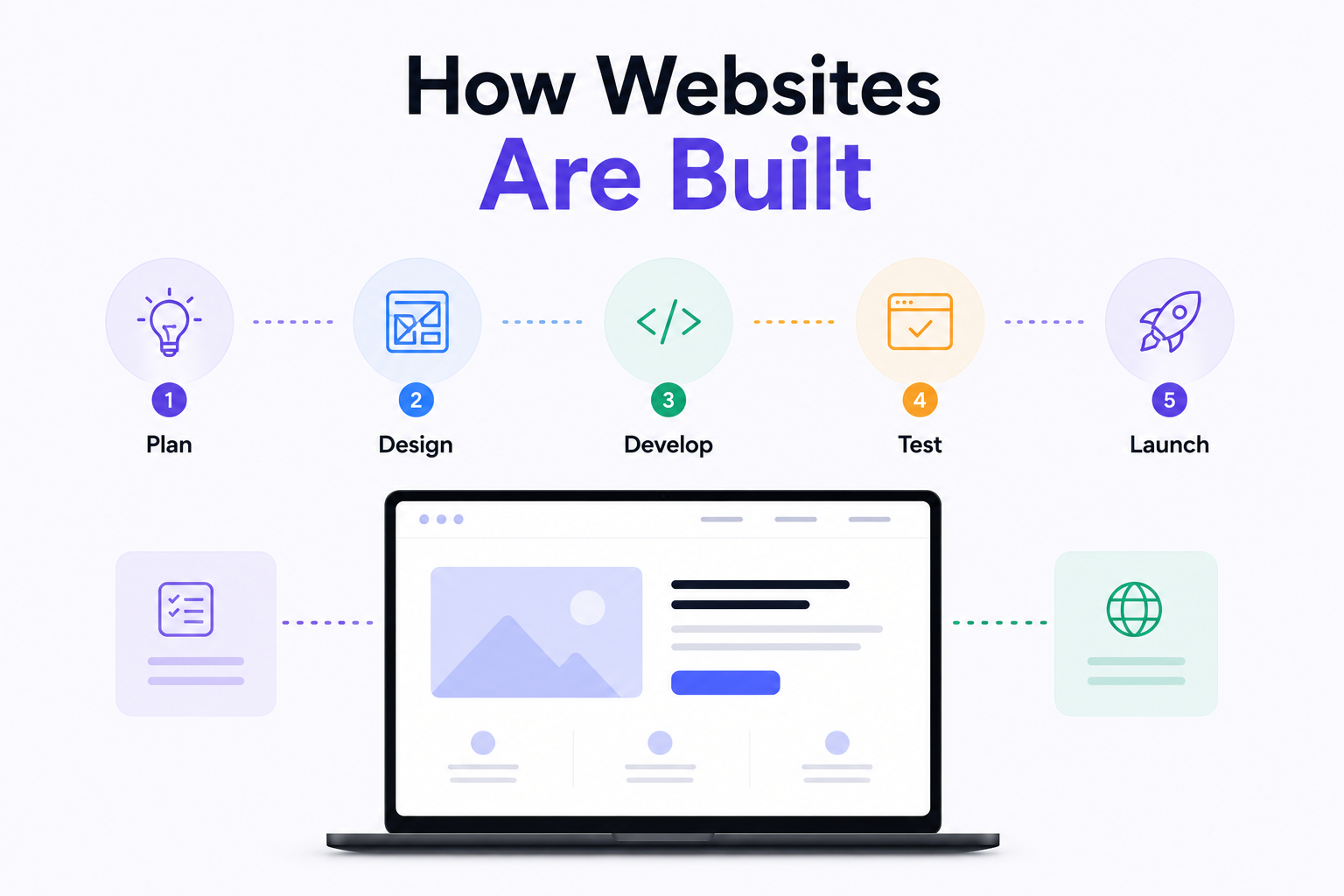
How Are Modern Websites Built in 2026?

Website Development Process & Life Cycle : Complete Guide
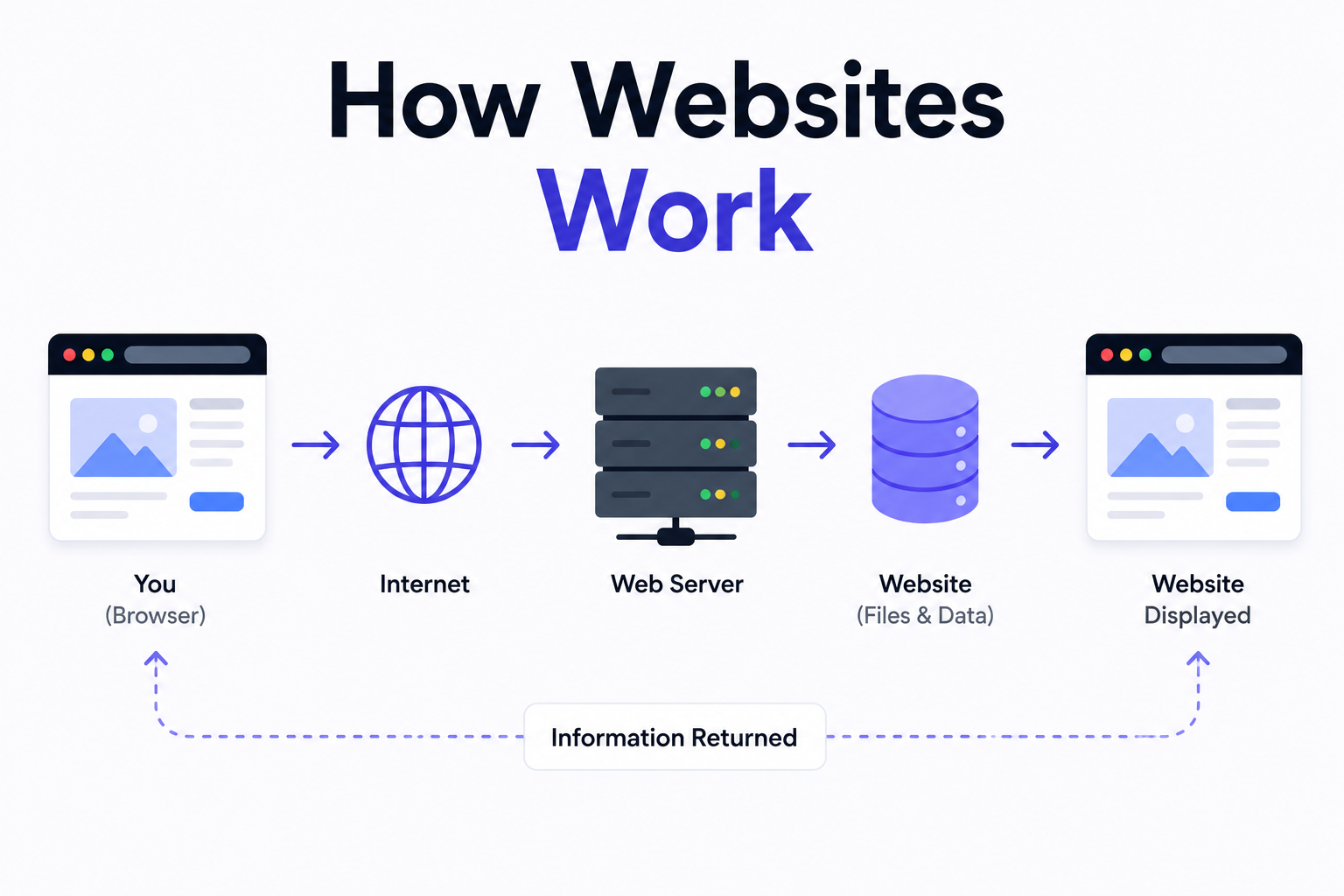
How Websites Work: DNS, Servers, Browsers
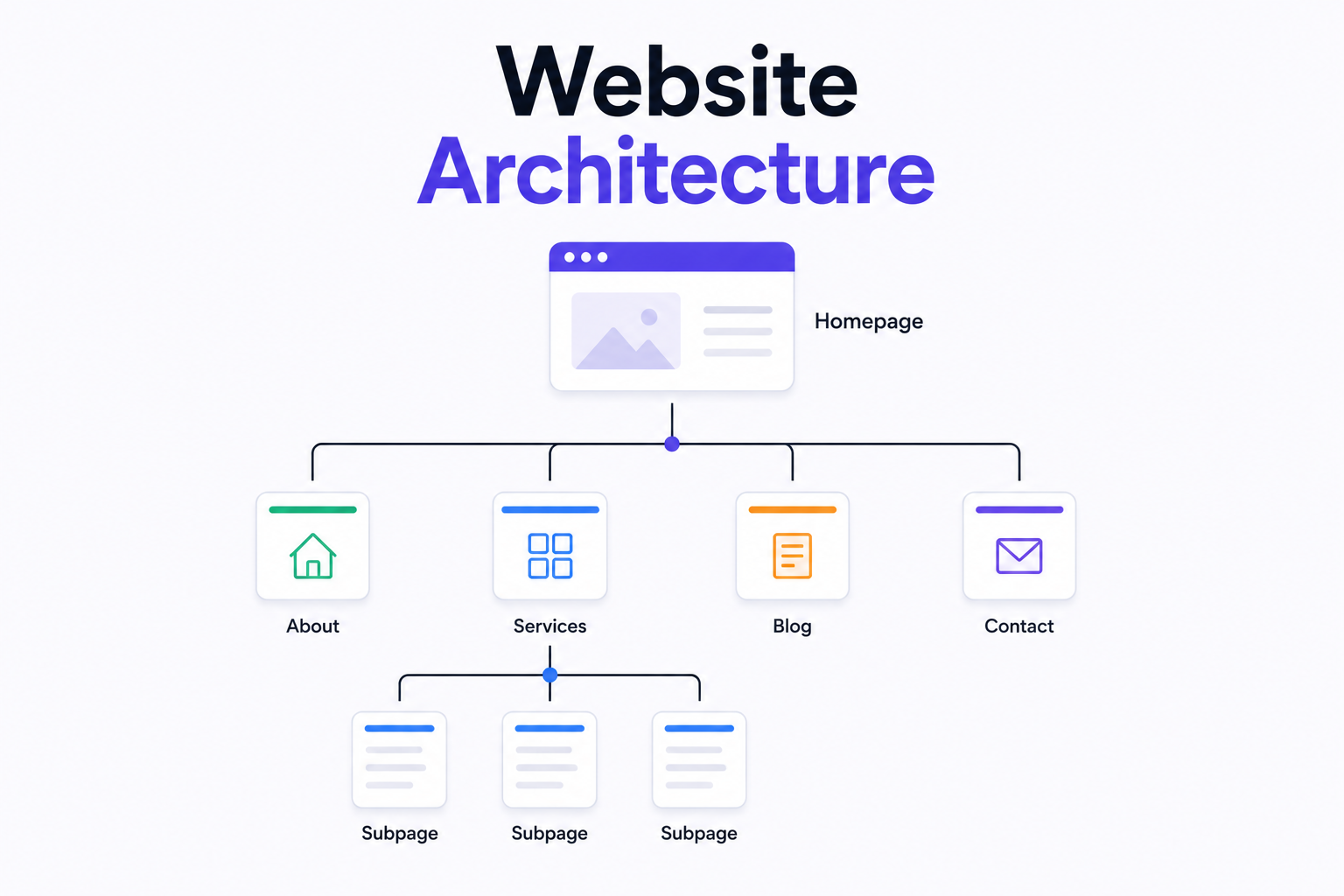
What is Website Architecture? Best Practices