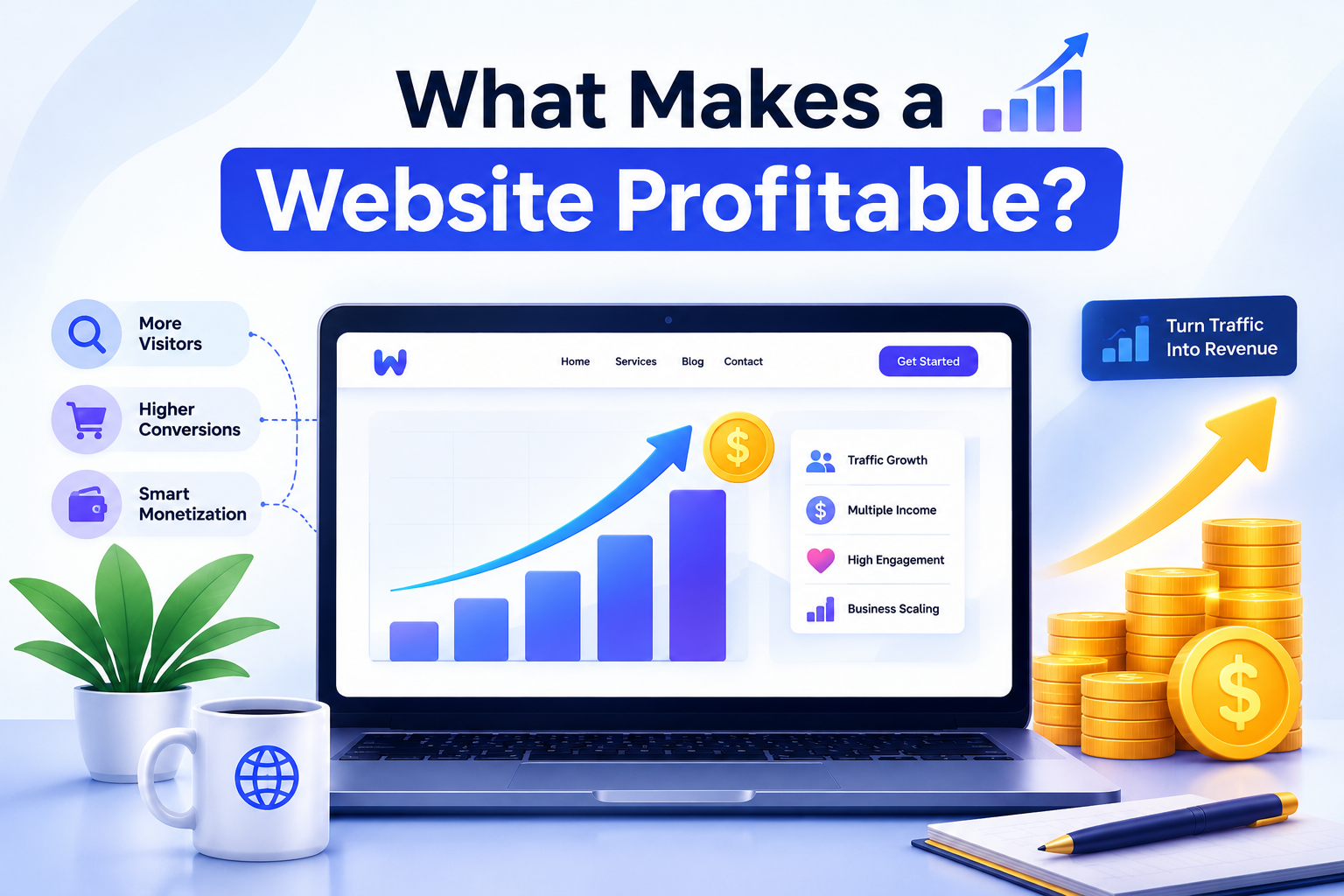
What Makes a Website Profitable?
A profitable website is not defined by how it looks or how much it cost to build. It is defined by whether it generates more value than it costs to operate. That value can take many forms: direct product or service revenue, affiliate commissions, advertising income, lead generation for an offline business, or recurring subscriptions from a paying audience. What all profitable websites share is a clear alignment between the audience they attract, the value they provide to that audience, and a mechanism that converts that value exchange into money.
Most websites fail to reach profitability not because they were built poorly but because they were built without a clear answer to three foundational questions: who is this site for, what problem does it solve for them, and how does solving that problem generate revenue? A website with a confident answer to all three has a clear path to profitability regardless of the niche. One without those answers produces traffic without conversions, or worse, a technically impressive site that nobody visits.
This guide covers every decision involved in building a website designed for profitability from the ground up, from choosing the right business model and monetisation approach through to the technical build, SEO strategy, conversion optimisation, and ongoing improvement cycles that compound results over time.
Step 1: Choose a Business Model Built Around Genuine Value
The business model determines everything else. Before choosing a domain, selecting a platform, or writing a single word of content, the question of how the website will make money needs a specific and defensible answer. Vague intentions to monetise later once traffic arrives consistently produce websites that generate traffic without revenue because the site was never structured to convert that traffic into any commercial outcome.
The most successful profitable websites pick one primary business model and build every architectural decision around it. Secondary revenue streams can be added once the primary model is working, but trying to pursue multiple models simultaneously from day one produces a site that serves none of them well. The table below compares the most common profitable website business models across the dimensions that matter most for making an informed choice.
Business Model Revenue Mechanism Traffic Needed Time to Revenue Scalability Ecommerce Product sales, margins on goods Medium Fast High SaaS / Subscription Recurring monthly fees Medium Medium Very high Affiliate marketing Commission on referred sales Medium to high Slow High Lead generation Paid per qualified enquiry delivered Medium Medium Medium Digital products One-time sales, high margin Low to medium Medium High Display advertising RPM-based ad network revenue High Slow Medium Service business Consulting, freelancing, agency fees Very low Fast Limited by capacity Membership platform Recurring access to premium content Medium Medium High
Step 2: Build on a Technical Foundation That Supports Growth
The technology a profitable website is built on determines its performance ceiling. A site built on an overloaded template with a bloated plugin stack might launch quickly but accumulates technical debt that constrains growth. Page load times degrade. SEO performance suffers. Adding new features requires increasingly complex workarounds. Eventually, the cost of fixing the foundation exceeds what it would have cost to build it correctly from the start.
Building a profitable website on React and Next.js eliminates this ceiling from day one. Server-side rendering ensures every page is fully indexed by search engines, which is the technical prerequisite for the organic traffic that most profitable websites depend on. Image optimisation is built in, which keeps load times fast even on image-heavy product or content pages. And the component-based architecture allows the site to scale in complexity without accumulating the instability that plugin-dependent builds produce under growth.
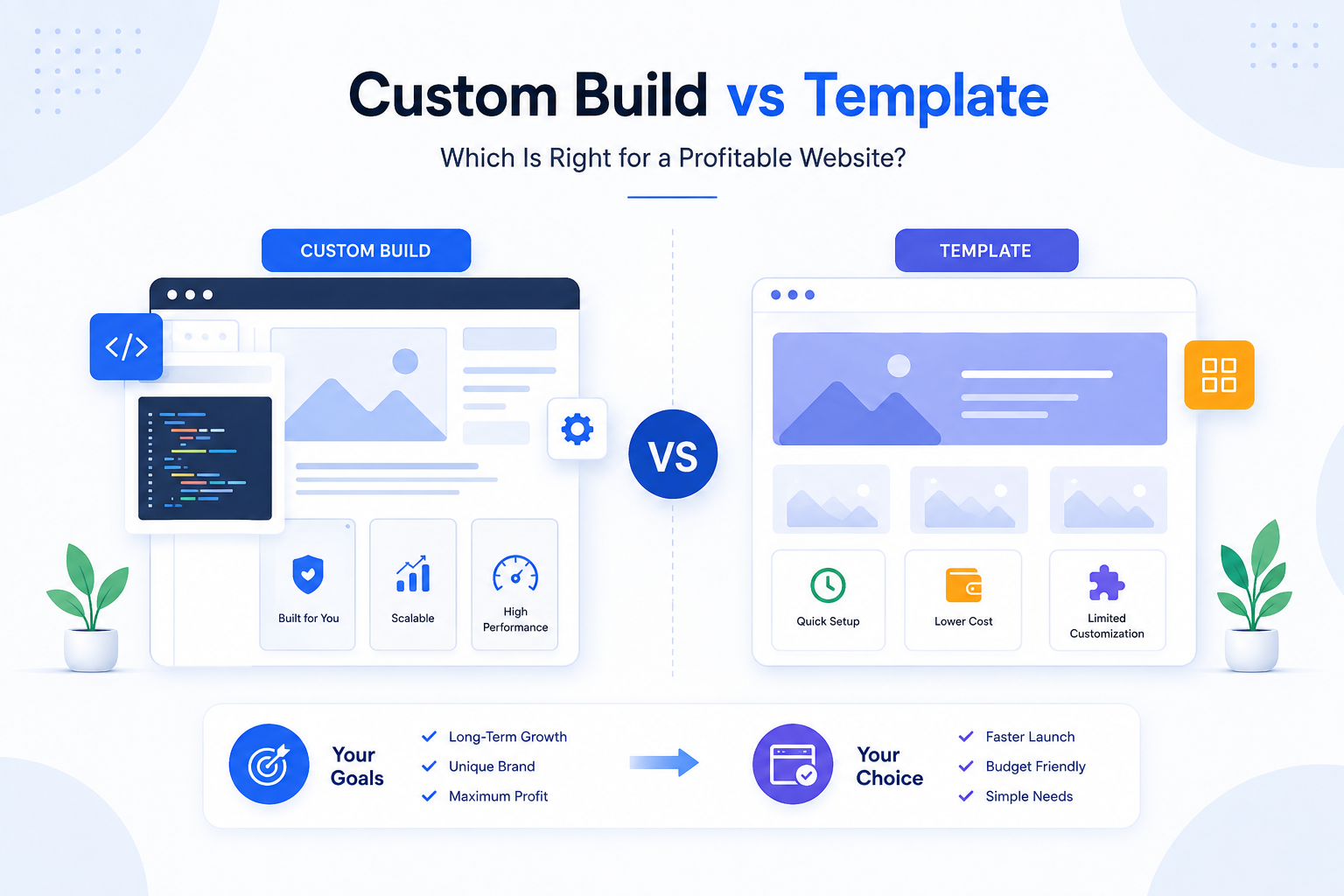
Custom Build vs Template: Which Is Right for a Profitable Website?
Templates and website builders can get a basic site live in days at low initial cost. For a business serious about online revenue, that initial cost saving typically inverts within twelve to twenty-four months as the limitations of the template constrain exactly the capabilities, conversion optimisation, and SEO performance that profitability requires. The comparison below covers the trade-offs honestly.
Factor Template / Builder Custom Next.js Build Time to launch Days to weeks Weeks to months Initial cost Low Medium to high Page speed Often poor under load Optimised by default SEO capability Limited by platform Full control Conversion optimisation Constrained by template Fully customisable Scalability Hits ceiling quickly Scales without ceiling Long-term cost Subscriptions compound, rebuilds required Owned asset, lower ongoing cost Competitive differentiation Looks like every competitor using same template Unique, brand-specific design
For a website where profitability is the goal from day one, a custom-built site on a modern stack is the more defensible long-term investment. The performance advantages, SEO flexibility, and conversion optimisation capability compound over time in ways that template-based sites structurally cannot replicate.
Step 3: Design for Conversion, Not Just Aesthetics
Design on a profitable website has one primary job: moving visitors toward the action that generates revenue. That action might be adding a product to a cart, submitting a contact form, clicking an affiliate link, or signing up for a paid subscription. Every design decision should be evaluated against whether it helps or hinders that action.
The most common design mistake on would-be profitable websites is optimising for visual complexity at the expense of clarity. Visitors who are confused about what to do next do not convert. A clean hierarchy that leads the eye from the value proposition to the supporting evidence to the call to action, in that order, outperforms a visually impressive layout that buries the conversion action beneath animation and decoration.
Conversion Architecture Principles
Above the fold clarity — The homepage hero section must communicate what the site offers, who it is for, and what the visitor should do next within three seconds of arriving. Every word above the fold competes for attention with the call to action. Fewer, more precise words almost always outperform longer explanations at this stage of the page.
Single primary CTA per page — Pages with multiple competing calls to action convert at lower rates than those with one clear primary action. Secondary actions should be visually subordinate and only present when there is a genuine alternative path worth offering, such as a newsletter signup for visitors who are not yet ready to buy.
Social proof at decision points — Reviews, testimonials, case study results, and client logos should appear closest to the page sections where the conversion decision is made, not only at the bottom of the page after most visitors have already left.
Friction reduction in forms — Every field in a signup or checkout form that is not strictly necessary to complete the transaction reduces conversion rate. The minimum viable form for the first conversion event is almost always shorter than the first version a team designs.
Mobile-first execution — More than half of all web traffic globally occurs on mobile devices. A conversion flow that works well on desktop but is cumbersome on mobile loses a significant proportion of potential conversions before they start.
Step 4: Build an SEO Strategy That Drives Qualified Traffic
A profitable website needs traffic, and organic search is the most cost-effective source of sustained qualified traffic available for most business models. Paid advertising can generate immediate traffic but requires continuous spend. Social media reach is increasingly constrained by platform algorithms. An organic search strategy compounds over time, building an asset that generates traffic without a recurring cost for each visit.
SEO for a profitable website operates at two levels that both need attention. Technical SEO ensures the site is structured in a way that search engines can crawl, index, and understand efficiently. Content SEO ensures the site publishes material that ranks for the queries the target audience is actually making. Neglecting either level creates a ceiling on organic growth that the other level cannot compensate for.
Technical SEO Priorities for a Profitable Website
Technical Factor Why It Matters for Profitability Priority Core Web Vitals Confirmed ranking signal, directly affects bounce rate Critical Mobile optimisation Google indexes mobile-first, majority of traffic is mobile Critical HTTPS Trust signal for users and search engines, required for payments Critical Clean URL structure Improves crawlability and keyword relevance signals High Structured data Enables rich results that improve click-through rate High XML sitemap Ensures all important pages are discovered and indexed High Internal linking Distributes authority to revenue-generating pages High Canonical tags Prevents duplicate content from diluting page authority Medium
Step 5: Create Content That Attracts and Converts
Content is the mechanism through which most profitable websites attract organic traffic. But not all content serves profitability equally. Informational content that attracts early-stage searchers builds topical authority and grows the audience. Commercial content that targets buyers who are ready to make a decision generates the revenue. A content strategy built around only one of these types leaves significant value on the table.
The most effective content strategy for a profitable website maps the full search journey from awareness through to purchase and creates content at every stage. A visitor who arrives through an informational article, finds a comparison page, reads a product review, and then makes a purchase through an affiliate link has been served by three distinct content types that each played a different role in the conversion. Removing any one of them shortens the path some visitors need but loses the visitors who needed the longer journey.
Content Types by Search Intent and Profitability Role
Content Type Search Intent Profitability Role Priority Best-of roundups Commercial investigation Highest affiliate conversion Highest Product reviews Commercial investigation Direct affiliate and purchase intent Highest Comparison pages Commercial investigation Captures final decision-stage traffic Highest How-to guides Informational Traffic volume, internal link to commercial pages High Pillar / topic cluster Informational Topical authority, lifts all related pages High Landing pages Transactional Direct conversion, paid and organic High News and trend pieces Informational Traffic spikes, backlink potential Medium
Step 6: Implement Monetisation Without Degrading User Experience
The relationship between monetisation and user experience is one of the most frequently mismanaged aspects of profitable website building. Aggressive monetisation that degrades the user experience reduces return visit rates, damages organic search performance through high bounce rates and low session durations, and ultimately reduces the total revenue the site generates even as the per-visit monetisation attempts increase. The goal is not to extract maximum revenue from each visit but to create the conditions where visitors return repeatedly and convert at a sustainable rate.
Monetisation Approaches: Advantages and Drawbacks
Approach Advantages Drawbacks Affiliate links in content High margin, natural fit in review content Income depends on third-party programs, terms can change Display ads via Mediavine or Raptive Passive, scales with traffic automatically Requires high traffic threshold, can slow pages Owned digital products Full margin, builds audience asset, no commission Requires product creation investment upfront Email sponsorships Independent of website traffic, high CPM Requires building email list first Gated premium content Recurring revenue, predictable income Reduces content indexation, requires content volume Sponsored posts High revenue per placement Must be disclosed, risk to editorial credibility if overused
Step 7: Track the Metrics That Actually Indicate Profitability
Most website owners track the wrong metrics. Page views and sessions are vanity metrics unless they are directly connected to revenue outcomes. A website with one hundred thousand monthly sessions and a conversion rate of zero point one percent is less profitable than one with ten thousand sessions and a two percent conversion rate. The metrics worth tracking on a profitable website are those that reveal the relationship between traffic, behaviour, and revenue.
Revenue per visitor (RPV) — Total revenue divided by total visitors over a period. This single metric captures the combined effect of traffic quality, conversion rate, and average order or commission value. Improving any one of these three factors improves RPV.
Organic traffic by intent — Breaking down organic traffic by informational, commercial, and transactional intent reveals whether the SEO strategy is attracting the audience that converts. High informational traffic with low commercial traffic indicates a content imbalance that needs to be addressed.
Conversion rate by traffic source — Organic search, email, social, and paid traffic convert at very different rates on most sites. Knowing which sources produce the highest quality visitors allows investment to be directed toward growing those sources first.
Email list growth rate — For sites where email is a monetisation channel or a primary traffic retention mechanism, list growth rate is a leading indicator of future revenue capacity that page view metrics do not capture.
Top revenue-generating pages — Identifying which pages generate the most affiliate clicks, the most product purchases, or the most qualified leads allows effort to be concentrated on improving and expanding the content types that are already demonstrating commercial performance.
Step 8: Optimise, Test, and Compound Results Over Time
A profitable website is not a finished product. It is an asset that improves with consistent attention. The sites that compound their profitability over years are those that treat optimisation as a permanent operating discipline rather than a launch phase activity.
Content that ranked well eighteen months ago may have been overtaken by newer, more comprehensive pages from competitors. Updating and expanding existing content to recapture lost rankings is often faster and more cost-effective than producing entirely new content. Conversion optimisation through A/B testing of headlines, call to action placement, and form design produces incremental improvements that compound significantly over the volume of a year's traffic. And regular technical audits ensure that page speed, Core Web Vitals, and crawl health are maintained at the standard that search engines expect from a high-quality site.
How We Work
At Munix Studio, every profitable website project begins with a revenue architecture phase where we define the business model, identify the primary conversion action, plan the content and SEO strategy, and design the technical foundation before development begins. We treat profitability as a design constraint, not an afterthought, which means every structural decision from the URL architecture to the CTA placement is made with the conversion outcome in mind.
Our development team builds profitable websites on React and Next.js with SEO foundations, monetisation integrations, conversion-optimised page templates, and analytics configured from day one. Every project is delivered with the technical and content foundations needed to grow from launch to a self-sustaining digital revenue asset.
Build Your Profitable Website With Munix Studio
Profitability requires the right foundation from day one. At Munix Studio we design and build websites engineered for revenue, with the technical performance, SEO architecture, and conversion design that turns traffic into sustainable income.
Website Development — Custom profitable websites built on React and Next.js with conversion-optimised architecture, monetisation integrations, and technical SEO built in from the first page.
SEO Optimization — Full-funnel SEO strategy covering technical foundations, content architecture, and on-page optimisation to drive the qualified organic traffic that profitable websites depend on.
UI/UX Design — Conversion-first design that guides visitors from landing to action with clear hierarchy, trust signals at the right moments, and frictionless paths to revenue.
Digital Marketing — Paid and organic marketing strategies that drive qualified traffic to your profitable website from day one while SEO compounds in the background.
Maintenance and Support — Ongoing performance monitoring, content updates, and technical audits to keep your profitable website ranking, converting, and growing over time.
Frequently Asked Questions
Ready to Get Started?
Website Development
Custom profitable websites built on React and Next.js with conversion-optimised architecture, monetisation integrations, and technical SEO foundations built in from day one.
Explore Website DevelopmentSEO Optimization
Full-funnel SEO strategy covering technical SEO, content architecture, and on-page optimisation to drive the qualified organic traffic that profitable websites depend on to grow.
Explore SEO OptimizationUI/UX Design
Conversion-first interface design that guides every visitor from landing to action with clear hierarchy, strategically placed trust signals, and frictionless paths to revenue.
Explore UI/UX DesignDigital Marketing
Paid and organic marketing strategies that drive qualified traffic to your profitable website from day one while your long-term SEO asset compounds in the background.
Explore Digital MarketingMaintenance and Support
Ongoing performance monitoring, content refresh, Core Web Vitals auditing, and technical support to keep your profitable website ranking, converting, and growing over time.
Explore Maintenance and SupportRelated Articles
What is Website Development? The Complete Guide for Beginners
How Are Modern Websites Built in 2026?
Website Development Process & Life Cycle : Complete Guide
How Websites Work: DNS, Servers, Browsers
What is Website Architecture? Best Practices