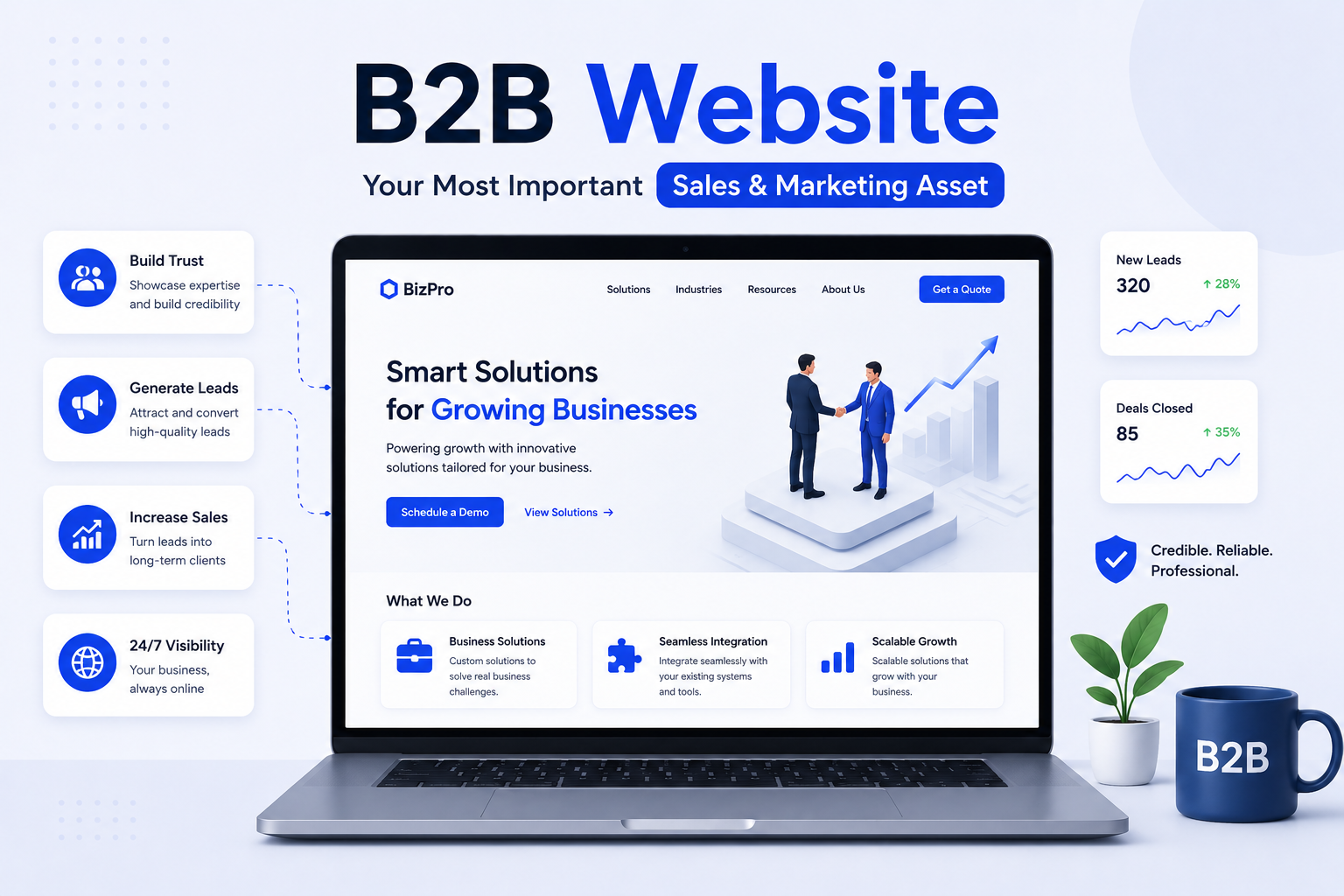
Why a B2B Website Is Your Most Important Sales and Marketing Asset
Business buyers research extensively before they ever speak to a salesperson. Studies consistently show that the majority of a B2B purchase decision is made before a prospect makes first contact with a vendor. They have already searched for solutions, evaluated competitors, read case studies, and formed a shortlist by the time they fill out a contact form or pick up the phone. If your website is not part of that research journey, you are not on the shortlist.
A B2B website is not a digital brochure. It is the centrepiece of your entire go-to-market strategy. It is where prospects validate their interest in your company, where your credibility is established or lost, where your positioning is communicated or confused, and where the decision to make contact is made or abandoned. Getting it right means understanding exactly who you are selling to, what they need to see and believe before they will engage, and how to build a site that delivers that experience consistently across every page and every visit.
This guide covers every step involved in building a B2B website that attracts the right buyers, builds genuine credibility with decision makers, and converts that credibility into qualified leads that your sales team can close.
Step 1: Understand Your Buyers and Their Decision Process
B2B purchasing decisions are rarely made by a single person. Most involve a buying committee of two to ten stakeholders, each with different priorities, different levels of technical knowledge, and different objections that need to be addressed before they will sign off. A website that only speaks to one of these stakeholders, typically the most senior decision maker, fails to move the other members of the committee toward approval and stalls deals that should have closed.
Understanding your buyers means mapping who is involved in the decision, what each stakeholder cares about, and what information they need to be comfortable recommending your company to the rest of the committee. A technical evaluator needs to understand how your solution integrates with their existing stack. A financial decision maker needs to understand the ROI case and the total cost of ownership. A procurement manager needs to see evidence of reliability and references from comparable clients. A well-built B2B website creates content and navigational pathways that serve all of these stakeholders without requiring each one to wade through information that is irrelevant to their role in the process.
Step 2: Define Your Positioning and Messaging With Precision
Vague positioning is the single most common reason B2B websites fail to convert. When a prospect lands on a homepage and reads something like "we help businesses achieve their goals through innovative solutions," they have learned nothing about what the company actually does, who it does it for, or why it is a better choice than any alternative. They leave. The homepage has failed its most fundamental job.
Strong B2B positioning answers three questions within the first few seconds of a homepage visit: what does this company do, who does it do it for, and why should I choose them over the alternatives. The more specific and concrete the answers to these questions, the more effectively the site pre-qualifies visitors. A homepage that says "we build custom software for logistics and supply chain companies that need to automate manual operations at scale" immediately tells the right prospect they are in the right place and tells the wrong prospect to look elsewhere. Both outcomes are valuable.
Messaging should be consistent from the homepage through to every service page, case study, and blog post on the site. Inconsistency in how the company describes itself and its value proposition creates doubt in the minds of prospects who are already conducting careful due diligence before committing to a purchase decision.
Step 3: Plan a Structure Built Around the Buyer Journey
A B2B website needs a page structure that serves prospects at different stages of their buying journey. Some visitors arrive having already identified their problem and are now evaluating specific vendors. Others arrive at the awareness stage with a problem they have not fully defined yet and a need for educational content that helps them understand their options. A well-structured B2B site serves both without forcing either to wade through content that does not match where they are in the process.
The core pages a B2B website requires include a homepage that communicates positioning clearly and directs different visitor types toward the content most relevant to them, individual service or solution pages that describe each offering in enough detail to allow genuine evaluation, an industry or use case section that demonstrates specific expertise in the verticals the company serves, a case studies or results section with detailed evidence of client outcomes, an about page that builds confidence in the team and the company, a resources or insights section for educational content that attracts organic search traffic from early-stage buyers, and a contact or get in touch page with a frictionless enquiry process.
Industry and use case pages deserve particular attention in the planning phase. B2B buyers overwhelmingly prefer to work with vendors who demonstrably understand their specific industry context rather than those who claim to serve everyone equally well. A dedicated page for each vertical the company operates in, written with genuine knowledge of that industry's specific challenges and requirements, consistently outperforms generic service pages both in search rankings and in conversion rate.
Step 4: Choose Technology That Reflects Your Professionalism
The technology a B2B company chooses for its website sends a signal about the company itself. A site that loads slowly, breaks on mobile, or looks outdated tells a sophisticated business buyer that the vendor does not invest in its own digital presence, which raises an obvious question about how much it invests in its clients. Performance, reliability, and design quality are not vanity metrics for a B2B website. They are credibility signals that influence buying decisions.
Building on React and Next.js delivers the performance, scalability, and SEO capability that a serious B2B company requires. Server-side rendering ensures every service page, industry page, and blog post is fully indexed by search engines, which is critical for the organic search visibility that generates top-of-funnel demand from early-stage buyers. Fast page load times reduce bounce rates at a point in the buyer journey where first impressions carry disproportionate weight. And a headless CMS integration gives marketing teams the ability to publish content, update messaging, and add case studies without depending on developer involvement for every change.
Step 5: Build Credibility Through Case Studies and Social Proof
In B2B sales, credibility is currency. Business buyers are making decisions that carry professional risk. Choosing the wrong vendor reflects badly on the person who recommended them. Choosing a vendor with a demonstrable track record of delivering results for comparable clients reduces that risk and makes the internal approval process significantly easier. Case studies are the most powerful tool a B2B website has for establishing this credibility.
Effective B2B case studies go beyond a brief client testimonial and a logo. They describe the client's situation and challenge before engaging the vendor, explain the specific approach and solution delivered, and quantify the outcomes achieved in terms that are meaningful to the target buyer. A case study that shows a 40 percent reduction in processing time, a six-figure increase in annual revenue, or a measurable improvement in a specific operational metric gives prospective clients a concrete benchmark against which to evaluate whether the vendor is right for them.
Beyond case studies, other forms of social proof that carry weight with B2B buyers include named testimonials from senior client contacts with specific outcomes attributed, recognised industry awards or accreditations, partnership credentials with major technology or industry platforms, press coverage and media mentions, and client logos from recognisable companies in the relevant sector. Each of these reduces perceived risk and moves the decision further toward a yes.
Step 6: Design for Clarity, Not Creativity
B2B website design has a different purpose than consumer website design. While a consumer site might prioritise emotional impact and visual excitement, a B2B site needs to prioritise clarity, navigability, and the efficient communication of complex information to sophisticated buyers who are evaluating multiple options simultaneously. Design choices that get in the way of clear communication, such as excessive animation, abstract imagery, or navigation structures that require effort to decode, reduce conversion rather than improving it.
The most effective B2B website designs use clean layouts with strong typographic hierarchy to guide the reader through information in the order that builds the case for the company most effectively. Clear calls to action that reflect where the visitor is in the buying journey, specific rather than generic, placed at the points in the page where interest and intent are highest, convert significantly better than generic contact buttons repeated at every scroll break. And mobile optimization is non-negotiable even in B2B, where an increasing proportion of initial research happens on mobile devices during commutes, between meetings, and outside office hours.
Step 7: Invest in Content That Attracts Early-Stage Buyers
The majority of B2B buyers who will eventually become your clients are not ready to buy when they first encounter your company. They are researching their problem, exploring their options, and building their understanding of the solution space. A B2B website that only speaks to buyers who are ready to purchase now misses the much larger pool of buyers who are not ready yet but will be in three, six, or twelve months. Content marketing is the strategy that keeps your company visible and credible throughout that entire research journey.
A B2B blog or resources section that publishes genuinely useful content targeting the specific questions and challenges your ideal buyers are searching for attracts early-stage organic traffic, builds topical authority in your sector, and keeps your company front of mind as buyers move through their decision process. Articles that address common industry problems, explain complex concepts relevant to your solution category, compare approaches or technologies, and share original data or insights are all formats that perform well in B2B organic search and establish the company as a credible voice in its field.
Step 8: Optimize for Search to Generate Top-of-Funnel Demand
B2B SEO operates across both informational and commercial search intent. Informational content targets the research- phase queries that early-stage buyers make when they are trying to understand their problem and their options. Commercial content targets the evaluation-phase queries that buyers make when they are comparing specific vendors and solutions. A complete B2B SEO strategy covers both, using informational content to build authority and attract top-of-funnel traffic, and commercial page optimization to capture buyers who are closer to making a decision.
Service pages and industry pages are the most important commercial SEO assets on a B2B website. Each should be written with the depth and specificity needed to rank for the queries your ideal buyers are using when they are actively evaluating vendors. Generic service descriptions that could have been written by any company in the category rarely rank competitively because they provide no distinctive signal to search engines about the company's specific expertise or the audience it serves. Specificity, depth, and genuine expertise demonstrated through content are what consistently win in competitive B2B search categories.
Step 9: Build a Lead Capture and Nurture Strategy Into the Site
Not every visitor to a B2B website is ready to request a demo or speak to sales on their first visit. A site that only offers a contact form as a conversion point captures only the small percentage of visitors who are at that stage of their journey and loses everyone else without any mechanism for continued engagement. Building additional conversion points for earlier-stage buyers significantly increases the total value the website generates from its traffic.
Content downloads such as whitepapers, guides, and research reports, newsletter subscriptions for ongoing industry insights, webinar registrations, and free assessment or audit tools are all conversion points that capture contact information from buyers who are not yet ready to talk to sales but are willing to engage with content. These contacts can then be nurtured through email sequences and retargeting until they reach the point in their buying journey where a sales conversation is appropriate. A B2B website with a thoughtful lead capture strategy generates significantly more pipeline from the same volume of traffic than one that relies entirely on contact form submissions.
Step 10: Monitor Performance and Optimize Continuously
A B2B website requires consistent measurement and improvement after launch to maintain its effectiveness as buyer behaviour, competitive dynamics, and search algorithms evolve. Tracking which pages generate the most qualified leads, which content attracts the most organic traffic from your target buyer profile, and where in the conversion journey prospects drop off provides the data needed to make decisions that actually improve commercial outcomes.
Regular messaging reviews ensure the site continues to reflect the company's current positioning and service offering accurately. New case studies published as client relationships mature expand the evidence base available to prospective buyers. New blog content targeting emerging search queries in the category expands the site's organic footprint continuously. And technical audits ensure page speed, mobile performance, and overall site health remain at the standard that both sophisticated buyers and search engines expect from a credible B2B company.
How We Work
At Munix Studio, every B2B website project begins with a discovery phase where we take the time to understand your buyers, your competitive landscape, your current positioning, and the specific commercial outcomes you need the site to deliver. We define the architecture, map the buyer journeys for each stakeholder type, and plan the content and messaging strategy before a single design decision is made.
Our design team builds a clear, professional visual experience that communicates your positioning precisely and builds confidence with sophisticated business buyers from the first page they visit. Our development team builds the site on a modern, performant stack with CMS access for your marketing team, SEO foundations built in from the first page, and the flexibility to grow as your content strategy and lead generation requirements evolve. We test thoroughly before launch and remain available for ongoing support as your business and website develop together.
Build Your B2B Website With Munix Studio
At Munix Studio we design and build B2B websites that communicate your positioning with precision, build credibility with decision makers, and generate the qualified leads your sales team needs to grow the business. Every project is built around your buyers, your competitive context, and the commercial outcomes that matter most to your company.
Website Development — Custom B2B websites built on React and Next.js with clear buyer journeys, CMS access for your marketing team, and SEO built in from day one.
UI/UX Design — Clear, professional design that communicates complex value propositions simply and guides sophisticated business buyers toward taking action.
SEO Optimization — B2B SEO strategy covering both informational and commercial intent, building organic visibility across the full buyer journey in your category.
App Development — Client portals, onboarding tools, and web applications that extend your B2B website into a full digital platform for your clients and prospects.
Maintenance and Support — Ongoing content updates, messaging refinements, and technical support to keep your B2B website competitive and generating qualified leads throughout the year.
Frequently Asked Questions
Ready to Get Started?
Website Development
Custom B2B websites built on React and Next.js with clear buyer journeys, CMS access for your marketing team, and SEO foundations built in from the very first page.
Explore WebsiteUI/UX Design
Clear, professional design that communicates complex value propositions simply and guides sophisticated business buyers naturally toward taking action.
Explore UI/UX DesignSEO Optimization
B2B SEO strategy covering both informational and commercial search intent, building organic visibility across the full buyer journey in your category.
Explore SEO OptimizationApp Development
Client portals, onboarding tools, and web applications that extend your B2B website into a full digital platform for clients and prospects alike.
Explore App DevelopmentMaintenance and Support
Ongoing content updates, messaging refinements, and technical support to keep your B2B website competitive and generating qualified leads throughout the year.
Explore Maintenance and SupportRelated Articles
What is Website Development? The Complete Guide for Beginners
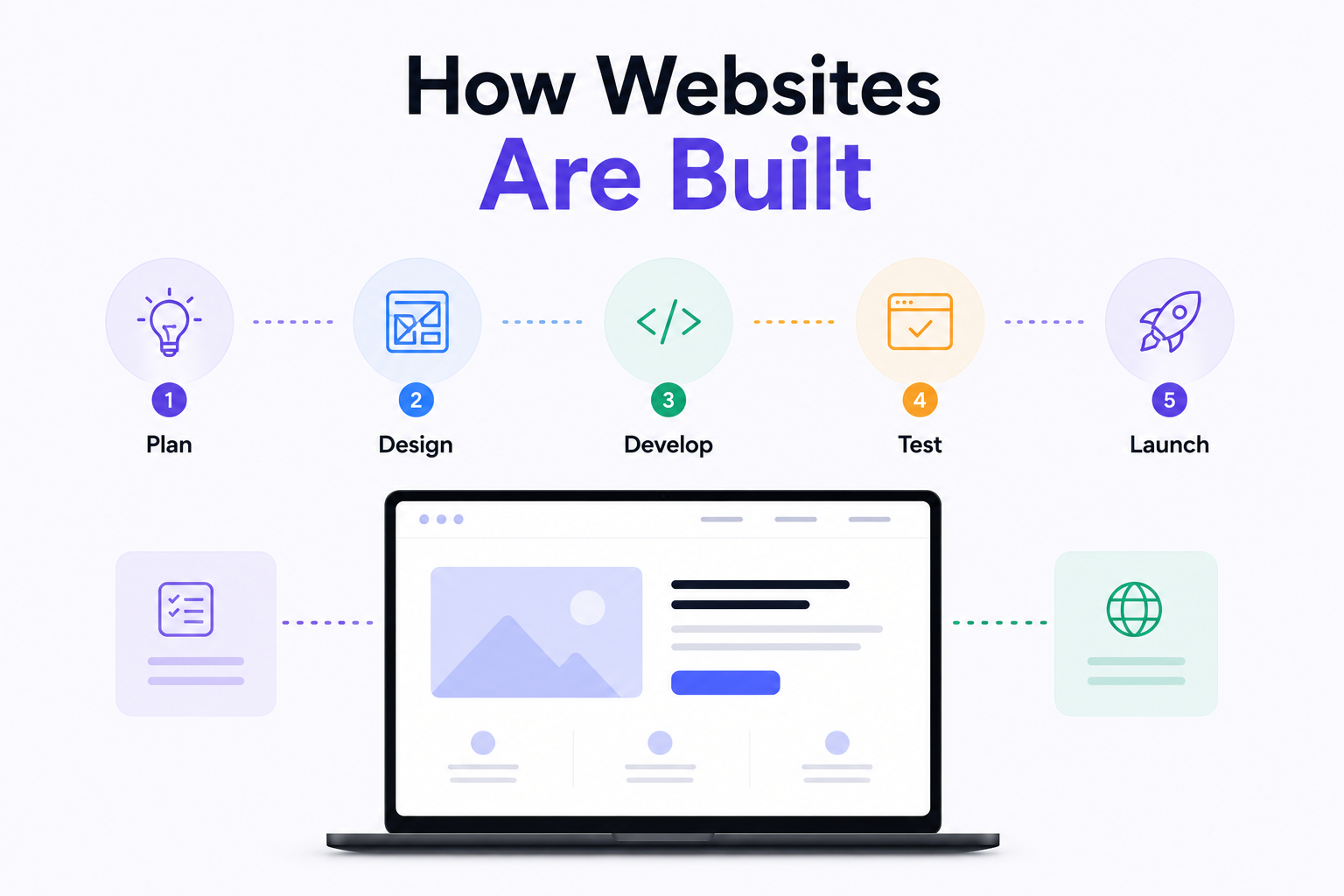
How Are Modern Websites Built in 2026?
Website Development Process & Life Cycle : Complete Guide
How Websites Work: DNS, Servers, Browsers
What is Website Architecture? Best Practices