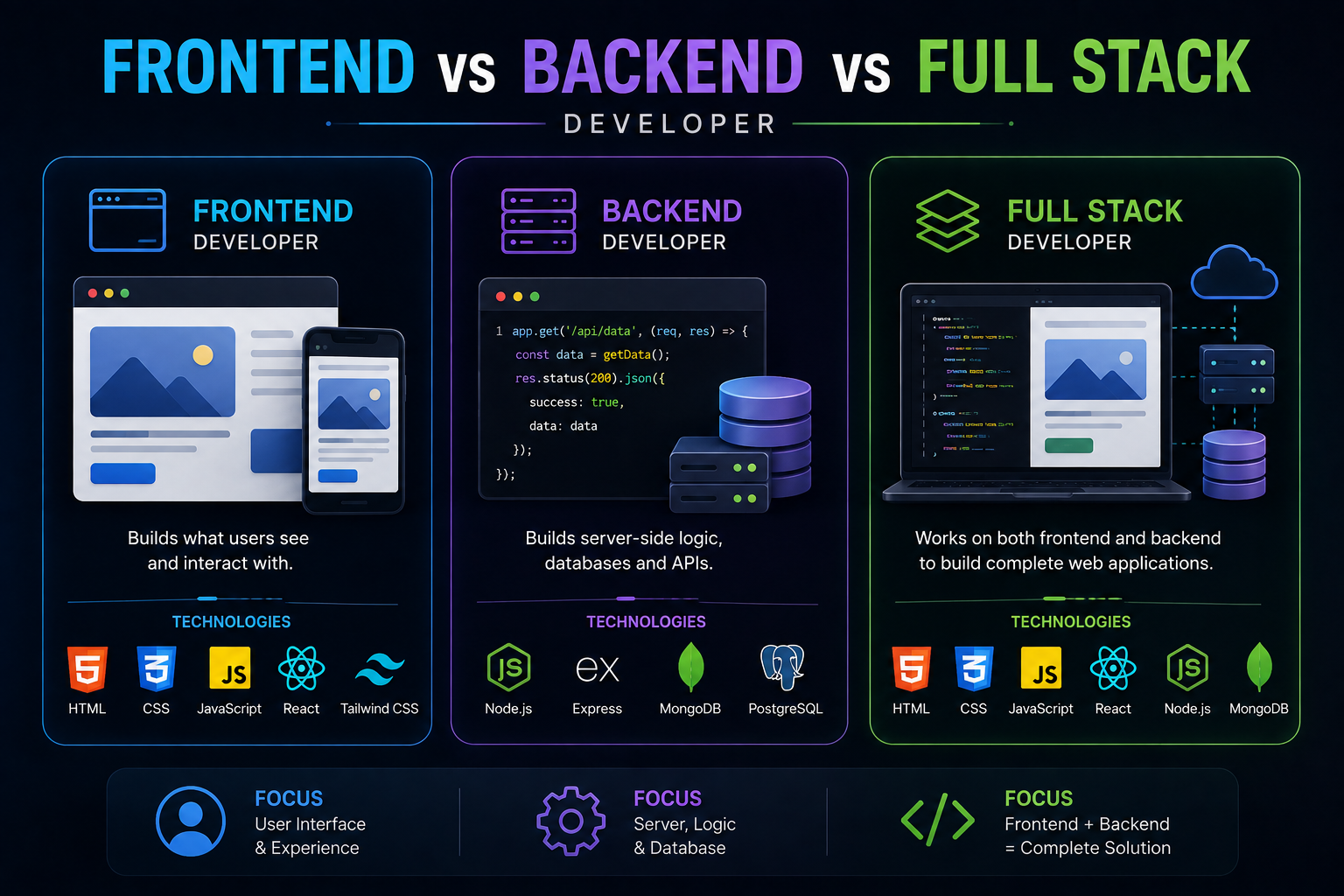
Few questions come up more consistently among people entering software development than this one: should I focus on frontend, backend, or go full stack? The question matters because the answer shapes years of learning, the types of roles you qualify for, the teams you work within, and ultimately the kind of work you spend your days doing. Each path is legitimate and valuable. Each has a different skill profile, a different daily reality, and a different position in the job market.
This guide gives you a complete, honest comparison of all three tracks — what each role actually involves, what technologies each requires, how they relate to each other in a development team, and what the career trajectory looks like for each. By the end, the decision should be considerably clearer than it is when you start Googling combinations of these terms at midnight wondering which direction to commit to.
What Frontend Development Actually Means
Frontend development is the discipline of building everything a user sees and interacts with in a browser or app interface. When you click a button, watch an animation play, fill out a form, or navigate between pages, you are interacting with work a frontend developer produced. The frontend is the surface layer of any digital product — the part that translates data and functionality into a visual, interactive experience.
The term frontend engineer and frontend developer are used interchangeably in most organisations, though some larger companies draw a distinction between frontend engineers who focus heavily on JavaScript architecture and performance, and UI developers who work more closely with design systems and component libraries. In practice, the overlap is substantial and the distinction rarely matters at the junior or mid level.
Frontend engineering sits at the intersection of design and technology. A good frontend developer understands visual hierarchy, typography, colour, and interaction patterns well enough to implement designs faithfully and to push back constructively when a design is technically impractical or creates accessibility problems. This dual literacy — technical and visual — is what makes strong frontend developers genuinely rare and consistently well-compensated.
Core Frontend Technologies
The foundational layer of frontend development is the trio of HTML, CSS, and JavaScript. HTML defines the structure and content of a page. CSS controls its visual presentation. JavaScript adds interactivity and dynamic behaviour. These three technologies underpin every website and web application in existence, and mastery of all three is non-negotiable for any frontend developer regardless of what frameworks or tools they work with on top of them.
Above that foundational layer sits the framework ecosystem. React is currently the dominant frontend framework across both startup and enterprise contexts, with a job market presence that significantly outweighs its alternatives. Vue.js is widely used in Asia and among teams that prefer a gentler learning curve. Angular remains prevalent in enterprise environments, particularly in financial services and government contexts. Svelte and SolidJS represent a newer generation of frameworks that compile away the runtime overhead of their predecessors, and both are gaining meaningful adoption among performance-conscious teams.
TypeScript has effectively become a standard expectation in professional frontend roles. CSS preprocessors like Sass and utility-first frameworks like Tailwind CSS are part of most modern frontend toolchains. Testing frameworks including Jest, Vitest, and Playwright round out the skill set expected at mid to senior level. The frontend ecosystem is broad and moves quickly, which is either energising or exhausting depending on your temperament.
What Backend Development Actually Means
Backend development is the discipline of building the systems that power an application from behind the scenes. Everything a user does on a frontend — creating an account, placing an order, sending a message, loading a personalised feed — triggers backend logic that validates the action, processes the data, queries a database, applies business rules, and returns a response. The backend is invisible to the user but responsible for everything that actually happens.
Back end software engineering is a broad discipline that encompasses server-side application development, database design and management, API architecture, authentication and security systems, background job processing, and increasingly cloud infrastructure and DevOps practices. The scope of what a backend engineer might own varies considerably between organisations — at smaller companies, backend developers often handle infrastructure and deployment alongside application code; at larger ones, these responsibilities are typically split across specialised teams.
Back end software engineering tends to attract developers who are more comfortable with systems thinking, data modelling, and the logic of how information flows through an application than with visual presentation. This is not an absolute distinction — plenty of backend developers have strong aesthetic sensibilities — but the daily work is characterised by problem-solving at a systems level rather than an interface level.
Core Backend Technologies
Backend development is more language-agnostic than frontend, where JavaScript dominates overwhelmingly. Node.js brings JavaScript to the server side and is widely used for APIs and real-time applications. Python is the dominant language in data-heavy backends, machine learning integration, and scripting-heavy environments — Django and FastAPI are its most widely used web frameworks. Java and Kotlin power the backends of many large-scale enterprise systems, particularly in financial services. Go has gained significant traction for high-performance services that need to handle large concurrency loads efficiently. PHP still runs a substantial portion of the web through WordPress and Laravel. Ruby on Rails, while less prevalent than at its peak, remains in production at many established companies and is still respected for rapid development.
Database knowledge is central to backend engineering in a way it is not for frontend. Relational databases — PostgreSQL being the most widely recommended for new projects, MySQL for legacy systems — require comfort with SQL, schema design, indexing strategies, and query optimisation. NoSQL databases including MongoDB, Redis, and Cassandra each serve specific use cases: document storage, caching and session management, and high-write distributed systems respectively. Understanding when to use which type of database, and how to design a schema that supports the application's access patterns efficiently, is a core backend competency.
What Full Stack Development Actually Means
A full stack developer works across both the frontend and backend layers of an application. Rather than specialising in one side of the stack, a full stack developer can build the interface a user interacts with and the server-side systems that power it. The term is frequently misunderstood in both directions — some people assume full stack means knowing everything about both frontend and backend equally deeply, which is essentially impossible. Others assume it means shallow knowledge of both, which undersells what strong full stack developers actually bring.
The most useful framing is that a full stack developer has genuine proficiency across both layers — enough to build complete, functional features independently — while typically having deeper expertise in one direction. Most full stack developers emerge from either a frontend or backend background and expand into the other over time. The distinction between a full stack developer and a full stack web developer is largely semantic: both terms describe someone who works across the complete web development stack, and the difference in phrasing reflects regional and organisational variation rather than any meaningful functional distinction.
Full stack development is particularly valuable in startup environments and smaller teams where the economics of maintaining separate frontend and backend specialists are not always practical. A full stack developer who can own a feature from database schema to API design to user interface is extremely productive in that context. In larger engineering organisations, the role often evolves toward one that bridges frontend and backend teams rather than fully owning both.
The Modern Full Stack: JavaScript End to End
The rise of Node.js created a path to full stack development that uses JavaScript on both sides of the application, which has significantly lowered the barrier to entry for developers coming from a frontend background. Frameworks like Next.js blur the frontend/backend boundary further by providing server-side rendering, API routes, and database access patterns within a single codebase. A Next.js developer working with Prisma for database access and deploying on Vercel is operating across what would previously have been considered three separate specialisations.
The T3 Stack — TypeScript, tRPC, Tailwind CSS, and Prisma on a Next.js foundation — has become one of the more popular full stack starting points for new projects in the JavaScript ecosystem, combining type safety end to end with a set of tools that work well together by design. This kind of integrated stack has made genuinely capable full stack development more accessible than it was when a frontend developer needed to learn an entirely separate language and ecosystem to touch the backend.
Three-Way Comparison: Frontend vs Backend vs Full Stack
Comparing these three tracks across the dimensions that matter most to someone choosing between them — daily work, required skills, team dynamics, career trajectory, and compensation — reveals meaningful differences that go beyond the technical skill lists.
Dimension Frontend Backend Full Stack Primary focus User interface and interaction Data, logic, and systems Both layers across the stack Core languages HTML, CSS, JavaScript, TypeScript Python, Node.js, Java, Go, SQL JavaScript / TypeScript end to end Key frameworks React, Vue, Angular, Svelte Express, Django, Laravel, Spring Next.js, Nuxt, Remix, SvelteKit Design sensitivity required High Low Moderate Systems thinking required Low to moderate High Moderate to high Time to first job-ready skill Faster Moderate Longer Best environment fit Product teams, agencies, design-led companies Enterprise, data-heavy platforms, SaaS Startups, small teams, freelance Freelance viability Good Good Excellent Ecosystem change pace Fast — framework churn is real Slower — core concepts stable Moderate
Frontend Developer vs Web Developer: Clearing Up the Confusion
The terms frontend developer and web developer are often used interchangeably in job listings and casual conversation, but they carry slightly different connotations in professional contexts. A web developer is a broader term that can encompass frontend, backend, or full stack work depending on the context — it describes someone who builds things for the web without specifying which layer they operate in. A frontend developer is more specific: it describes someone who works in the browser-facing layer of web applications.
In agency and freelance contexts, "web developer" most often refers to someone who builds complete websites — typically frontend-heavy work with some CMS configuration, which leans toward the full stack end of the spectrum without necessarily involving complex backend engineering. In product company contexts, "frontend developer" or "frontend engineer" is more precise and implies working within a larger engineering team with backend colleagues handling the server-side work.
For anyone evaluating job listings or career paths, the practical advice is to read the job description rather than the title. A "web developer" role at a small agency and a "frontend engineer" role at a fintech company describe very different daily realities despite the surface-level similarity in what they build.
Salary and Market Demand: What the Data Shows
Compensation across all three tracks is competitive relative to most other technical and non-technical career paths, and the differences between them are smaller than the internet debates about which is "better paid" suggest. Salary variation within each track — driven by geography, company size, seniority, and specific technology expertise — is far larger than the average variation between tracks.
Track US Median Salary (2024) Remote Demand Job Listing Volume Freelance Rate Range Frontend Developer $110,000 – $140,000 Very High High $50 – $150/hr Backend Developer $120,000 – $155,000 Very High High $60 – $175/hr Full Stack Developer $115,000 – $150,000 Highest Very High $55 – $180/hr
Backend developers edge ahead on median salary in most markets, which reflects the historically higher barrier to entry and the concentration of backend roles in enterprise environments that tend to pay more. Full stack developers command the widest range — the ceiling is high because a senior full stack developer who can own an entire feature is extremely valuable, while the floor is lower because the label is applied loosely to developers of varying actual capability. Frontend salaries have risen significantly over the past decade as the complexity of frontend work has increased and the distinction between a UI developer and a frontend engineer has become more widely understood.
In markets outside the United States, the relative demand picture shifts. Full stack developers are disproportionately in demand in markets where startups and growing product companies are hiring, because the ability to own end-to-end feature development with a smaller team is more valuable in those contexts than it is in large engineering organisations with the budget to maintain specialised teams.
Should You Learn Frontend or Backend First?
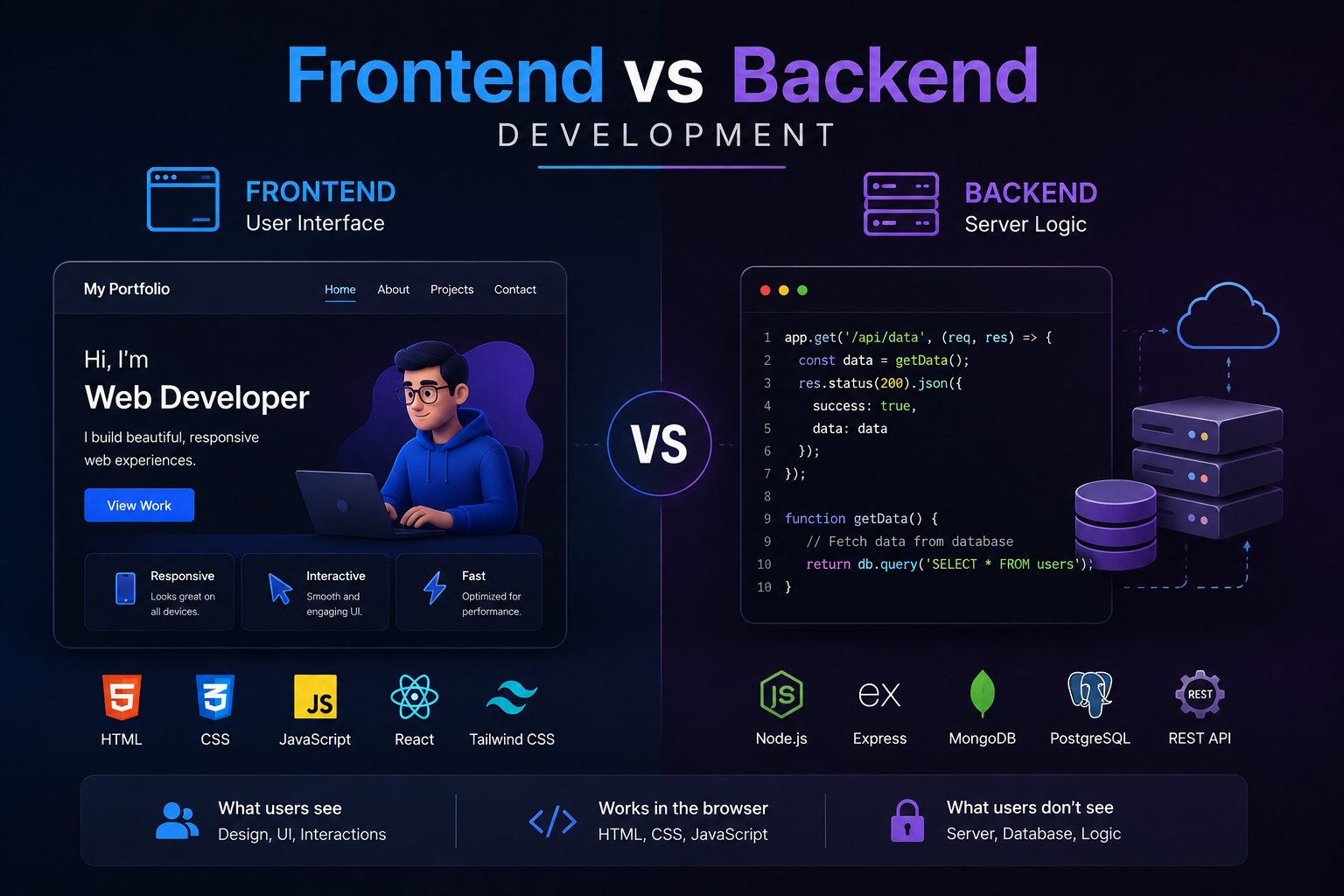
This question has a clearer answer than most of the debates in this space suggest. For the vast majority of people starting from zero, learning frontend first is the better path — for reasons that are practical rather than ideological.
Frontend development produces visible results from the earliest stages of learning. Writing HTML and CSS that renders as a webpage in a browser gives immediate, tangible feedback that learning SQL queries or server routing does not. That feedback loop matters enormously for maintaining motivation through the difficult early months of learning to code. People who can see their work taking shape are more likely to persist through the periods where progress feels slow.
Frontend also has a lower floor to first employment. A junior frontend developer with a solid portfolio of HTML, CSS, and React projects can find their first role faster than a junior backend developer who needs to demonstrate understanding of databases, server architecture, and API design before they are credible at a professional level. Getting that first job matters because the learning that happens in a professional environment — working on real codebases, in real teams, on real problems — is categorically different from self-directed learning and accelerates development dramatically.
The exception to this recommendation is someone who comes from a background that gives them a head start on backend concepts — mathematics, computer science, data analysis, or systems administration. If you already understand data structures, can reason about algorithms, and are comfortable with logical abstraction, the visual feedback advantage of frontend matters less and the backend path may suit your existing mental models better.
Career Trajectories: Where Each Path Leads
All three tracks lead to strong career outcomes when pursued with genuine depth and commitment. The trajectories diverge in their later stages in ways worth understanding before committing to a direction.
Senior Frontend Engineering
Senior frontend engineers at product companies typically own the architecture of the frontend application — component library design, state management strategy, performance budgets, accessibility compliance, and the technical standards that govern how other frontend developers on the team write code. The role expands from writing features to shaping how features are built across a team. At the most senior level, staff and principal frontend engineers work across multiple teams on cross-cutting frontend concerns, and their work product is often internal tooling, design systems, and technical standards documentation as much as product features.
Senior Backend Engineering
Senior backend engineers increasingly work at the intersection of application development, systems design, and infrastructure. Designing systems that scale reliably under load, architecting data models that support complex business logic without becoming unmanageable, and making decisions about service boundaries in distributed systems are the defining challenges at senior backend levels. The career path from senior backend engineer can diverge toward engineering management, solutions architecture, or the increasingly prevalent staff and principal engineer tracks that maintain technical depth without moving into people management.
Senior Full Stack Engineering
Senior full stack engineers at smaller organisations often function as the technical lead across an entire product. At larger ones, the full stack designation sometimes evolves into a hybrid role that bridges frontend and backend teams, translating requirements and architectural decisions between the two. The full stack path also leads naturally to technical co-founder and CTO roles at startups, because the ability to evaluate and make decisions across the entire technical stack is exactly what those roles require. Independent consultants and freelance developers also tend to skew full stack, for the simple reason that a single developer who can deliver a complete product is more valuable to a small client than one who can only deliver half of it.
How These Roles Work Together in a Real Development Team
Understanding how frontend, backend, and full stack developers interact on a real project illuminates the practical value of each role in a way that abstract comparisons cannot. On a typical product team building a web application, frontend developers own the browser-side codebase and implement the user interface against designs from the design team. Backend developers own the API, the database, and the server-side business logic that the frontend calls. Full stack developers may own specific features end to end, bridging both layers, or they may contribute to both sides depending on where bandwidth is needed at any given point.
The handoff between frontend and backend is typically mediated by the API contract — a shared agreement about what data the backend will provide and in what format, which the frontend consumes. Most modern applications use REST or GraphQL APIs for this purpose. GraphQL in particular, developed internally at Facebook and released publicly in 2015, gives frontend developers more control over what data they request and reduces the back-and-forth that used to characterise REST API development when frontend needs changed frequently.
At Munix Studio, our development teams are structured to match the scale and requirements of each project. Smaller projects benefit from full stack developers who can move fluidly across the entire application. Larger, more complex builds use dedicated frontend and backend specialists working in close coordination. The ability to staff projects appropriately rather than forcing every project into the same team structure is one of the genuine advantages of working with a dedicated development studio over hiring a single generalist developer for every problem.
Choosing Your Path: A Framework for the Decision
After all the comparison, the decision ultimately comes down to a combination of temperament, existing strengths, and what you want your daily work to feel like. The following questions are more useful than any salary table or job listing count for arriving at a genuine answer.
When you use a digital product, are you more curious about how it looks and responds, or how it stores and processes data? The former points toward frontend; the latter toward backend.
Do you have existing design sensibility — an eye for typography, layout, and visual detail — or does that dimension feel unnatural? Comfort with visual design is an advantage in frontend work and largely irrelevant in backend.
Are you energised by the idea of owning a complete feature from database to interface, or do you prefer going deep in one layer? The former points toward full stack; the latter toward specialisation.
What is your target environment — a startup where you will need to cover a wide surface area, a product company with specialised teams, or freelance work where client projects need to be delivered end to end? Each suggests a different optimal path.
How much does framework churn bother you? The frontend ecosystem changes significantly faster than the backend, and developers who find this energising thrive in frontend roles while those who find it exhausting tend to be happier in backend work where core concepts are more stable.
No path is permanent. Frontend developers become full stack. Backend developers pick up React and start shipping complete features. Full stack developers specialise when they find the layer they love most. The initial choice shapes the first few years of a career, not the whole thing — and the skills transfer between tracks more readily than the labels suggest.
Related Services
Whether you are building a team, scaling a product, or looking for development expertise across the full stack, Munix Studio provides the specialised and integrated development capability that individual hiring cannot always match:
Dedicated Developers — Access frontend specialists, backend engineers, or full stack developers on a dedicated basis — matched to your stack, your team structure, and your project requirements without the overhead of full-time hiring.
Website Development — Full stack web development delivered by a team with genuine depth across frontend and backend — from architecture decisions to deployment, without gaps in coverage.
App Development — Mobile and web application development spanning frontend interfaces, backend APIs, and database architecture — built by developers who understand the full stack rather than just one side of it.
UI/UX Design — Design that is built to be implemented accurately — produced by designers who work closely with frontend developers and understand the technical constraints of the browser environment.
DevOps and Cloud — Infrastructure and deployment engineering that supports both frontend delivery pipelines and backend server environments — the layer that connects all parts of the stack in production.
Frequently Asked Questions
Ready to Get Started?
Dedicated Developers
Frontend specialists, backend engineers, and full stack developers available on a dedicated basis — matched to your stack and team structure without full-time hiring overhead.
Explore Dedicated DevelopersWebsite Development
Description: Full stack web development with genuine depth across frontend and backend — from architecture through to deployment, with no gaps in technical coverage.
Explore Website DevelopmentApp Development
Mobile and web application development spanning frontend interfaces, backend APIs, and database architecture — built by developers who understand the complete stack.
Explore App DevelopmentUI/UX Design
Design produced by specialists who work in close collaboration with frontend developers and understand the browser environment's technical constraints from the inside.
Explore UI/UX DesignDevOps and Cloud
Infrastructure and deployment engineering that connects frontend delivery pipelines and backend server environments — the layer that holds the full stack together in production.
Explore DevOps and CloudRelated Articles
What is Website Development? The Complete Guide for Beginners
How Are Modern Websites Built in 2026?

Website Development Process & Life Cycle : Complete Guide
How Websites Work: DNS, Servers, Browsers
What is Website Architecture? Best Practices