What Is a Membership Website?
A membership website is a platform where access to content, communities, tools, or services is restricted to registered members who pay a recurring subscription fee or a one-time access fee. The content behind the membership gate can be anything from online courses and exclusive articles to private communities, software tools, templates, coaching sessions, or a combination of all of these. What defines a membership site is not what it contains but the fact that access is conditional on membership status.
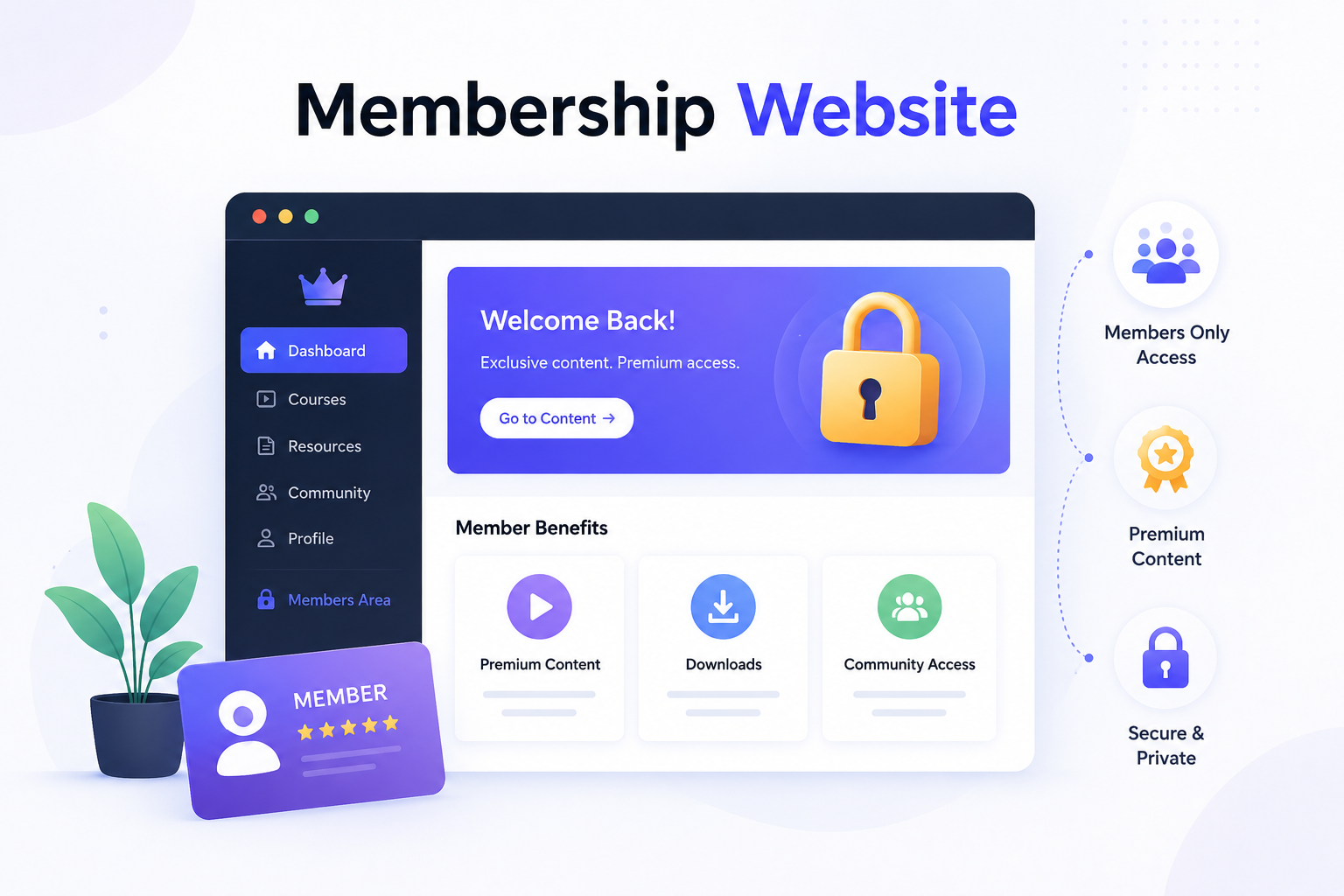
Membership websites have become one of the most attractive business models for creators, educators, consultants, and businesses of all sizes because they generate predictable recurring revenue rather than the unpredictable one-off sales that most other business models produce. A membership site with a thousand paying members at thirty dollars per month generates thirty thousand dollars in monthly recurring revenue that the business can plan around, invest from, and build on. That predictability changes how a business can operate and grow in fundamental ways.
This guide covers everything involved in creating a membership website that delivers genuine value to members, retains them over time, and scales into a sustainable recurring revenue business.
Types of Membership Websites
Membership sites take many different forms depending on the type of value being delivered to members. Understanding which model fits your content and audience is one of the most important decisions you will make before building anything.
Membership Type What Members Get Examples Retention Difficulty Content membership Articles, videos, podcasts, reports Substack, Patreon, newsletters Medium Online course membership Structured learning content and curriculum MasterClass, Skillshare Lower while in course Community membership Private forums, peer groups, networking Circle, Mighty Networks Low when community is active Software or tools membership Access to SaaS tools or templates Figma, Notion, Canva Pro Low if tool is essential Coaching or mentorship membership Live sessions, feedback, direct access Coaching programmes, mastermind groups High without consistent value delivery Hybrid membership Combination of content, community, and tools Most premium membership businesses Lowest when all elements are strong
Step 1: Define Your Membership Value Proposition
The single most important question your membership website needs to answer clearly and immediately is: what will members get that they cannot get anywhere else for free? If the answer is not immediately compelling, the site will struggle to convert visitors into paying members regardless of how well it is built or marketed.
Successful membership businesses are built around a specific audience with a specific pain point or aspiration, and a specific body of value that addresses it better than free alternatives. A fitness professional whose membership gives members access to weekly workout plans, a private community of people with the same goals, and monthly live Q&A sessions has a clear and compelling value proposition for a clearly defined audience. A membership site that offers generic content on a broad topic available freely elsewhere does not.
Before building anything, write a single sentence that describes who the membership is for, what it gives them, and why that matters to them. If you cannot write this sentence clearly, the membership concept needs more definition before development begins.
Step 2: Plan Your Membership Tiers and Pricing
Most successful membership sites offer more than one tier of access, giving potential members a choice between different levels of value at different price points. A tiered structure broadens the accessible audience by accommodating different budgets and different levels of commitment, while also creating a natural upgrade path for members who join at a lower tier and want more over time.
Tier Typical Price Range What to Include Goal Free or trial tier Free Limited content samples, basic community access Lead generation and conversion to paid tiers Core membership $10 to $50 per month Full content library, community access, regular new content Primary revenue driver Premium membership $50 to $200 per month Everything in core plus live sessions, direct access, premium tools Higher revenue per member, deeper engagement Annual plan 10 to 20 percent discount on monthly rate Same as chosen tier, paid annually Improved retention and cash flow
Pricing a membership correctly requires understanding what the value is worth to your specific audience, not what feels comfortable to you as the creator. Most membership businesses underprice their offering significantly at launch because they fear resistance. Underpricing communicates low value and attracts members who are less committed to engaging with what the membership offers. Starting at a price that reflects the genuine value being delivered and adjusting based on conversion data is almost always better than starting too low and struggling to raise prices later.
Step 3: Plan the Pages and Features Your Site Needs
A membership website has two distinct environments that need to be designed and built separately. The public-facing side is what non-members see and its purpose is entirely to communicate the value of membership and convert visitors into paying members. The member-facing side is the gated environment that paying members access after logging in, and its purpose is to deliver the value that the membership promises and keep members engaged over time.
The public side needs a compelling sales page that articulates the membership value proposition clearly, addresses common objections, displays social proof from existing members, and makes the signup and payment process as straightforward as possible. Every element of this page exists to serve one goal: converting a visitor into a paying member.
The member side needs a dashboard that gives members an immediate overview of what is available to them and what is new since their last visit, a content library organized in a way that makes finding relevant content easy, a community or discussion area if the membership includes community access, a profile and account management section where members can update their details and manage their subscription, and a clear upgrade path for members on lower tiers who want to access higher-tier content.
Step 4: Choose the Right Technology Approach
The technology decision for a membership website is one of the most consequential choices in the build process. There are several approaches available, each with meaningful trade-offs around speed to launch, flexibility, cost, and scalability.
Approach Examples Best For Scalability Customization All-in-one membership platforms Kajabi, Teachable, Podia Creators wanting fast launch Moderate Limited WordPress with membership plugins MemberPress, Restrict Content Pro WordPress-comfortable site owners Moderate Moderate Community-first platforms Circle, Mighty Networks Community-led memberships Good within the platform Limited Custom built platform React, Next.js, Node.js, Stripe Businesses needing full control and scalability Excellent Full control
For creators and educators launching their first membership with a limited audience, all-in-one platforms like Kajabi reduce the time and cost to get started significantly. For businesses that need a fully branded experience, complex content structures, custom features, or the ability to integrate deeply with other systems, a custom-built membership platform on a modern stack delivers capabilities that no off-the-shelf solution can match.
Step 5: Set Up Recurring Payment and Subscription Management
The payment infrastructure of a membership website needs to handle recurring billing reliably, manage failed payments gracefully, support upgrades and downgrades between tiers, process cancellations and refunds, and provide members with self-service access to their billing history and payment details. Getting any of these wrong creates support burden and member frustration that directly increases churn.
Stripe is the dominant payment infrastructure for membership websites. Stripe Billing handles recurring subscription management with support for multiple pricing plans, trial periods, proration when members change tiers, automatic retry logic for failed payments with configurable dunning sequences, and webhooks that allow the membership platform to respond to payment events in real time. For most membership businesses, Stripe is the right choice and building the subscription logic on top of Stripe's infrastructure rather than from scratch is almost always the correct decision.
Step 6: Build Content Gating and Access Control
Content gating is the mechanism that restricts access to member-only content based on a user's membership status and tier. This needs to be implemented at the server level, not just the frontend, to prevent technically sophisticated users from bypassing the gate by inspecting the page source or manipulating browser state. A frontend-only content gate that hides content visually but still loads it in the page response is not a real content gate from a security perspective.
In a properly built membership platform, the server checks the user's authentication status and membership tier before deciding what content to include in the response. Content that the user does not have access to is never sent to the browser at all. This requires a backend that stores and checks membership status in real time, synchronized with the payment system so that access is granted immediately when a payment succeeds and revoked promptly when a subscription lapses.
Step 7: Focus on Member Retention From Day One
Acquiring a new member costs significantly more than retaining an existing one. The economics of a membership business only work sustainably when churn is low enough that the recurring revenue from retained members grows over time. Focusing on retention from the very beginning rather than treating it as a problem to solve once growth slows down is what separates membership businesses that compound from those that plateau.
The most powerful retention mechanism is consistent value delivery. Members who regularly receive content, connections, or tools that genuinely improve their situation will continue paying. Members who join with high expectations and find the reality underwhelming will cancel within the first two billing cycles. A content calendar that ensures new value is delivered consistently, a welcome sequence that helps new members find the most relevant content quickly, and regular community engagement that makes members feel connected to the platform and each other all contribute significantly to retention.
Failed payment recovery is a purely mechanical but extremely impactful retention lever that many membership businesses underinvest in. A significant percentage of cancellations happen not because members consciously decided to leave but because a payment failed and the platform did not recover it effectively. A well-configured dunning sequence that retries failed payments at optimal intervals and sends clear, non-threatening communications to members about updating their payment details recovers a meaningful proportion of what would otherwise be involuntary churn.
Advantages and Drawbacks of Membership Websites
Advantages
Predictable recurring revenue that compounds as the member base grows, making financial planning and reinvestment significantly easier than one-off sales businesses.
Deep audience relationships built over time as members engage repeatedly with the content and community, creating loyalty that is difficult for competitors to disrupt.
Content created once continues generating revenue indefinitely as new members join and access the back catalogue, improving the return on content creation investment over time.
Multiple revenue expansion opportunities exist within an existing member base through tier upgrades, one-time product sales, events, and coaching offers that complement the core membership.
Drawbacks
Requires consistent ongoing content creation and community management to justify the recurring fee, which creates a permanent operational commitment that cannot be paused without impacting retention.
Revenue builds slowly in the early stages since it compounds gradually rather than generating immediate large returns, requiring patience and sustained effort before the economics become compelling.
Churn management becomes an ongoing operational priority that requires dedicated attention and system investment to manage effectively at scale.
Member expectations increase over time as competitors launch similar offerings, requiring continuous investment in improving the membership experience to maintain the perceived value that justifies the recurring fee.
Step 8: Launch Strategy and Growing Your Member Base
The most effective membership launches are built around a founding member offer that creates urgency and rewards early adopters for taking a chance on a new platform. A founding member price that is significantly lower than the eventual standard price, available only to the first hundred or two hundred members, gives people a concrete reason to act now rather than waiting to see how the membership develops.
Building an email list or audience before launch is the single most important preparation step for a successful membership launch. A membership launched to a warm audience of people who already know and trust the creator consistently outperforms one launched cold with no existing relationship. If you do not yet have an audience, building one through consistent free content publication in the months before launch is the most reliable path to a strong opening.
After launch, organic growth through member referrals, SEO-driven content that attracts relevant visitors, and strategic partnerships with complementary creators or businesses in adjacent niches are the most sustainable long-term growth channels for membership businesses.
Build Your Membership Website With Munix Studio
Whether you need a fully custom membership platform built from scratch or a professionally engineered solution that goes beyond what off-the-shelf tools can deliver, Munix Studio builds membership websites that handle recurring payments, content gating, member management, and community features in a single well-architected platform designed to scale with your business.
Website Development — Custom membership platforms built on React and Next.js with content gating, tier management, member dashboards, and Stripe subscription integration built in from day one.
App Development — Native mobile applications that give your members access to content, community, and their account on iOS and Android with a seamless native experience.
UI/UX Design — Membership-focused interface design covering the public sales experience, onboarding flow, member dashboard, and content discovery that keeps members engaged and retained.
SEO Optimization — Content and technical SEO strategy that drives organic traffic to your membership sales pages from the audiences most likely to convert into paying members.
Maintenance and Support — Ongoing platform management covering payment system monitoring, content updates, feature additions, and the technical reliability that a live membership platform requires every day.
Frequently Asked Questions
Ready to Get Started?
Website Development
Custom membership platforms built on React and Next.js with content gating, tier management, member dashboards, and Stripe subscription integration from day one.
Explore Website DevelopmentApp Development
Native mobile applications that give your members access to content, community, and their account on iOS and Android with a seamless native experience.
Explore App DevelopmentUI/UX Design
Membership-focused interface design covering the public sales experience, onboarding flow, member dashboard, and content discovery that keeps members engaged and retained.
Explore UI/UX Design/services/ui-ux-design
Content and technical SEO strategy that drives organic traffic to your membership sales pages from the audiences most likely to convert into paying members.
Explore SEO OptimizationMaintenance and Support
Ongoing platform management covering payment system monitoring, content updates, feature additions, and the technical reliability a live membership platform requires every day.
Explore Maintenance and SupportRelated Articles
What is Website Development? The Complete Guide for Beginners
How Are Modern Websites Built in 2026?

Website Development Process & Life Cycle : Complete Guide
How Websites Work: DNS, Servers, Browsers
What is Website Architecture? Best Practices