What Is a Marketplace Website?
A marketplace website is a platform that connects buyers and sellers, allowing third parties to list and sell products or services while the platform owner facilitates the transactions and typically takes a commission or fee in return. Amazon, Airbnb, Etsy, Fiverr, and Uber are all marketplace businesses at their core. The platform itself does not own the inventory or deliver the services. It creates the environment where supply and demand meet and transactions happen.
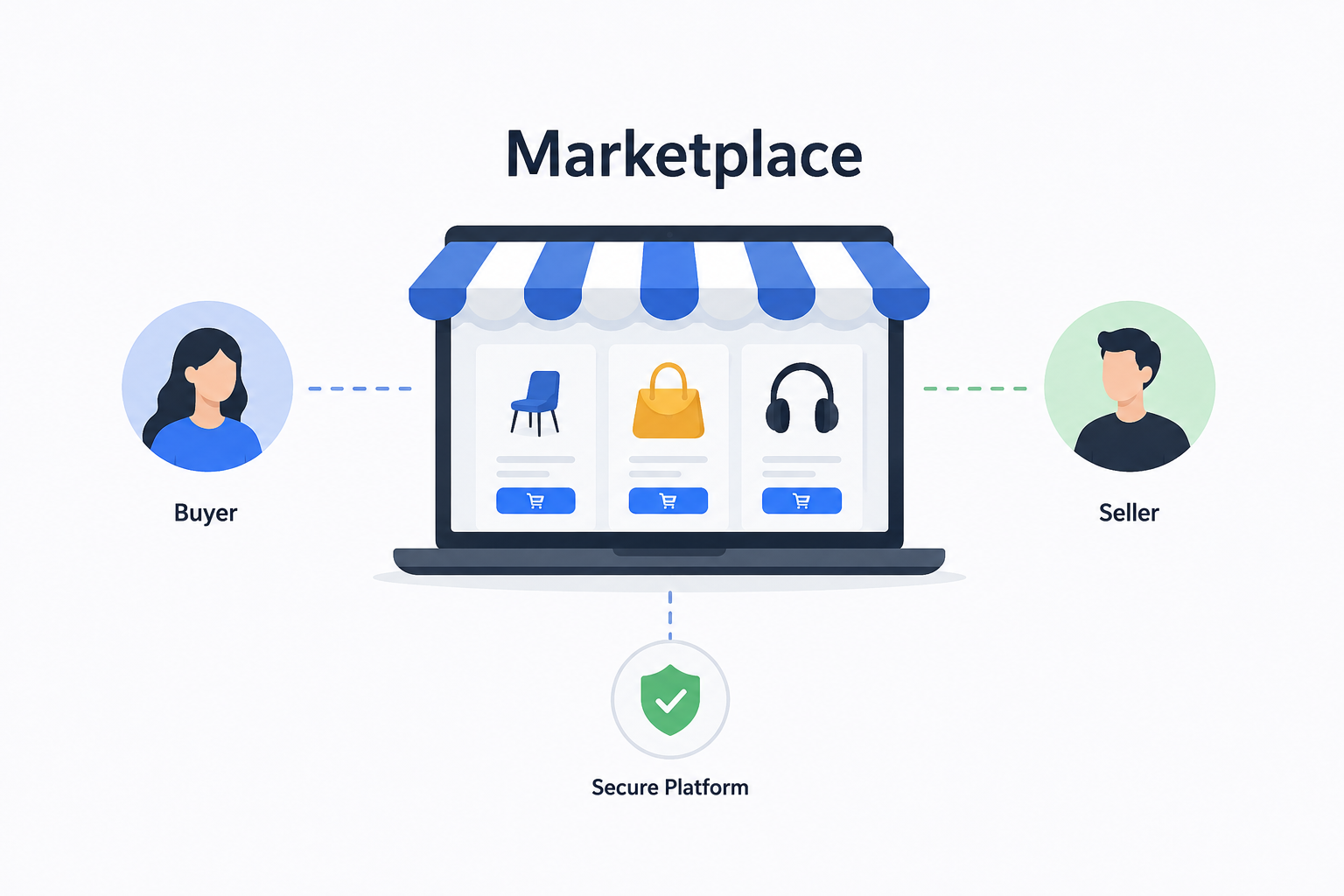
Marketplace businesses are among the most scalable business models in existence because the platform grows in value as more buyers and sellers join without the owner needing to manage inventory, employ service providers, or bear the operational costs associated with traditional product or service businesses. This network effect is what makes marketplaces both enormously attractive as a business model and genuinely difficult to build well, since both sides of the market need to be present for the platform to deliver value to either.
This guide covers everything involved in creating a marketplace website from the ground up, including the different types of marketplace models, the technology decisions involved, payment infrastructure, the cold start problem every new marketplace faces, and what it takes to scale beyond the initial launch.
Types of Marketplace Websites
Before deciding how to build your marketplace, you need to be clear about what type of marketplace you are building. The model determines the features required, the payment infrastructure needed, the trust mechanisms that matter most, and the overall complexity of the technical build.
Marketplace Type What Is Exchanged Examples Build Complexity Product marketplace Physical or digital goods Amazon, Etsy, eBay High Service marketplace Professional or freelance services Fiverr, Upwork, Bark High Rental marketplace Temporary access to spaces or assets Airbnb, Turo, Fat Llama Very high B2B marketplace Wholesale goods or business services Alibaba, Thomasnet Very high Multi-vendor marketplace Multiple seller stores under one platform Shopify Markets, Not On The High Street High Hyperlocal marketplace Local goods and services within a geography Nextdoor, Taskrabbit High
Step 1: Define Your Niche and Value Proposition
The most common mistake first-time marketplace founders make is trying to build a platform that serves too broad an audience. A general marketplace competing with Amazon or eBay without a clear differentiation is not a viable strategy. The marketplaces that succeed today almost always start with a specific niche, serve it exceptionally well, and expand from a position of strength once they have established genuine product-market fit within that niche.
Your niche defines the specific category of buyers and sellers your platform will serve, the type of transactions it will facilitate, and the specific problem it solves better than existing alternatives. A marketplace for independent furniture makers to sell to interior designers is a niche. A marketplace for freelance legal professionals to offer services to small businesses is a niche. Each of these has a clearly defined audience on both sides and a clear reason to exist beyond simply being another general marketplace.
Your value proposition needs to answer the question that both sides of the market will ask before joining: why should I use this platform instead of what I am already using? For sellers, the answer is usually access to more relevant buyers, better tools for managing listings and transactions, lower fees, or a more trusted brand in their specific category. For buyers, it is usually better selection, more trust in the sellers, easier discovery, or a more streamlined purchasing experience.
Step 2: Choose Your Revenue Model
Marketplace businesses generate revenue in several different ways, and the model you choose affects the features you need to build, the incentives of buyers and sellers on the platform, and how quickly the business can become profitable. Most mature marketplaces use a combination of revenue streams rather than relying on a single model.
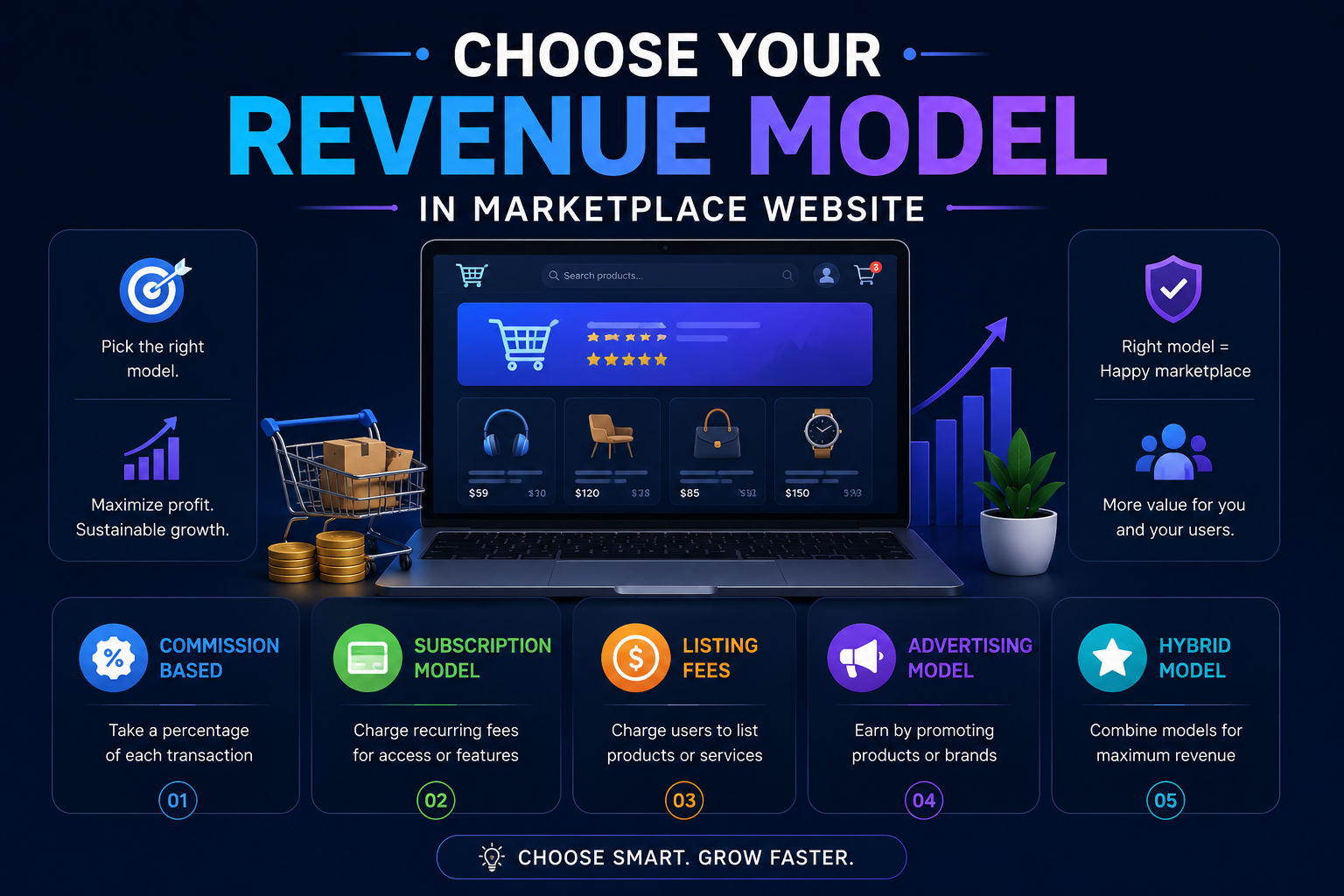
Revenue Model How It Works Best For Commission per transaction Platform takes a percentage of each sale Most marketplace types Listing fees Sellers pay to list each item or service High-volume product marketplaces Subscription fees Sellers or buyers pay a recurring fee for platform access B2B and professional service marketplaces Featured listings Sellers pay for premium placement in search results High-competition categories Lead fees Sellers pay per qualified buyer introduction Service marketplaces like home services Freemium tiers Free basic access with paid upgrades for advanced features Marketplaces targeting high seller volume
Step 3: Plan the Core Features Your Marketplace Needs
A marketplace website is significantly more complex to build than a standard e-commerce store or business website because it needs to serve two distinct user groups simultaneously with different needs, different dashboards, and different workflows. Planning the feature set carefully before development begins is essential to avoid scope creep and budget overruns during the build.
The core features every marketplace needs on the seller side include a registration and onboarding flow, a profile or store page, a listing management system for creating and editing listings, an order or booking management dashboard, a messaging system for communicating with buyers, and a payout system for receiving earnings. On the buyer side, the essential features are search and filtering, listing or profile browsing, a secure checkout and payment flow, order tracking or booking confirmation, a review and rating system, and a messaging system for communicating with sellers.
Beyond these core features, the platform itself needs an admin panel for managing users, monitoring transactions, handling disputes, and configuring platform settings. This admin layer is one of the most underestimated components in marketplace development and one that becomes increasingly important as the platform scales and the volume of activity requiring human oversight grows.
Step 4: Choose the Right Technology Stack
The technology decisions made when building a marketplace have long-term consequences that are expensive to reverse. A platform that starts on a no-code tool or a WordPress multi-vendor plugin might get to a basic version quickly, but will consistently hit scaling and customization ceilings that require a full rebuild to overcome. Building on a proper custom stack from the start is almost always the right decision for any marketplace that expects meaningful growth.
Approach Time to Launch Scalability Customization Long-term Cost No-code (Bubble, Sharetribe) Fast (weeks) Limited Limited High subscription fees WordPress multivendor plugins Medium (1-2 months) Poor at scale Moderate Plugin and maintenance overhead Custom built (React, Next.js, Node.js) Longer (3-6 months) Excellent Full control Lower over time Headless commerce platform Medium (2-4 months) Good Moderate Platform fees apply
At Munix Studio we build marketplace platforms on React and Next.js for the frontend, with Node.js and NestJS on the backend, and PostgreSQL for the relational data that marketplace transactions require. This stack gives the flexibility, performance, and scalability that serious marketplace businesses need without the limitations that off-the-shelf solutions consistently impose.
Step 5: Build a Robust Payment System
Payment infrastructure is one of the most technically complex and legally sensitive parts of building a marketplace. Unlike a standard e-commerce store where payments go from buyer directly to the store owner, a marketplace involves splitting payments between the platform and multiple sellers, handling escrow periods where funds are held until a transaction is confirmed, managing refunds across a two-sided transaction, and paying out earnings to sellers in potentially multiple currencies and countries.
Stripe Connect is the most widely used payment infrastructure for marketplace businesses because it is specifically designed for multi-party payment flows. It handles the complexity of splitting payments between the platform and sellers, manages KYC verification for sellers receiving payouts, handles dispute resolution and chargebacks, and supports payouts in multiple currencies. Building a custom payment system from scratch instead of using an established infrastructure like Stripe Connect is almost never the right decision for a marketplace at any stage.
Step 6: Build Trust Into the Platform
Trust is the currency of a marketplace. Buyers need to trust sellers enough to hand over money for goods or services they have not yet received. Sellers need to trust the platform enough to invest time and effort in building their presence on it. And both sides need to trust that the platform will handle disputes fairly when things go wrong.
The review and rating system is the most important trust mechanism on most marketplaces. Reviews provide social proof that a seller can be trusted and give buyers the information they need to make decisions with confidence. The design of the review system matters significantly. Reviews need to be verified as coming from real transactions, displayed prominently on seller profiles and listings, and difficult to manipulate or game.
Identity verification for sellers, secure messaging between buyers and sellers that keeps contact information protected until a transaction is confirmed, a clear dispute resolution process, and buyer protection guarantees that ensure refunds are available for genuine complaints all contribute to the trust infrastructure that makes transactions happen on the platform.
Step 7: Solve the Cold Start Problem
Every new marketplace faces the chicken and egg problem at launch. Buyers will not join a marketplace with no sellers. Sellers will not join a marketplace with no buyers. Solving this cold start problem is one of the most important challenges in marketplace business and one that the platform's design and launch strategy need to address directly.
The most effective approach is to focus on one side of the market first before opening to the other. Most successful marketplaces seed the supply side, meaning they recruit sellers or service providers manually before there is significant buyer demand, because a marketplace with good supply can attract buyers but a marketplace with buyers and no supply delivers no value and loses those buyers immediately.
Starting with a constrained geography or niche is another proven approach. Rather than launching nationally and spreading thin, concentrating all early supply and demand efforts in a single city or very specific category allows the platform to achieve the density needed to be genuinely useful within that constrained area before expanding. Uber, Airbnb, and DoorDash all followed this approach in their earliest stages.
Step 8: Plan for Search, Discovery, and SEO
A marketplace's internal search and discovery system is how buyers find relevant sellers and listings on the platform. Getting this right matters enormously for conversion rates because a buyer who cannot quickly find what they are looking for will leave rather than spend time trying to navigate a poorly designed search experience.
External search engine optimization is equally important. Marketplace listing pages and seller profile pages are valuable SEO assets because they target the specific search queries that buyers in your niche are already making. A marketplace for freelance graphic designers whose individual profile pages rank for searches like "hire freelance graphic designer" generates organic traffic without paid advertising spend. Building the platform's URL structure, page titles, and content with this in mind from the start creates a significant long-term traffic advantage.
Advantages and Challenges of the Marketplace Business Model
Advantages
Asset-light model where the platform does not own inventory or employ service providers, keeping operational costs low relative to the revenue generated at scale.
Network effects create compounding value as more participants join, making the platform more useful to all existing participants and increasingly difficult for competitors to replicate.
Multiple revenue streams available including commissions, subscriptions, listing fees, and featured placements that diversify income beyond a single monetization mechanism.
Highly scalable once the supply and demand balance is achieved, since adding more participants to the platform does not proportionally increase operational complexity for the platform owner.
Challenges
The cold start problem requires significant upfront effort to seed both sides of the market before the platform delivers meaningful value to either.
Disintermediation risk exists when buyers and sellers who meet on the platform choose to transact directly off-platform to avoid paying commission fees.
Quality control becomes increasingly difficult as the number of sellers grows, requiring investment in moderation, verification, and dispute resolution systems.
Technical complexity is significantly higher than a standard e-commerce store, requiring more sophisticated payment infrastructure, dual-sided user management, and robust admin tooling from the start.
Build Your Marketplace With Munix Studio
Building a marketplace is one of the most technically demanding web projects a founder can take on. Getting the architecture right from the start, choosing the right payment infrastructure, and building the trust mechanisms that make transactions happen requires experience across the full stack of marketplace development. At Munix Studio we build custom marketplace platforms designed to scale from day one, with the flexibility to evolve as your business grows and your understanding of your market deepens.
Website Development — Custom marketplace platforms built on React, Next.js, and Node.js with dual-sided user management, listing systems, and admin infrastructure built for scale.
App Development — Native mobile applications for iOS and Android that extend your marketplace to mobile users with full feature parity and a seamless experience.
UI/UX Design — Marketplace-specific interface design covering buyer discovery flows, seller onboarding, listing pages, and the trust signals that make transactions happen.
SEO Optimization — Marketplace SEO strategy that turns your listing and profile pages into organic traffic assets that attract buyers without paid advertising spend.
DevOps and Cloud — Scalable cloud infrastructure that handles traffic spikes, ensures uptime, and keeps your marketplace performing reliably as the platform grows.
Maintenance and Support — Ongoing platform management covering security updates, performance monitoring, feature additions, and the operational support a live marketplace requires after launch.
Frequently Asked Questions
Ready to Get Started?
Website Development
Custom marketplace platforms built on React, Next.js, and Node.js with dual-sided user management, listing systems, payment integration, and admin infrastructure built to scale.
Explore Website DevelopmentApp Development
Native mobile applications for iOS and Android that extend your marketplace to mobile users with full feature parity and a seamless experience on every device.
Explore App DevelopmentUI/UX Design
Marketplace-specific interface design covering buyer discovery flows, seller onboarding, listing pages, and the trust signals that make transactions happen consistently.
Explore UI/UX DesignSEO Optimization
Marketplace SEO strategy that turns listing and profile pages into organic traffic assets attracting buyers without paid advertising spend.
Explore SEO OptimizationDevOps and Cloud
Scalable cloud infrastructure that handles traffic spikes, ensures uptime, and keeps your marketplace performing reliably as the platform grows.
Explore DevOps and CloudMaintenance and Support
Ongoing platform management covering security updates, performance monitoring, feature additions, and operational support a live marketplace requires after launch.
Explore Maintenance and SupportRelated Articles
What is Website Development? The Complete Guide for Beginners
How Are Modern Websites Built in 2026?
Website Development Process & Life Cycle : Complete Guide
How Websites Work: DNS, Servers, Browsers
What is Website Architecture? Best Practices