What Is a Lead Generating Website?
A lead generating website is one built with a single commercial purpose: converting visitors into qualified prospects for a business. Unlike an ecommerce site that closes a transaction online, a lead generation site collects contact information, enquiry details, or booking requests from people who are interested in a product or service and passes those prospects to a sales team or service delivery process. The website does not close the deal. It starts the conversation.
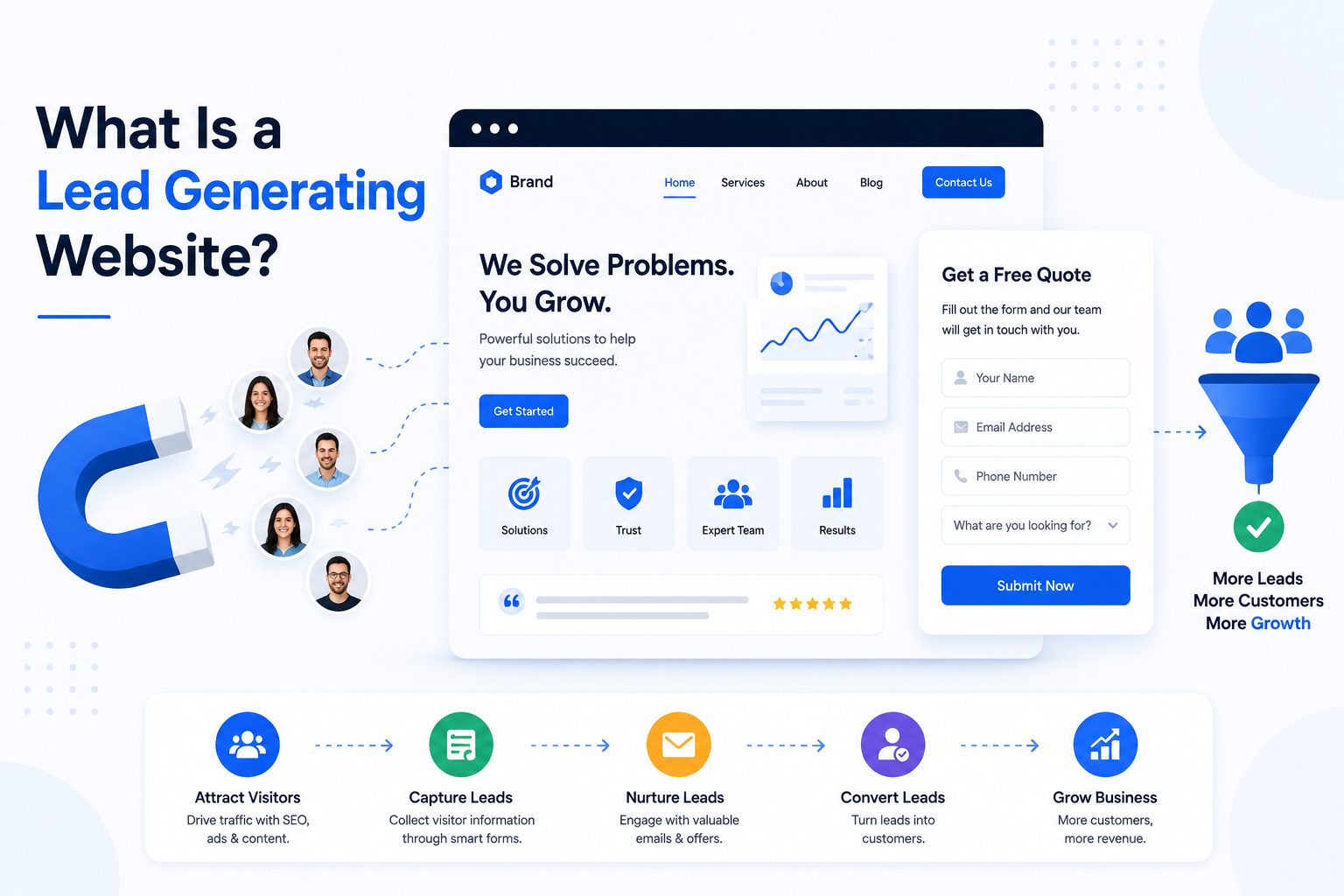
This model applies to an enormous range of businesses. Law firms, digital agencies, cleaning companies, mortgage brokers, architects, consultants, software vendors, and recruiting firms all operate websites where the primary commercial outcome is a form submission, a phone call, a booked demo, or a consultation request. For all of them, the website's job is identical: attract the right visitor, build sufficient trust and conviction, and remove every barrier between interest and contact.
Most businesses underestimate how much deliberate architecture this requires. A website that looks professional is not the same as a website that generates leads. The difference between the two lies in how the visitor journey is designed, how trust is built at each stage, how friction is removed from the conversion action, and how the site is structured to attract qualified traffic from search in the first place. This guide covers every element of that architecture from the ground up.
Step 1: Define What a Qualified Lead Looks Like
Before a single page is designed, the business needs a precise definition of what constitutes a qualified lead. Without this definition, the website cannot be optimised to attract and qualify the right visitors, the conversion forms cannot be designed to collect the right information, and there is no basis for evaluating whether the site is performing well or poorly.
A qualified lead is not simply anyone who fills out a contact form. It is someone who has a genuine need for what the business offers, the authority or intent to make a purchasing decision, and a realistic expectation of the cost or commitment involved. A mortgage brokerage generating enquiries from renters with no intention of buying in the next twelve months is generating form submissions, not qualified leads. The website needs to be designed to attract and qualify the right profile, which requires knowing that profile in detail before the architecture is planned.
Lead Qualification Dimension What to Define How It Shapes the Website Audience profile Industry, role, company size, location Messaging, page copy, service page targeting Problem awareness How well the lead understands their own problem Content depth, educational vs sales-first approach Budget expectation Minimum viable project or contract value Pricing transparency, qualifying form fields Decision timeline How urgently the lead needs to act CTA urgency framing, nurture vs direct conversion Decision maker vs researcher Whether the visitor can approve the purchase Content for multiple stakeholders, shareable assets Geographic scope Local, national, or international service area Local SEO vs national content strategy
Step 2: Build a Page Structure Around the Conversion Journey
A lead generating website needs a deliberate page structure that moves visitors through a sequence of stages: awareness of the business and what it offers, consideration of whether it is the right fit, and conversion into a contact action. Most business websites are designed to communicate information but not to move visitors through this sequence. The result is a site that explains what the company does without ever compelling the visitor to take action.
Core Pages Every Lead Generation Site Requires
Homepage — The homepage must communicate who the business serves, what problem it solves, and what makes it the right choice, all within the first screen a visitor sees. It is not a place to explain everything the company does. It is a place to answer the single question every new visitor arrives with: am I in the right place? A clear headline, a supporting subheadline, and a single primary call to action above the fold is the baseline. Everything below that fold should build the case that justifies clicking it.
Service pages — Each distinct service the business offers should have its own dedicated page. Generic services overview pages that list everything the company does in one place rank poorly in search and convert poorly because they speak to no one specifically. A dedicated page for each service targets the specific search queries that prospective clients use when looking for that service, allows the content to address the specific concerns and objections of the relevant buyer, and creates the right context for a targeted call to action.
Industry or use case pages — For businesses serving multiple industry verticals, dedicated industry pages are among the most valuable pages on the site. A prospect in the healthcare sector who lands on a page specifically addressing healthcare clients converts at a dramatically higher rate than one who lands on a generic services page, because the page speaks directly to their context, their concerns, and their regulatory environment.
Case studies and results pages — Evidence that the business has delivered results for clients comparable to the visitor is the single most powerful trust-builder on a lead generation site. A case study that describes the client's situation, the approach taken, and the specific measurable outcome achieved gives prospective clients a concrete basis for expecting similar results. Generic testimonials without specific outcomes carry a fraction of the persuasive weight.
Contact and enquiry page — The contact page is where the conversion happens and it deserves far more design attention than most businesses give it. A well-designed contact page reinforces the value proposition one final time, removes any remaining sources of hesitation, presents the form with the minimum required fields, and sets clear expectations about what happens after submission.
Blog or resources section — Educational content that targets the informational queries prospective clients search during their research phase attracts early-stage visitors, builds topical authority in organic search, and creates internal linking pathways that funnel traffic toward service pages and conversion points.
Step 3: Choose Technology That Supports Conversion Performance
The technology stack of a lead generation site directly affects its performance in organic search and its conversion rate. A slow site loses leads before the form is ever reached. A site with poor mobile performance loses the significant proportion of visitors who arrive on a smartphone. A site built on a platform with limited SEO flexibility caps organic traffic before the content has a chance to rank competitively.
Platform Lead Gen Suitability SEO Control Page Speed CRM Integration Next.js (custom) Excellent Full Excellent Any via API WordPress Good Good with plugins Variable Plugin dependent Webflow Good Good Good Limited natively Squarespace / Wix Poor for serious lead gen Poor Poor Very limited HubSpot CMS Good with HubSpot CRM Good Good Native HubSpot
For businesses where lead generation is the primary commercial function of the website, a custom-built Next.js site gives the most control over every performance and conversion variable. Form submissions can be routed to any CRM, form validation can be tailored to qualify leads at the point of submission, A/B testing of conversion elements is unconstrained by platform limitations, and page speed is optimised without the overhead of a plugin stack. The result is a lead generation machine rather than a general-purpose website that happens to have a contact form.
Step 4: Design Landing Pages That Convert
A landing page is any page on which a visitor lands from a specific traffic source with the expectation of finding a specific piece of information and taking a specific action. In lead generation contexts, landing pages are the most commercially critical pages on the entire site. Their design determines whether the traffic the site attracts converts into enquiries or exits without engaging.
Anatomy of a High-Converting Lead Generation Landing Page
Page Section Purpose Common Mistakes Hero headline Confirm relevance in under 3 seconds Vague taglines that say nothing specific Subheadline Expand the headline with the specific value proposition Repeating the headline without adding new information Primary CTA Direct the visitor to the conversion action Generic text like Contact Us or Submit Problem statement Demonstrate understanding of the visitor's situation Jumping to the solution before establishing the problem Solution overview Explain what the business does and how it solves the problem Feature lists without outcome-focused framing Social proof Reduce perceived risk with evidence from comparable clients Generic quotes without names, outcomes, or context Objection handling Address the specific concerns that prevent enquiry Ignoring objections and hoping the visitor will contact anyway Lead capture form Collect the minimum information needed to qualify and respond Too many fields, ambiguous labels, no confirmation message Next steps clarity Tell the visitor exactly what happens after they submit Leaving visitors uncertain about what the submission triggers
Writing CTAs That Actually Drive Action
The call to action is the single highest-leverage element on a lead generation landing page. A poorly written CTA on a page with excellent content still fails to convert. The most effective CTAs for lead generation are specific, outcome-oriented, and low in perceived commitment. The difference between a CTA that says Contact Us and one that says Get Your Free Strategy Call is the difference between a generic request and a specific, valuable offer.
Outcome-focused: Get Your Free Audit, Claim Your Consultation, See How It Works
Low commitment framing: No obligation, free, takes 2 minutes, no credit card required
Specificity over generality: Book a 30-Minute Discovery Call outperforms Talk to Us
First person phrasing: Start My Free Trial outperforms Start Your Free Trial in many tests
Urgency where genuine: Limited spots available or Accepting new clients in April work only when true. Manufactured urgency damages trust.
Step 5: Design Lead Capture Forms That Qualify Without Repelling
The lead capture form is where the conversion happens, and its design has a direct and measurable impact on how many visitors complete it. Every additional field in a form reduces the completion rate. Research from HubSpot and other conversion optimisation platforms consistently shows that forms with three fields convert at higher rates than forms with seven, even when the longer form would theoretically provide more useful information about the lead.
The resolution to this tension between data collection and conversion rate is to collect the minimum information at the first conversion point and gather additional qualifying information progressively. The first form asks for name, email, and one qualifying question. The follow-up email or call collects the rest. This approach maximises the number of leads entering the pipeline while still providing enough information to route them correctly.
Form Design: Advantages and Drawbacks by Approach
Form Approach Advantages Drawbacks Best For Minimal (2 to 3 fields) Highest completion rate, lowest friction Less pre-qualification, more unqualified leads High-traffic sites, top of funnel Standard (4 to 6 fields) Balance of volume and qualification Some drop-off from longer fields Most service businesses Detailed (7 or more fields) Highly pre-qualified leads, less sales time needed Significantly lower completion rate High-value, low-volume B2B sales Multi-step form Higher completion than equivalent single-page form More complex to build, requires progress indication Complex services needing detailed briefing Calendar booking widget Immediate commitment, skips back-and-forth scheduling Higher friction than a simple form, requires available calendar Consultants, coaches, agencies offering discovery calls
Step 6: Build Trust Architecture Throughout the Site
Trust is the precondition for a lead generation conversion. A visitor who does not trust the business will not submit their contact details regardless of how well-designed the form is or how compelling the offer sounds. Building trust on a lead generation site is not a single section at the bottom of the homepage. It is a systematic architecture of trust signals distributed throughout every page at the moments where doubt is most likely to arise.
Specific client outcomes in testimonials — A testimonial that says "We increased our organic traffic by 180% in six months working with this team" is worth ten times the persuasive weight of one that says "Great service, highly recommend." Specificity is what makes social proof credible rather than decorative. Named clients with job titles and company names amplify this effect further.
Named team members with photographs — A lead generation site that hides behind a brand without showing the people behind it creates the impression there is something to hide. Named consultants, account managers, or founders with real photographs and professional biographies reduce the anonymity that prevents prospective clients from making contact.
Credentials and accreditations — Industry memberships, certifications, partner badges from recognised platforms, and regulatory compliance credentials should be displayed on the homepage and on relevant service pages rather than only on an about page that many visitors never reach.
Client logos — Recognisable client names or logos signal that the business has been trusted by organisations similar to the prospective client. Even if the logos are not household names, the volume and variety of them communicates an established track record.
Privacy and data handling transparency — A clear, plain-language statement near the form about how contact information is used and not shared removes a specific concern that prevents some visitors from submitting, particularly in B2B contexts where decision makers are wary of triggering aggressive follow-up.
Step 7: Drive Qualified Traffic Through Local and Organic SEO
A lead generation site with no traffic generates no leads regardless of how well it is designed. Organic search is the most sustainable source of qualified traffic for most lead generation businesses because the visitors arriving from specific service-related search queries are already in a problem-aware state and actively looking for a solution. This intent level is dramatically higher than traffic from social media or display advertising, which reaches people who are not currently thinking about the problem the business solves.
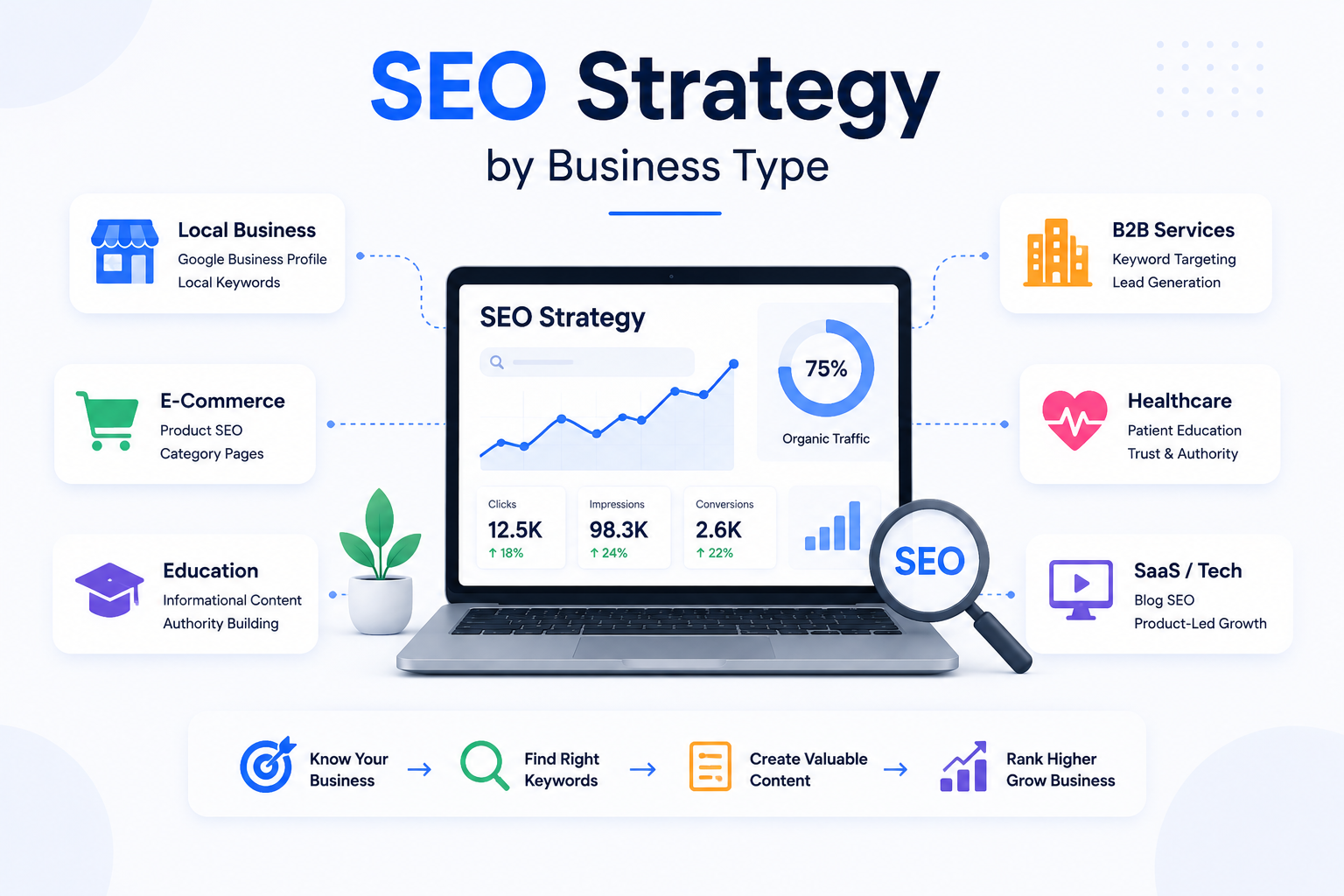
SEO Strategy by Business Type
Business Type Primary SEO Strategy Key Page Types Timeline Local service business Local SEO, Google Business Profile, location pages Service pages, location pages, testimonials 3 to 6 months B2B service provider Industry pages, thought leadership content, case studies Industry pages, service pages, blog, case studies 9 to 18 months Professional services Local and topical authority, E-E-A-T signals, FAQs Practice area pages, attorney bios, blog, location pages 6 to 12 months SaaS or software Feature pages, comparison pages, integration pages, blog Feature pages, use case pages, comparison pages 12 to 24 months Agency or studio Service pages, portfolio, industry pages, learn content Service pages, case studies, industry pages, blog 6 to 12 months
Local SEO deserves particular attention for businesses that serve clients in a defined geographic area. A plumber, solicitor, accountant, or marketing agency serving a specific city or region generates their best leads from people searching for exactly that service in exactly that location. Appearing in the Google local pack for service-plus-location queries is often more commercially valuable than ranking organically for the same query, because the local pack appears above the organic results and carries the additional trust signal of a visible star rating and review count.
Step 8: Integrate CRM and Lead Routing From Day One
A lead that is not followed up quickly is a lead that converts to a competitor. Research from the Harvard Business Review found that businesses contacting leads within an hour of submission are seven times more likely to qualify the lead than those that wait longer. The website's lead capture infrastructure needs to route new submissions to the right person or system instantly, not via a shared inbox that someone checks twice a day.
CRM integration connects the website's form submissions directly to a pipeline where leads can be tracked, assigned, and followed up systematically. HubSpot, Salesforce, Pipedrive, and Monday CRM are all commonly integrated with custom-built lead generation sites via API or webhook. The form submission triggers an immediate automated confirmation email to the prospective client, sets an internal notification to the relevant team member, and creates a deal or contact record in the CRM, all without manual intervention. This infrastructure is the difference between a lead generation website and a lead generation system.
Step 9: Measure Lead Quality, Not Just Lead Volume
The most common mistake in measuring lead generation website performance is tracking form submissions as the primary success metric without tracking what happens to those submissions downstream. A website generating one hundred leads per month where ten convert to clients is less valuable than one generating forty leads per month where twenty convert, even though the first site appears to be performing better on raw volume.
Lead-to-opportunity rate — What percentage of form submissions become genuine sales opportunities worth pursuing? A low rate indicates a qualification problem in the website's targeting or form design.
Opportunity-to-client rate — What percentage of qualified opportunities convert to paying clients? A low rate may indicate a sales process problem or, more relevantly for the website, a misalignment between what the site promised and what the business delivers.
Cost per qualified lead by channel — Comparing organic search, paid search, referral, and social traffic by cost per qualified lead (not total lead) reveals which channels are generating genuinely profitable traffic and which are generating volume without value.
Time on site for converting visitors — Understanding which content paths converting visitors follow before submitting a form reveals which pages are doing the most work in the conversion journey and deserve more investment.
Form abandonment rate — Tracking how many visitors start the form but do not complete it identifies friction in the form design that is costing leads at the final stage of an otherwise successful visitor journey.
How We Work
At Munix Studio, every lead generation website project begins with a conversion architecture session where we define the ideal lead profile, map the visitor journey from search query to form submission, identify the trust signals that matter most to the target audience, and plan the SEO strategy before a single page is designed. We treat lead generation as a system, not a layout, because the difference between a site that generates one lead a week and one that generates twenty is almost never the visual design. It is the architecture behind it.
Our development team builds lead generation websites on React and Next.js with CRM integrations, conversion- optimised form flows, structured data for local and service schema, page speed and Core Web Vitals optimised from launch, and analytics configured to track the metrics that connect traffic to pipeline. Every project is delivered ready to generate and route qualified leads from day one.
Build Your Lead Generation Website With Munix Studio
A lead generation website is your most scalable sales asset. At Munix Studio we build lead generation sites that attract qualified visitors through organic search, convert them through deliberate conversion architecture, and route them into your pipeline automatically so your team can focus on closing, not chasing.
Website Development — Custom lead generation websites built on React and Next.js with CRM integration, conversion-optimised landing pages, and technical SEO built in from the ground up.
UI/UX Design — Conversion-first design that guides every visitor from landing to enquiry with clear trust architecture, strategically placed social proof, and friction-free form flows.
SEO Optimization — Service page SEO, local search optimisation, and content strategy designed to attract the high-intent visitors that lead generation websites depend on to fill the pipeline.
Digital Marketing — Paid search and remarketing campaigns that drive immediate qualified traffic to your lead generation landing pages while organic authority builds in the background.
Maintenance and Support — Ongoing conversion optimisation, form performance monitoring, CRM integration maintenance, and technical support to keep your lead pipeline running at full capacity.
Frequently Asked Questions
Ready to Get Started?
Website Development
Custom lead generation websites built on React and Next.js with CRM integration, conversion-optimised landing pages, and full technical SEO built in from the ground up.
Explore Website DevelopmentUI/UX Design
Conversion-first design that guides every visitor from landing page to enquiry form with clear trust signals, strategic social proof placement, and friction-free conversion flows
Explore UI/UX DesignSEO Optimization
Service page SEO, local search optimisation, and content strategy designed to attract the high-intent organic visitors that lead generation websites depend on to fill the pipeline.
Explore SEO OptimizationDigital Marketing
Paid search and remarketing campaigns that drive immediate qualified traffic to your lead generation pages while your long-term organic search asset builds in the background.
Explore Digital MarketingMaintenance and Support
Ongoing conversion rate optimisation, form performance monitoring, CRM integration maintenance, and technical support to keep your lead pipeline running at full capacity.
Explore Maintenance and SupportRelated Articles
What is Website Development? The Complete Guide for Beginners
How Are Modern Websites Built in 2026?
Website Development Process & Life Cycle : Complete Guide
How Websites Work: DNS, Servers, Browsers
What is Website Architecture? Best Practices