Getting people to donate online is harder than it looks. It is not just a matter of putting up a PayPal button and waiting. Donors make trust decisions in seconds. They look at how the website feels, whether the cause is explained clearly, whether the payment process seems secure, and whether the organisation behind the page appears credible. A donation website that fails on any of these dimensions loses contributions before a visitor ever reaches the checkout.
This guide covers everything involved in building a donation website that actually performs: the pages it needs, the features that drive conversions, the payment infrastructure required, and the design principles that separate trusted charity sites from ones that make donors hesitate.
What Makes a Donation Website Different from a Regular Website
Most websites exist to inform or sell. A donation website exists to persuade, reassure, and convert — in that order. The visitor already has some goodwill toward the cause when they arrive; the website's job is not to manufacture motivation from scratch but to remove every possible barrier between that motivation and the act of giving.
That means the design, copy, and technical architecture all serve a single goal: making a donor feel confident enough to hand over their payment details. Security signals matter enormously. Clear explanations of where the money goes matter. Minimal friction in the donation form matters. Every design decision on a donation website should be evaluated through that lens.
Nonprofit organisations like UNICEF, Cancer Research UK, and the Red Cross invest heavily in their donation UX because the data consistently shows that a well-optimised donation flow increases average gift size and repeat donation rates. The same principles apply whether you are raising funds for a global charity or a local community project.
Planning Your Donation Website: Core Pages
Before any development begins, the page structure needs to be mapped out. A donation website does not need to be large, but every page that exists should serve a clear purpose in moving a visitor toward giving.
Homepage
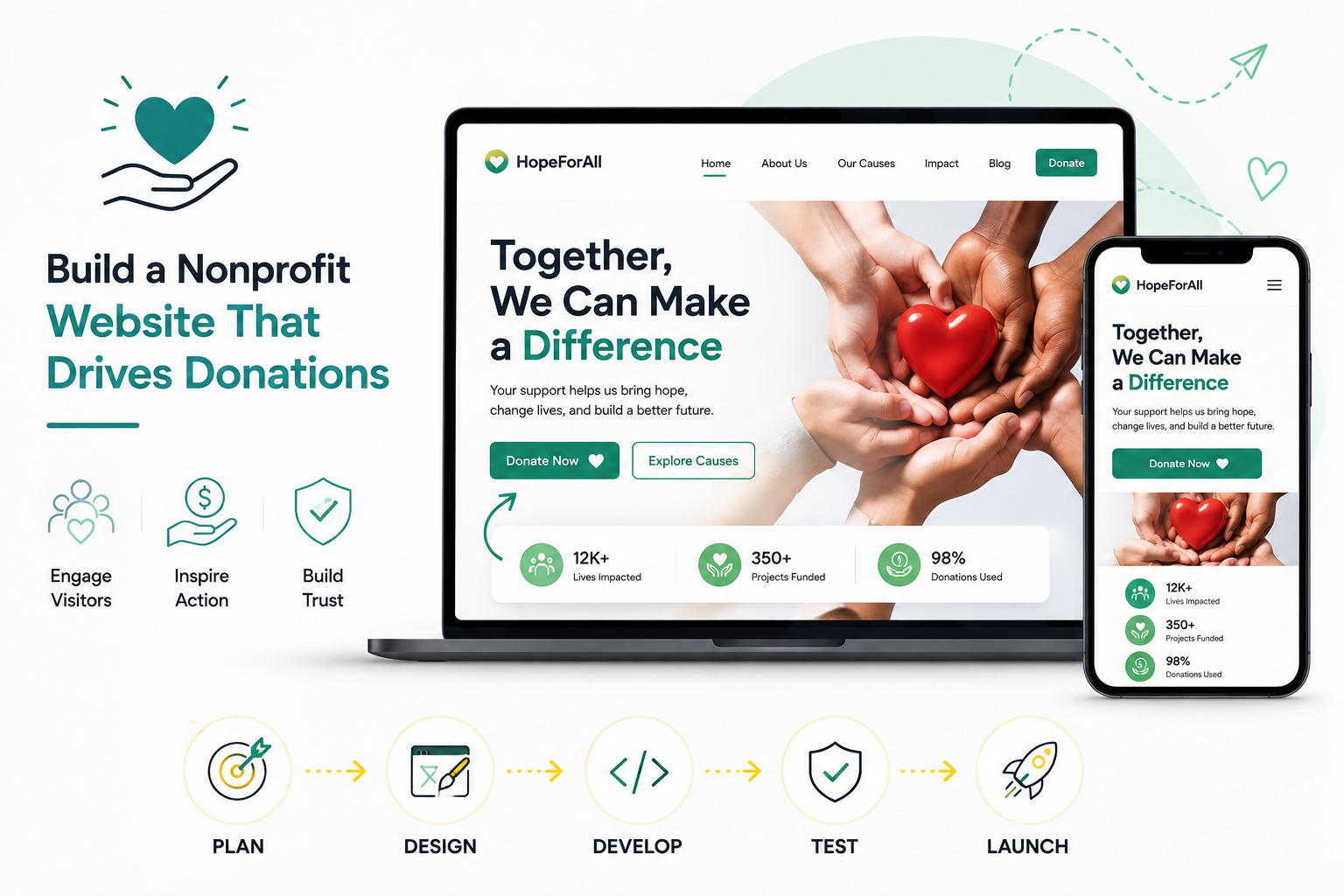
The homepage should communicate the cause, its urgency, and the impact of a donation within the first screen of content. A strong headline, a short emotionally resonant description, real impact figures where available, and a prominent donate button above the fold. Visitors should never have to scroll to find a way to give. Social proof elements — number of donors, total raised, testimonials — work well here to establish legitimacy quickly.
Donation Page
The donation page is the most critical page on the entire site. It should be distraction-free, with a clean form that asks only for what is necessary. Pre-set donation amounts with impact descriptions — "£25 provides school supplies for one child for a year" — consistently outperform open input fields alone. Offer a one-time and a recurring donation option prominently. Every element that is not directly related to completing the donation should be removed from this page.
About / Our Mission Page
Many first-time donors visit the about page before they commit to giving. This page needs to explain who runs the organisation, what they do, how long they have been operating, and — critically — what percentage of donations goes directly to the cause versus operational costs. Transparency on this point is one of the strongest trust signals a charity website can offer.
Impact or Projects Page
Donors want to see what their money does. An impact page with real stories, photographs, and outcome statistics connects the abstract act of donating to tangible results in the world. Update this page regularly. Stale impact reports with three-year-old photographs send a quiet signal that the organisation may not be active, which is the last impression you want a potential donor to have.
Thank You and Confirmation Page
The post-donation experience matters more than most organisations realise. A personalised thank you page that confirms the donation amount, explains what happens next, and invites the donor to share the campaign on social media turns a completed transaction into a potential advocacy moment. Pair this with an immediate confirmation email that includes a receipt and a short human message from the organisation.
Choosing Your Platform or Development Approach

The platform decision for a donation website carries more weight than for a typical business site because payment processing, data security, and compliance requirements come into play. There are three main paths available.
Approach Best For Payment Handling Design Control Transaction Fees Crowdfunding Platforms (GoFundMe, JustGiving) One-off campaigns, individuals Built-in Minimal High (5–8%) Nonprofit Platforms (Donorbox, Givebutter) Small to mid-size nonprofits Built-in Embed only Low (1.5–2%) WordPress + Plugin (GiveWP, Charitable) Established nonprofits with content needs Via gateway integration Theme-limited Gateway rates only Custom Built (React / Next.js) Established organisations, large campaigns Direct API integration Complete Gateway rates only
Crowdfunding platforms offer instant setup but take a significant cut of every donation and give you almost no control over branding or donor data. For a one-off personal campaign this trade-off is acceptable. For any organisation that plans to fundraise repeatedly over time, paying 5 to 8 percent of every donation to a platform is a significant ongoing cost that compounds quickly.
Dedicated nonprofit platforms like Donorbox and Givebutter sit in a sensible middle ground. They handle payment processing, recurring donations, donor management, and receipt generation at much lower fees, and their embeddable forms integrate into any existing website. The limitation is that your donation experience lives inside their widget, which means your design control ends at the widget boundary.
A fully custom-built donation website gives an organisation complete ownership over the donor experience, the data, the design, and the payment flow. Integrating directly with Stripe or PayPal's API means you pay only standard gateway processing rates — typically around 1.4 to 2.9 percent depending on the provider and transaction volume — with no additional platform fees. For high-volume fundraising campaigns this difference in fees alone can amount to tens of thousands of pounds or dollars annually.
Payment Gateway Integration for Donation Websites
Selecting and integrating the right payment gateway is the most technically sensitive part of building a donation website. Donors are trusting you with their card details; the gateway you choose determines how that data is handled, what currencies and payment methods you can accept, and what compliance obligations your organisation must meet.
Stripe
Stripe is the most widely used payment gateway for custom-built donation websites and for good reason. Its API is developer-friendly, it supports recurring payments natively, and it offers Stripe for Nonprofits — a discounted fee structure for registered charitable organisations. Stripe handles PCI DSS compliance on the payment side, meaning donor card data never touches your server directly. It supports over 135 currencies and a wide range of local payment methods including Apple Pay, Google Pay, and bank transfers.
PayPal Giving Fund
PayPal's Giving Fund programme waives processing fees entirely for registered nonprofits in several countries. The donor recognition is high — PayPal is a brand most internet users trust — and the checkout experience is familiar. The downside is that PayPal's API is less flexible than Stripe's for building highly customised donation flows, and some donors prefer not to create or log into a PayPal account to complete a donation.
Local and Regional Gateways
Organisations operating primarily in specific markets should consider whether a local gateway offers better rates or higher conversion for their audience. In Pakistan, for example, JazzCash and EasyPaisa have high adoption among mobile users. In South Asia broadly, Razorpay covers a wide range of payment methods. Supporting familiar local payment options alongside international card processing can meaningfully increase donation completion rates from regional audiences.
Donation Form Design: What Actually Converts
The donation form is where the psychological and technical work either pays off or falls apart. Research from the Nonprofit Technology Network and organisations like Blackbaud consistently shows that form design has a direct, measurable impact on completion rates and average gift size.
Pre-set Donation Amounts
Offering three to four pre-set amounts with short impact descriptions performs better than an open input field alone. The impact descriptions do important work: "£10 feeds a family for a week" anchors the donor's decision in real-world outcomes rather than abstract numbers. Always include a custom amount option for donors who want to give more or less than the suggested amounts.
One-Time vs Recurring Toggle
Defaulting the form to recurring monthly giving, rather than one-time, consistently increases the proportion of recurring donors. This is one of the highest-value design decisions on the entire site because a recurring donor is worth many times more over their lifetime than a single-gift donor. Make the toggle prominent but not confusing, and be clear about how easy it is to cancel a recurring donation — this reassurance reduces hesitation significantly.
Minimal Required Fields
Ask only for what you genuinely need to process the donation and issue a receipt. First name, last name, email address, and payment details are the baseline. Every additional field — phone number, postal address, date of birth — adds friction and reduces completion rates. If you need additional information for compliance or gift aid purposes, collect it on a secondary step after the payment is confirmed rather than before.
Trust Signals on the Form Page
Security badges, SSL indicators, and charity registration numbers displayed near the payment fields directly reduce donation abandonment. A short line of copy such as "Your payment is encrypted and secure" near the submit button does measurable work. If your organisation is registered with a national charity regulator, display that registration number clearly.
Security and Compliance Requirements
Any website that processes financial transactions carries compliance obligations. For donation websites these fall into two main areas: payment security and data protection.
Requirement What It Means Who It Applies To Handled By PCI DSS Card data must never be stored on your server without proper certification Any site accepting card payments Payment gateway (Stripe, PayPal) SSL Certificate All data transmitted between donor and server must be encrypted Every website, mandatory for payment pages Hosting provider GDPR / Data Protection Donor data must be collected with consent and stored securely Orgs with EU/UK donors Organisation + developer Gift Aid Compliance (UK) Gift Aid declarations require specific wording and record-keeping UK registered charities Form design + CRM Anti-Fraud Measures Protect against card testing and fraudulent transactions All donation sites Gateway + reCAPTCHA
Using a reputable payment gateway like Stripe handles the most technically complex compliance requirements automatically. Card numbers are tokenised client-side before transmission, meaning your server only ever receives a token — not the actual card data. This removes the heaviest PCI DSS burden from your development team. What remains is your responsibility to protect donor personal data, collect appropriate consents, and ensure the site itself is served over HTTPS at all times.
Donor Management and CRM Integration
A donation website that does not connect to a donor management system is leaving significant value on the table. Every completed donation should automatically create or update a donor record, log the gift amount and date, and trigger a receipt email. Over time, this data tells you who your most engaged donors are, which campaigns drove the most first-time gifts, and which donors are lapsing and need re-engagement.
Dedicated nonprofit CRMs like Salesforce Nonprofit Success Pack, Bloomerang, or Little Green Light integrate with Stripe and PayPal via webhooks or direct API connections. For smaller organisations, even a well-structured spreadsheet-based system connected through tools like Zapier provides basic donor tracking until a full CRM is justified by volume.
Email marketing integration deserves particular attention. Connecting your donation form to a platform like Mailchimp, ConvertKit, or ActiveCampaign allows you to segment donors by gift size, frequency, and campaign, and send targeted follow-up communications that are relevant to their giving history. Donors who receive personalised stewardship communications give again at significantly higher rates than those who receive only transactional receipts.
Campaign Pages and Fundraising Goals
Beyond the core donation infrastructure, many organisations need the ability to create individual campaign pages with specific fundraising goals and deadlines. A progress bar showing how close a campaign is to its target creates urgency and social proof simultaneously. Donors are more likely to give when they can see that others have already contributed and that the goal is within reach.
Campaign pages should be shareable by design. Each one needs a distinct URL, a social sharing preview image, and pre-written share copy that supporters can post with a single click. Peer-to-peer fundraising — where individual supporters create their own personal fundraising pages linked to the main campaign — is a feature that can multiply reach dramatically if your audience is engaged enough to participate.
Related Services
Building a donation website that earns donor trust, processes payments securely, and converts visitors into recurring supporters requires expertise across development, design, and optimisation. Munix Studio provides the technical foundation and user experience thinking that charitable organisations and nonprofits need to build a donation platform that works.
Website Development — Custom donation websites built with secure payment gateway integration, recurring donation support, and campaign page functionality.
UI/UX Design — Donation form and page design optimised for trust, minimal friction, and maximum conversion from first-time visitors.
SEO Optimization — Search visibility for your cause so that people actively looking to donate to organisations like yours find your website first.
Maintenance and Support — Ongoing security monitoring, payment integration updates, and performance maintenance to keep your donation platform running reliably.
Digital Marketing — Donor acquisition campaigns, social media fundraising, and paid advertising strategies that drive traffic to your donation pages.
Frequently Asked Questions
Ready to Get Started?
Website Development
Custom donation websites with secure payment gateway integration, recurring donation flows, campaign pages, and donor management connectivity built from the ground up.
Explore Website DevelopmentUI/UX Design
Donation page and form design optimised to build donor trust, reduce abandonment, and increase average gift size through clear, conversion-focused layouts.
Explore UI/UX DesignSEO Optimization
Search optimisation for nonprofit and charity websites so donors actively searching for causes like yours find your donation pages before your competitors.
Explore SEO OptimizationMaintenance and Support
Ongoing security updates, payment gateway maintenance, and performance monitoring to ensure your donation platform stays reliable and secure.
Explore Maintenance and SupportDigital Marketing
Donor acquisition campaigns, Google Ad Grants management, and social fundraising strategies that drive qualified traffic to your donation pages.
Explore Digital MarketingRelated Articles
What is Website Development? The Complete Guide for Beginners
How Are Modern Websites Built in 2026?

Website Development Process & Life Cycle : Complete Guide
How Websites Work: DNS, Servers, Browsers
What is Website Architecture? Best Practices