What Is a Direct Booking Website?
A direct booking website is a site that allows customers to reserve, schedule, or purchase a service or experience without going through a third-party platform. Hotels that take reservations without Booking.com, tour operators that sell without Airbnb Experiences, salons that schedule without Fresha, and consultants that book calls without Calendly all operate direct booking websites at their core. The defining characteristic is ownership: the business controls the booking flow, retains the full revenue, and owns the customer relationship from the first interaction.
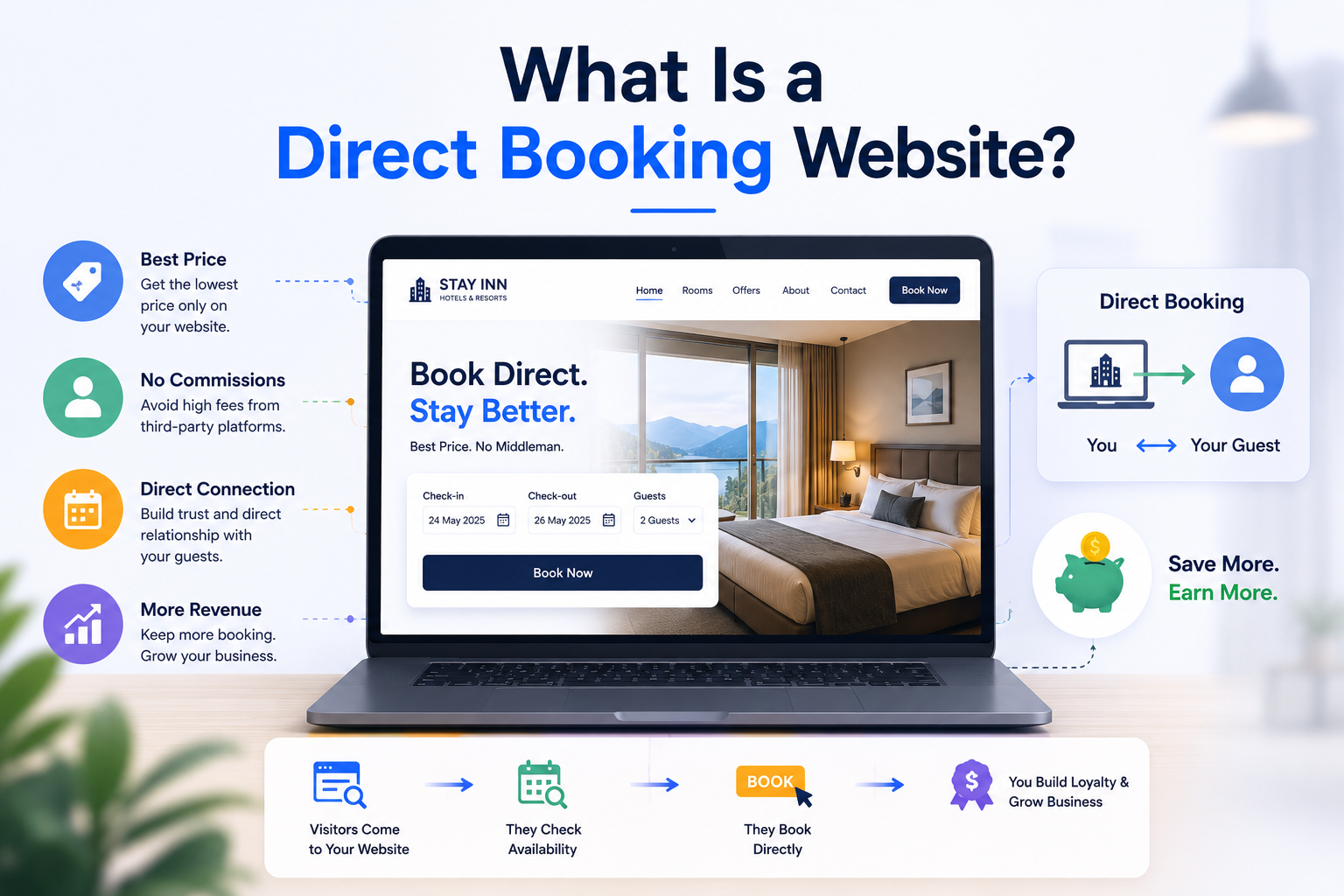
Third-party booking platforms offer genuine value, particularly in the early stages of a business when marketplace visibility accelerates discovery. But that value comes at a cost that compounds over time. Commission rates of fifteen to thirty percent on every booking, customer data that belongs to the platform rather than the business, and a brand experience that puts the platform front and centre rather than the business itself all represent long-term structural disadvantages for any business that relies on third-party platforms exclusively.
A well-built direct booking website eliminates these disadvantages. It captures the full booking revenue, builds a proprietary customer database that the business owns, enables a branded experience that reinforces the business identity at every step, and creates the foundation for direct marketing to repeat customers without paying a platform for the privilege. This guide covers every decision involved in building one from the ground up.
Direct Booking vs Third-Party Platforms: The Full Picture
Before committing to a direct booking strategy, it is worth understanding the trade-offs honestly. The goal for most businesses is not to abandon third-party platforms entirely but to reduce dependence on them progressively by building a direct channel that grows over time. The comparison below covers both sides of that decision.
Factor Third-Party Platform Direct Booking Website Commission per booking 15% to 30% of booking value Payment processing only (1.5% to 3%) Customer data ownership Platform owns the relationship Business owns all customer data Brand experience Platform brand dominates Fully branded throughout Discovery and visibility Built-in marketplace audience Requires SEO and marketing investment Repeat booking cost Full commission on every repeat booking Zero acquisition cost for repeat customers Pricing control Often constrained by platform policies Full control over pricing and offers Review and reputation control Reviews live on platform, not transferable Reviews collected directly on own platform Setup time Hours to days Weeks to months for custom build Long-term business value Builds platform's asset, not yours Builds a proprietary revenue asset
The strategic case for building a direct booking website strengthens with every repeat customer the business serves. A hotel paying Booking.com twenty percent commission on a guest who stays three times a year for five years pays a significant and entirely avoidable ongoing cost for a relationship the business already owns. The investment in a direct booking site is a one-time cost that produces compounding returns as the direct channel grows.
Step 1: Define Your Booking Model and Requirements
Direct booking websites serve an enormous range of business types with fundamentally different booking requirements. A holiday rental property needs date-based availability, nightly rate calculation, and a multi-step checkout. A yoga studio needs class scheduling with capacity limits and a membership plan integration. A consultant needs a simple calendar with buffer time between appointments and a pre-call questionnaire. A restaurant needs table reservation by party size, time slot, and dietary requirement notes.
Defining the booking model before any technology decisions are made prevents the common failure of choosing a platform or booking tool that cannot handle the specific requirements of the business and requiring an expensive rebuild six months later. The questions to answer upfront are: what is being booked, how is availability defined, what information does the business need from the customer at the point of booking, how is payment taken and when, what confirmation and reminder communications are needed, and what constitutes a cancellation or modification request.
Business Type Booking Unit Key Requirements Payment Timing Hotel or rental property Night or date range Calendar availability, dynamic pricing, room types Deposit on booking, balance on arrival Tour operator or activity Session or package Capacity limits, departure dates, add-ons Full payment at booking Salon or clinic Appointment slot Staff assignment, service duration, cancellation policy Card on file or in-person Consultant or coach Time slot Calendar sync, buffer time, intake form Upfront or invoice post-call Restaurant Table reservation Party size, time slot, dietary notes, no-show deposit Deposit or card hold Fitness or wellness studio Class or session Class capacity, waitlists, membership plans, credits Membership recurring or credit pack Event or venue hire Date block Enquiry form, site visits, custom quotes Deposit to hold, staged payments
Step 2: Choose the Right Technology Stack
The technology architecture of a direct booking website is more complex than a standard business site because it needs to handle real-time availability, payment processing, customer account management, automated communications, and a back-office management interface simultaneously. The stack needs to be chosen with all of these requirements in mind, not just the front-facing booking experience that customers see.
Build vs Integrate: The Core Architecture Decision
There are two architectural approaches to a direct booking website. The first is to build a custom booking system from scratch, where every aspect of availability management, payment processing, and customer communication is built specifically for the business. The second is to build a custom-designed frontend on React and Next.js and integrate a specialist booking engine via API to handle the availability and transaction logic behind it. The second approach is the right choice for the vast majority of businesses because it combines the brand experience and SEO performance of a custom site with the battle-tested reliability of purpose-built booking infrastructure.
Approach Advantages Drawbacks Best For Fully custom build Complete control, no third-party dependency Very high cost, long build time, complex maintenance Large enterprises with unique requirements Custom frontend + booking API Best UX and branding, reliable booking logic, faster build API dependency, some feature constraints Most serious businesses Embedded booking widget Fastest to implement, low cost Poor brand consistency, limited customisation Early stage, low budget All-in-one booking platform Everything included, minimal setup Poor SEO, generic design, ongoing subscription cost Businesses not prioritising organic growth
Recommended Technology Stack
Layer Recommended Tool Purpose Frontend framework Next.js SSR for SEO, fast page delivery, component architecture Payment processing Stripe Card payments, deposits, refunds, subscriptions Database PostgreSQL via Supabase Availability, booking records, customer data Authentication Supabase Auth or Clerk Customer accounts, booking history, repeat booking Email notifications Resend or SendGrid Booking confirmations, reminders, cancellations Calendar sync Google Calendar API Two-way calendar sync for staff and resources CMS Sanity Service pages, blog, marketing content management Deployment Vercel Global CDN, ISR for content pages, serverless API routes
Step 3: Build an Availability and Booking Flow That Converts
The booking flow is the most commercially critical part of a direct booking website. Every step of unnecessary friction between a customer deciding they want to book and successfully completing the reservation is a step where that customer might abandon the process and return to a third-party platform where the booking experience is already familiar. A direct booking flow needs to be as smooth as or smoother than the platform alternative to compete effectively for customer behaviour.
The Six Stages of an Effective Direct Booking Flow
Availability display — The customer needs to see what is available without ambiguity. A real-time availability calendar or schedule that reflects current bookings, blocks, and any pricing variations by date or slot gives customers the information they need to make a selection without contacting the business first. Availability that requires a phone call or email to confirm loses a significant proportion of customers who expect to complete the booking independently.
Selection and configuration — Once the customer has selected a date, time, or session, they need to configure the booking to their specific requirements: number of guests or attendees, service type, add-ons, special requests, or any other variables relevant to the booking. This step should be presented as a natural continuation of the selection, not as a separate form that appears after the customer thought they were nearly done.
Pricing summary — Before asking for payment details, the customer needs a clear, itemised summary of what they are paying for. Surprises at this stage, such as unexpected fees or a total that does not match the displayed rate, are among the most common causes of booking abandonment. Transparency at the pricing summary stage builds trust and reduces drop-off immediately before the payment step.
Account creation or guest checkout — Requiring account creation before completing a booking is a significant conversion barrier. Offering a guest checkout with an optional prompt to save details for future bookings after payment is confirmed maximises first-time conversion while still building the customer account base over time.
Payment processing — The payment step needs to feel secure, load quickly, and support the payment methods the target audience uses. Stripe's Payment Element handles card, Apple Pay, Google Pay, and local payment methods through a single integration that maintains visual consistency with the surrounding booking flow rather than redirecting customers to a separate payment gateway page.
Confirmation and next steps — An immediate booking confirmation page and confirmation email sets the expectation for what happens next: what the customer needs to do before the booking, what to bring, where to go, how to modify or cancel, and how to contact the business if they have questions. This step is the first impression of the post-booking relationship and is worth investing in properly.
Step 4: Handle Payments, Deposits, and Cancellations
Payment handling on a direct booking website is more complex than a standard ecommerce checkout because bookings often involve deposits rather than full upfront payment, cancellation policies that trigger partial or full refunds under specific conditions, and in some cases recurring payments for membership or retainer arrangements. Each of these scenarios needs to be handled correctly at the technical level and communicated clearly at the customer-facing level.
Payment Scenario Stripe Implementation Customer Communication Full payment at booking Payment Intent, charge immediately Receipt and booking confirmation email Deposit plus balance Charge deposit, save card for balance Deposit receipt, balance due date communicated clearly Card hold, charge on arrival Payment Intent with capture_method: manual Explain hold clearly, confirm no charge until service Recurring membership Stripe Subscriptions with billing cycle Recurring amount, renewal date, cancellation process Refund on cancellation Stripe Refunds API with policy-based logic Policy stated at booking, refund confirmation email No-show fee Saved payment method, charge via Payment Intent No-show policy stated at booking, notification before charge
Step 5: Design for Trust at Every Stage of the Booking Journey
A customer booking directly with a business for the first time is making a trust decision at every stage of the process. They are considering whether the business is legitimate, whether their payment details are safe, whether the booking will be honoured, and whether they will have recourse if something goes wrong. Third-party platforms provide implicit answers to all of these questions through their established brand and dispute resolution processes. A direct booking website needs to provide explicit answers through deliberate trust architecture.
Security indicators — HTTPS throughout the site, Stripe's trusted payment interface, and visible security badges near the payment step reassure customers that their card details are handled safely. The absence of these signals is conspicuous and creates doubt at exactly the moment when confidence is most needed.
Verified reviews displayed prominently — Reviews from past customers sourced from Google, Trustpilot, or collected directly through post-booking surveys give prospective customers social proof that the booking experience and the service itself deliver what the site promises.
Clear cancellation and refund policy — Stating the cancellation policy in plain language before the payment step, not hidden in terms and conditions, removes a major source of hesitation for first-time bookers. A fair and clearly stated policy increases bookings even when the terms are not the most generous in the market.
Named contact and support options — A visible phone number, email address, or live chat option that allows the customer to ask a question before committing to a booking reduces the number of customers who abandon the process because they have an unanswered concern. The contact option does not need to be used frequently to be valuable. Its presence alone reduces doubt.
Instant confirmation — An immediate on-screen confirmation message and a booking confirmation email delivered within seconds of payment provides the reassurance that the booking was received and recorded. A delay of even a few minutes in the confirmation email is enough to generate customer service contacts from anxious first-time bookers.
Step 6: Build a Customer Account System for Repeat Bookings
One of the most significant advantages a direct booking website has over a third-party platform is the ability to build a direct relationship with every customer who books. That relationship only becomes commercially valuable if the business has the infrastructure to maintain it. A customer account system that stores booking history, saves payment preferences, and allows customers to rebook in seconds rather than re-entering all their details is the primary mechanism for converting first-time bookers into loyal repeat customers.
The repeat booking experience should be dramatically faster than the first booking. A returning customer who can log in, see their previous bookings, select the same service or a new date with a single click, and pay with a saved card without re-entering any information is experiencing a booking flow that competes with or beats the convenience of any third-party platform. That convenience is what builds the direct booking habit that makes the entire investment worthwhile.
Step 7: Optimise for Search to Drive Direct Traffic
A direct booking website with no organic search visibility depends entirely on paid advertising or social media to drive traffic, which reintroduces the cost-per-acquisition problem that the direct booking model is meant to solve. Building organic search visibility through a deliberate SEO strategy is what transforms a direct booking site from a booking mechanism into a sustainable customer acquisition channel.
Service pages and location pages are the most important SEO assets on a direct booking site. Each service offered should have a dedicated page that describes the service in depth, answers the questions a prospective customer has before booking, and includes a clear call to action that leads directly into the booking flow. Each location or area served should similarly have its own page that targets the location-specific search queries prospective customers use when looking for a bookable service in a specific area.
SEO Page Type Target Query Booking Conversion Role Priority Service page [service] booking or [service] near me Primary conversion page Critical Location page [service] in [city] or [city] [service] Local intent capture, direct to booking Critical Homepage Brand name, generic category queries Brand entry point, routes to service pages High FAQ page Pre-booking questions, how does X work Resolves objections, links to booking flow High Blog and guides Informational queries related to the service Awareness, internal links to service pages Medium Reviews page [business] reviews, is [business] good Trust building, captures validation-stage searchers Medium
Step 8: Set Up Automated Communications That Reduce No-Shows
No-shows are the most expensive operational problem a booking-based business faces. A confirmed reservation that is not honoured represents lost revenue that cannot be recovered if the slot cannot be filled at short notice. Automated communications are the most effective tool for reducing no-show rates and their implementation should be planned as a core part of the booking system architecture rather than an afterthought.
Immediate booking confirmation — Sent within seconds of payment confirmation, containing all booking details, the cancellation policy, and instructions for what to do before the appointment.
72-hour reminder — Sent three days before the booking with the details, a link to modify or cancel if needed, and any preparation instructions. This reminder catches customers who have forgotten the booking with enough notice to reschedule rather than simply not showing up.
24-hour reminder — Sent the day before with the booking details, directions or access instructions, and a final cancellation window if the policy allows same-day cancellations. This reminder is the single most effective no-show reducer in most business contexts.
Post-booking review request — Sent twenty-four to forty-eight hours after the booking is completed, asking the customer to leave a review and providing a direct link to the preferred review platform. Timing this while the experience is still fresh produces significantly higher response rates than requests sent days later.
Rebooking prompt — Sent at an interval relevant to the booking type, a reminder to rebook is one of the most cost-effective retention tools available. A hair salon sending a rebooking prompt six weeks after the last appointment, or a personal trainer following up at the end of a programme block, recovers customers who intended to rebook but had not gotten around to it.
Step 9: Measure Performance Beyond Booking Volume
Booking volume is the most visible metric on a direct booking website but it is not the most useful one for identifying where to invest improvement effort. The metrics that reveal the health of the direct booking operation are those that connect traffic to bookings to revenue to customer lifetime value.
Metric What It Reveals Action If Low Booking conversion rate % of visitors who complete a booking Audit booking flow for friction, improve trust signals Booking abandonment by step Where in the flow customers drop off Fix the specific step causing abandonment Direct vs platform booking ratio How effectively the direct channel is growing Invest in SEO and direct booking incentives Repeat booking rate % of customers who rebook directly Improve post-booking communication and rebooking flow No-show rate % of confirmed bookings not honoured Strengthen reminder sequence or introduce no-show deposit Revenue per visitor Total booking revenue divided by total site visitors Improve conversion rate or attract higher-intent traffic
How We Work
At Munix Studio, every direct booking website project begins with a booking architecture session where we map the booking model, define the availability logic, plan the payment and cancellation flows, and design the customer communication sequence before a single component is built. We treat the booking flow as the commercial core of the site and invest the technical and design effort accordingly.
Our development team builds direct booking websites on React and Next.js with Stripe for payment processing, Supabase for availability and customer data, automated email sequences for confirmations and reminders, customer account portals for repeat booking, and SEO foundations built into every service and location page. Every project is delivered as a complete direct booking system, not just a website with a contact form.
Build Your Direct Booking Website With Munix Studio
A direct booking website is the most valuable digital asset a service business can own. At Munix Studio we build direct booking systems that cut commission costs, own the customer relationship, and generate organic bookings through search without paying a platform for every reservation.
Website Development — Custom direct booking websites built on React and Next.js with Stripe payment integration, real-time availability, customer accounts, and automated booking communications from day one.
UI/UX Design — Conversion-first booking flow design that guides customers from availability selection to confirmed payment with minimal friction and maximum trust at every step.
SEO Optimization — Service and location page SEO strategy that drives organic direct bookings from high-intent local and service-specific search queries without platform dependency.
App Development — Native mobile booking applications for businesses that want to offer direct booking, appointment management, and push notification reminders in a dedicated app experience.
Maintenance and Support — Ongoing booking system maintenance, payment integration updates, availability logic refinements, and performance monitoring to keep your direct booking pipeline operating at full capacity.
Frequently Asked Questions
Ready to Get Started?
Website Development
Custom direct booking websites built on React and Next.js with Stripe payment integration, real-time availability, customer account portals, and automated booking communications from day one.
Explore Website DevelopmentUI/UX Design
Conversion-first booking flow design that takes customers from availability selection to confirmed payment with minimal friction and maximum trust at every stage of the journey.
Explore UI/UX DesignSEO Optimization
Service and location page SEO strategy that drives organic direct bookings from high-intent local and service-specific search queries without depending on platform traffic.
Explore SEO OptimizationApp Development
Native mobile booking applications for businesses that want direct booking, appointment management, and push notification reminders in a dedicated app experience.
Explore App DevelopmentMaintenance and Support
Ongoing booking system maintenance, payment integration updates, availability logic refinements, and performance monitoring to keep your direct booking pipeline running at full capacity.
Explore Maintenance and SupportRelated Articles
What is Website Development? The Complete Guide for Beginners
How Are Modern Websites Built in 2026?

Website Development Process & Life Cycle : Complete Guide
How Websites Work: DNS, Servers, Browsers
What is Website Architecture? Best Practices