You can publish the best content in your industry and still rank nowhere. If search engines cannot crawl your pages, cannot understand your site structure, or find that your pages load slowly on mobile, the content quality is irrelevant. Technical SEO is the foundation that determines whether everything else you do in SEO actually works. Without it, your investment in content and links builds on unstable ground.
This guide explains what technical SEO is, why it matters, what the most important factors are in 2025, what issues commonly damage rankings, and how to measure whether your technical foundation is sound. It is written for both business owners who need to understand the business case and developers or marketing managers who need enough depth to take action.

What Is Technical SEO in Plain Language
Technical SEO refers to the work done on a website's infrastructure — the code, server configuration, site architecture, and performance characteristics — to make it easier for search engines to find, crawl, understand, and index the site's content. It has nothing to do with what you write and everything to do with how your site is built and how it behaves.
Think of it this way. A search engine like Google sends automated programs called crawlers to visit websites and read their content. If your site has pages that block crawlers, links that go nowhere, content that loads too slowly, or a structure that makes it unclear which pages are most important, the crawler leaves with an incomplete or inaccurate picture of your site. The result is poor indexation, weak rankings, and organic traffic that consistently underperforms relative to the quality of your content.
Technical SEO fixes the conditions under which search engines operate on your site. It removes obstacles. It provides signals. It ensures that when Google visits, it can do its job completely and accurately.
Why Technical SEO Matters for Rankings and User Experience
Google has been explicit that user experience is a ranking factor. Core Web Vitals — a set of metrics measuring loading speed, visual stability, and interactivity — are part of Google's ranking algorithm. A site that loads slowly, shifts layout elements after they appear, or takes too long to respond to user input is penalised in rankings relative to competitors whose pages perform better on these metrics. Technical SEO and user experience are not separate concerns — they overlap significantly.

Beyond user experience, technical SEO affects how efficiently Google allocates its crawl budget across your site. Every site gets a limited number of crawl requests from Google in a given period. If a large portion of that budget is consumed by duplicate pages, broken links, redirect chains, or low-value URLs that should not be indexed, important pages get crawled less frequently. On large sites, this directly impacts how quickly new content appears in search results after publication.
For business owners, the practical implication is this: technical SEO problems are silent. Unlike a broken form or a missing page, technical SEO issues rarely surface as visible errors. They simply suppress your rankings quietly, month after month, while your content and link building investment produces a fraction of the return it should.
The Three Pillars of SEO and Where Technical SEO Fits
SEO is built on three pillars: technical SEO, content, and backlinks. These are sometimes called the three kings of SEO. Each one is necessary. None is sufficient on its own. A site with excellent technical foundations but no quality content has nothing worth ranking. A site with great content and links but poor technical infrastructure will be outranked by competitors with equivalent content and a cleaner technical setup. Understanding how the three interact is essential to building a strategy that produces compounding results.
Technical SEO is the foundation. Content is what you build on that foundation. Backlinks are the external signals that tell Google your content is worth ranking above competitors. The sequence matters — technical issues should be resolved before significant content investment or link acquisition begins, because both are partially wasted when the technical foundation is unsound.
Technical SEO for Developers: What to Build Into Every Project
Most technical SEO guides are written for marketers who hand recommendations to developers. This section is written for the developer who needs to understand what to build correctly from the start, because retrofitting technical SEO onto a live application is significantly more expensive than building it in from day one.
Rendering Strategy Is the Most Important Decision You Make
Before writing a single component, decide how your application renders content. This single architectural decision determines how easily Google can crawl and index your pages.
Server-side rendering means the server generates complete HTML before sending it to the browser. Google's crawler receives a fully readable page on first request with no JavaScript execution required. This is the most crawl-friendly rendering approach and is what Next.js provides by default with its App Router.
Static site generation pre-renders pages at build time and serves them as static HTML files from a CDN. This is even more crawler-friendly than SSR and delivers the best possible Core Web Vitals scores because there is no server processing time per request. Use this for pages whose content does not change on every request.
Client-side rendering means the server sends a nearly empty HTML shell and JavaScript builds the page in the browser. Google can process JavaScript, but it does so in a second crawl wave that can delay indexation by days or weeks. For pages that need to rank, CSR alone is a mistake. If you are building in React without Next.js, you are likely using CSR and your pages are taking longer to index than they should.
Metadata Implementation in Code
In a Next.js application, metadata is generated through the Metadata API in the App Router. Each page or layout exports a metadata object or a generateMetadata function for dynamic pages. Every page that needs to rank should have a unique title, description, and canonical URL defined in code rather than relying on a default fallback.
The canonical URL is particularly important in JavaScript applications because dynamic routing can create multiple URL paths that render the same content. Define the canonical explicitly on every page rather than assuming the framework handles it correctly by default.
Structured Data in a JavaScript Application
Structured data in a Next.js or React application is implemented by injecting a JSON-LD script tag into the page head. This is cleaner than microdata markup and easier to maintain. The most commonly needed schema types for a business site are Organization, WebPage, Article, FAQPage, BreadcrumbList, and LocalBusiness. Implement these as a reusable component that accepts the relevant data as props and renders the script tag consistently across all pages that need it.
robots.txt and Sitemap Configuration
In Next.js 13 and above, both robots.txt and sitemap.xml are generated programmatically through the app directory. Create a robots.ts file at the app root that explicitly allows Googlebot and disallows any application routes, dashboard paths, or authenticated sections that should not be indexed. Create a sitemap.ts file that generates the complete list of indexable URLs dynamically.
Do not leave either file as a static file if your site has dynamic content. A static sitemap goes stale and begins including URLs that no longer exist or missing URLs that were recently created.
Core Web Vitals That Developers Control Directly
Largest Contentful Paint is determined primarily by how quickly the largest visible element on the page loads. Developers control this through image optimization using the Next.js Image component which handles lazy loading, modern format serving, and size optimization automatically, through eliminating render-blocking resources by deferring non-critical scripts, and through reducing server response time.
Cumulative Layout Shift is caused by elements that move after the page initially renders. The most common causes are images without explicit width and height attributes, dynamically injected content above existing content, and web fonts that cause text to reflow when they load. Set explicit dimensions on all images and use font-display swap with a matching fallback font to minimize layout shift during font loading.
Interaction to Next Paint measures responsiveness to user input. Long JavaScript tasks that block the main thread are the primary cause of poor INP scores. Break up long synchronous operations using setTimeout or requestIdleCallback, reduce the size of your JavaScript bundles through code splitting, and avoid blocking the main thread with heavy computation that could run in a Web Worker.
Technical SEO vs On-Page SEO vs Content SEO
These three terms are often used interchangeably, which creates confusion about what each actually involves and who is responsible for it. They are distinct disciplines with different scopes, different owners, and different timelines for showing impact.
Aspect Technical SEO On-Page SEO Content SEO What it involves Site speed, crawlability, indexation, structured data, mobile usability, HTTPS, site architecture Title tags, meta descriptions, heading structure, keyword placement, image alt text, internal linking Keyword research, content depth, topical authority, content planning, updating existing pages Who is responsible Developer + SEO specialist SEO specialist + content team SEO strategist + writers Tools used Screaming Frog, Google Search Console, PageSpeed Insights, Ahrefs Site Audit Semrush, Surfer SEO, Yoast, Google Search Console Semrush, Ahrefs, Google Trends, content management systems Impact timeline Weeks to months after fixes are implemented Weeks — faster than technical for individual pages Months — slowest but most durable Requires developer Almost always Sometimes Rarely
Technical SEO Definitions: A Glossary of Key Terms
Understanding technical SEO requires familiarity with a set of specific terms that are used consistently across the discipline. The definitions below cover the vocabulary you will encounter in audit reports, developer conversations, and Search Console data.
Crawlability refers to whether search engine bots can access and read the content of a page. A page may be publicly visible to users but still be uncrawlable if it is blocked by a robots.txt rule, protected behind a login, or rendered in a way that the crawler cannot process, such as client-side JavaScript without server-side rendering.
Indexation refers to whether a page has been added to Google's search index and can therefore appear in search results. A page can be crawlable but not indexed if it has a noindex directive, if Google determines it is low quality or duplicate, or if it has not yet been crawled since being published.
Crawl budget is the number of pages Google will crawl on your site within a given time period. Large sites need to manage crawl budget carefully because Google will not crawl every page on every visit. Wasting crawl budget on low-value URLs such as faceted navigation pages, empty tag archives, or duplicate content means important pages get crawled less frequently.
Canonical tag is an HTML element that tells Google which version of a page is the authoritative one when multiple URLs contain the same or similar content. It looks like this in the page head: rel canonical. Without canonical tags, Google must decide which version to index, and it may choose the wrong one or split ranking signals across multiple versions.
robots.txt is a text file at the root of a domain that instructs search engine crawlers which pages or sections of the site they are allowed to crawl. It does not prevent pages from being indexed if they are linked to from elsewhere. It only controls crawler access.
XML sitemap is a structured file that lists all the indexable URLs on a site, along with optional metadata about when each page was last modified. Submitting a sitemap to Google Search Console helps Google discover pages faster, particularly new content on large sites where internal linking alone may not surface every page quickly.
Core Web Vitals are a set of three performance metrics that Google uses as ranking signals. Largest Contentful Paint measures how long the largest visible element takes to load and should be under 2.5 seconds. Cumulative Layout Shift measures visual stability by tracking how much page elements shift during loading and should be below 0.1. Interaction to Next Paint measures how quickly the page responds to user input and should be under 200 milliseconds.
Structured data is code added to a page that describes its content in a format search engines can understand. It uses vocabulary from schema.org and is typically implemented as a JSON-LD script in the page head. Structured data enables rich results in Google search such as star ratings, FAQ accordions, recipe cards, and breadcrumb trails.
Redirect chain occurs when a URL redirects to a second URL that then redirects to a third URL before reaching the final destination. Each redirect in a chain adds latency and loses a small amount of link equity. Chains of three or more redirects are particularly harmful and should be collapsed into a single direct redirect from the original URL to the final destination.
Hreflang is an HTML attribute used to indicate the language and regional targeting of a page to search engines. It is essential for sites that publish content in multiple languages or target the same language in different regions, such as English for the US versus English for the UK. Incorrect hreflang implementation is one of the most common technical SEO issues on international sites.
Mobile-first indexing means Google primarily uses the mobile version of a site for indexing and ranking decisions rather than the desktop version. If your mobile site has less content, slower load times, or different structured data than your desktop version, your rankings are determined by the weaker mobile experience.
Log file analysis is the process of examining the raw server logs that record every request made to your server, including requests from search engine crawlers. Log file analysis reveals which pages Googlebot actually crawls, how frequently it crawls them, and which pages it ignores entirely. This data is more reliable than crawl simulations because it shows real crawler behaviour rather than estimated behaviour.
The Most Important Technical SEO Ranking Factors in 2025
The technical ranking factors that matter most have evolved over the past several years. Mobile-first indexing, Core Web Vitals, and HTTPS became non-negotiable. Structured data has grown in importance as Google's search results incorporate more rich features that pull from schema markup. The table below covers the factors with the greatest practical impact on rankings for most websites in 2025.
Factor What It Means How to Check It Priority Core Web Vitals LCP, INP, and CLS scores measuring load speed, interactivity, and visual stability PageSpeed Insights, Search Console Core Web Vitals report Critical Mobile Usability Google indexes the mobile version of your site first — mobile must be fully functional Search Console Mobile Usability report, Google Mobile-Friendly Test Critical HTTPS SSL certificate ensuring encrypted connection — a confirmed ranking signal since 2014 Browser address bar, SSL checker tools Critical Crawlability Whether Googlebot can access and read all important pages without being blocked Screaming Frog crawl, Search Console Coverage report Critical Indexation Control Ensuring only the right pages are indexed — no duplicate, thin, or parameter-generated URLs Search Console Index Coverage, site: search operator Critical Structured Data Schema markup that helps Google understand page content and enables rich results Google Rich Results Test, Search Console Enhancements report High Internal Linking How pages within your site link to each other — distributes authority and guides crawlers Screaming Frog, Ahrefs Site Audit High Canonical Tags Tells Google which version of a page is the authoritative one — prevents duplicate content dilution Screaming Frog, browser developer tools High XML Sitemap A structured file listing all indexable URLs — helps Google discover and prioritise pages Search Console Sitemaps report, direct URL check High Redirect Management Proper 301 redirects from old URLs — prevents link equity loss and crawler confusion Screaming Frog redirect chains report, server logs High
Common Technical SEO Issues That Hurt Rankings
Most technical SEO problems fall into a predictable set of categories. The issues below appear consistently across audits for sites of all sizes and industries. Knowing what to look for is the first step toward fixing what is suppressing your rankings.
Issue How It Hurts Rankings How to Fix It Slow page load speed Fails Core Web Vitals, increases bounce rate, direct negative ranking signal Compress images, enable browser caching, use a CDN, reduce render-blocking scripts Duplicate content Splits ranking signals across multiple URLs, confuses Google about which page to rank Implement canonical tags, consolidate duplicate pages, fix parameter-generated URLs Crawl errors and blocked pages Important pages not indexed, invisible to search engines regardless of content quality Audit robots.txt, fix noindex tags on important pages, resolve server errors Broken internal links Wastes crawl budget, breaks link equity flow, poor user experience Regular crawl audits with Screaming Frog, redirect or remove broken links Missing or misconfigured canonical tags Duplicate content issues, diluted page authority across versions Audit all canonical implementations, ensure self-referencing canonicals on all pages Redirect chains and loops Each redirect loses a small amount of link equity, chains compound the loss Identify chains with Screaming Frog, update to direct 301 redirects Poor mobile experience Google uses mobile-first indexing — a broken mobile experience directly suppresses rankings Responsive design, test with Google Mobile-Friendly Test, fix tap target sizing Missing structured data Misses rich result eligibility — lower click-through rates versus competitors with schema Implement relevant schema types: Article, FAQ, Product, LocalBusiness, BreadcrumbList Thin or unindexed pages bloating the index Wastes crawl budget, signals low overall site quality to Google Noindex low-value pages (tag archives, filtered pages), consolidate thin content
Common Technical SEO Mistakes Businesses Make
Beyond the specific issues above, certain patterns of poor decision-making appear consistently across technical SEO audits. These are the mistakes that tend to be systemic rather than isolated — they affect entire sections of a site rather than individual pages.
Launching a site without an SEO technical review is the most common and most costly mistake. Development teams optimise for functionality, not for search engine accessibility. A site can be technically flawless from an engineering perspective and riddled with SEO problems — JavaScript-rendered content that crawlers cannot read, pages blocked by a misconfigured robots.txt, no sitemap submitted to Search Console. These issues are far cheaper to address before launch than after.
Migrating a site without proper redirect mapping is the second most damaging mistake. Every time a URL changes — whether because of a platform migration, a domain change, or a site restructure — and the old URL does not redirect to the new one, you lose the ranking equity that URL had accumulated. Large migrations that handle redirects poorly can cause organic traffic to drop 40 to 60 percent and take a year or more to recover fully.
Over-relying on JavaScript frameworks without server-side rendering is a third significant mistake. React, Vue, and Angular applications that render content entirely in the browser create a situation where the crawler sees a blank page until JavaScript executes. Googlebot can process JavaScript, but it does so in a second crawl wave that can delay indexation by days or weeks. Server-side rendering or static generation — as provided by Next.js — eliminates this problem entirely.
Technical SEO for Ecommerce Websites
Ecommerce sites face a set of technical SEO challenges that are more severe than most other site types, primarily because of scale. A retailer with thousands of product pages creates thousands of opportunities for duplicate content, thin pages, and crawl waste if the technical architecture is not managed carefully.
Faceted navigation — the filter and sorting systems on category pages — is one of the biggest technical SEO problems in ecommerce. Every filter combination (colour, size, price range) typically generates a new URL with near-identical content. Left unmanaged, this creates hundreds or thousands of indexable duplicate pages that fragment link equity, dilute topical relevance, and consume crawl budget that should be spent on pages that can actually rank. The solution involves a combination of canonical tags, parameter handling in Search Console, and strategic use of noindex directives on filter combinations that have no standalone ranking value.
For Shopify specifically — the dominant ecommerce platform — the most persistent technical SEO issues include duplicate URLs generated by collection and product URL structures, the platform's handling of canonical tags which does not always follow best practice, limited control over robots.txt, and pagination implementation that can create indexation problems on large catalogues. These are solvable, but they require someone who knows the platform's specific architecture rather than applying generic technical SEO advice.
Technical SEO for SaaS and Startup Websites
SaaS and startup websites face a different technical SEO profile from ecommerce or content sites. The most common problem is that the marketing site and the product application share a domain — meaning a logged-in user interface sits on the same domain as the public-facing pages Google should be crawling and indexing. This creates situations where app pages, dashboard routes, and authenticated content are accidentally exposed to crawlers, consuming crawl budget and potentially causing indexation problems.
Startups building on modern JavaScript frameworks need to pay particular attention to rendering strategy from day one. A Next.js site with proper static generation or server-side rendering will outperform an identical site built as a client-rendered React app purely on the basis of how quickly and completely Google can index its content. This is a technical architecture decision made at the beginning of a project that has compounding SEO consequences for years afterward. Changing rendering strategy after launch is expensive and disruptive — building it right at the start costs almost nothing extra.
For B2B SaaS businesses, technical SEO matters because the conversion funnel typically starts with organic search — a potential buyer searching for a solution to a problem your product solves. If the technical foundations prevent your blog posts, comparison pages, and feature pages from ranking effectively, the entire inbound pipeline is throttled before it begins.
Technical SEO KPIs and How to Measure Performance
One of the legitimate challenges with technical SEO is demonstrating its value in terms that connect to business outcomes. Unlike content SEO, where you can track rankings and traffic for specific pages, the impact of technical fixes is often felt as an improvement across the entire site rather than attributable to a single change. The right KPIs acknowledge this while still providing meaningful measurement.
Crawl coverage rate — the percentage of your important pages that Google has crawled and indexed versus the total number of pages on your site. Tracked in Search Console's Coverage report.
Core Web Vitals pass rate — the percentage of pages that pass Google's LCP, INP, and CLS thresholds. Tracked in Search Console's Core Web Vitals report and PageSpeed Insights.
Index bloat ratio — the number of URLs Google has indexed divided by the number of pages that should be indexed. A ratio significantly above 1.0 indicates indexation of low-value or duplicate content.
Crawl error rate — the volume of 4xx and 5xx errors Google encounters when crawling your site, measured over time. A falling trend indicates improving technical health.
Average page load time by template — measuring load performance by page type (homepage, category, product, blog) rather than as a single site average reveals which templates need the most attention.
Organic click-through rate — improvements in structured data implementation and title tag quality show up as improvements in click-through rate from the same ranking positions. Tracked in Search Console's Performance report.
Technical SEO Manager: Role, Responsibilities, and Skills
A technical SEO manager is a specialist who owns the technical health of a website from a search performance perspective. The role sits at the intersection of marketing and engineering, requiring enough technical depth to work directly with developers and enough strategic understanding to translate technical findings into business impact.
Day-to-Day Responsibilities
The core activities of a technical SEO manager include running regular crawl audits using tools like Screaming Frog or Sitebulb to identify new technical issues before they affect rankings, monitoring Google Search Console for crawl errors, indexation drops, and Core Web Vitals regressions, writing technical specifications that describe exactly what developers need to implement for SEO fixes, and tracking the impact of implemented fixes through rank monitoring and traffic analysis.
On larger sites, a technical SEO manager also owns the SEO review process for major site changes. Any significant template change, platform migration, URL restructure, or new feature that affects how pages are crawled or rendered should go through a technical SEO review before deployment. Catching issues before they reach production is substantially cheaper than diagnosing and recovering from them after launch.
How the Role Differs From a General SEO Manager
A general SEO manager typically covers keyword research, content strategy, on-page optimisation, and performance reporting across all three pillars of SEO. A technical SEO manager goes much deeper on the infrastructure layer and typically has less involvement in content creation and link building. The technical SEO role requires the ability to read code, understand server architecture, interpret log files, and diagnose complex crawl budget problems on sites with thousands or millions of URLs.
Skills Required
The core skill set for a technical SEO manager includes proficiency with crawl audit tools, familiarity with HTML, CSS, and JavaScript sufficient to understand how rendering decisions affect crawlability, the ability to write and interpret regular expressions for URL pattern matching, log file analysis using tools like Screaming Frog Log Analyser, fluency with Google Search Console and Google Analytics data, and strong communication skills for translating technical findings into clear developer specifications and business-level reporting.
More advanced technical SEO managers also understand server configuration, CDN behavior, caching strategies, and the specifics of how different JavaScript frameworks handle rendering. Experience with international SEO including hreflang implementation is increasingly expected at the senior level.
Typical Salary Ranges
In the United States, technical SEO managers earn between $70,000 and $120,000 annually depending on experience, company size, and location. Senior technical SEO managers at larger enterprises or agencies can earn $120,000 to $160,000. In the United Kingdom, the range is typically £45,000 to £80,000 for mid to senior level roles. Fully remote technical SEO roles have expanded the talent market significantly and salaries at the upper end are increasingly competitive with equivalent engineering roles, reflecting the genuine technical depth the role requires.
Essential Technical SEO Fixes for 2025
While the fundamentals of technical SEO have not changed dramatically, the weighting and context of certain factors has shifted. These are the fixes that carry the most impact in 2025 for sites that have not yet addressed them.
Achieving good Core Web Vitals scores — specifically Largest Contentful Paint under 2.5 seconds, Interaction to Next Paint under 200 milliseconds, and Cumulative Layout Shift below 0.1 — is no longer optional for competitive rankings. Implementing server-side rendering or static generation for JavaScript-heavy sites resolves both crawlability and performance issues simultaneously. Deploying structured data across all relevant page types — articles, FAQs, products, local business information — increases eligibility for rich results that improve click-through rates from the same ranking position. Conducting a thorough crawl audit to identify and resolve redirect chains, eliminate index bloat, and fix broken internal linking provides compounding benefits across every other SEO investment.
What Google Says About Technical SEO: Official Guidance
Understanding technical SEO through Google's own published guidance is more reliable than following third-party interpretations that may be outdated or inaccurate. The points below reflect Google's documented positions on the most commonly misunderstood aspects of technical SEO.
Google's Search Essentials
Google's Search Essentials, formerly known as the Webmaster Guidelines, is the primary official document describing what Google expects from websites that want to appear in search results. The three core requirements Google states are that pages must be accessible to Googlebot, that pages must contain content Google can index, and that the content must not violate Google's spam policies. Everything in technical SEO ultimately serves one of these three requirements.
Google's Position on CMS and Framework Choice
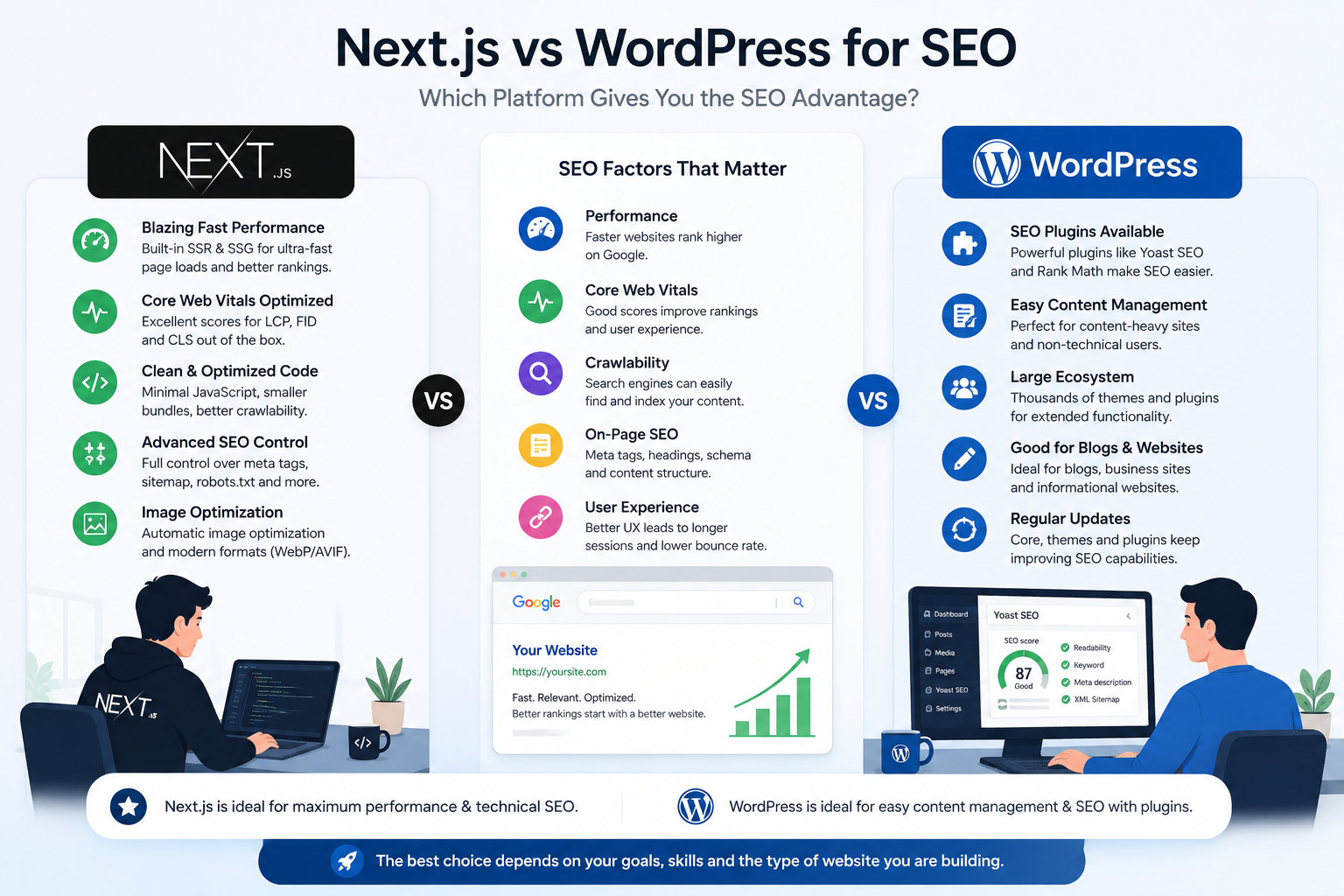
Google's Search Advocate John Mueller has stated publicly that Google's search systems do not favor any particular content management system or JavaScript framework. Google evaluates the final rendered output of a page, not how it was built. A WordPress site and a Next.js site have equal ranking potential if both are technically sound. The practical difference is that maintaining technical soundness requires significantly more ongoing effort on a plugin-heavy WordPress site than on a well-architected Next.js application.
Google's Position on JavaScript Rendering
Google can process JavaScript but does so in a second crawl wave after the initial crawl. This means JavaScript-rendered content may take days or weeks longer to be indexed than server-rendered content. Mueller and Google's developer documentation both recommend server-side rendering or static generation for content that needs to rank, and reserve client-side rendering for application interfaces that do not need to appear in search results.
Google's Position on Core Web Vitals as a Ranking Signal
Google confirmed Core Web Vitals as a ranking signal in May 2021. However, Mueller has also clarified that Core Web Vitals are not giant ranking factors and that great content on a slightly slow page will typically outrank poor content on a fast page. The correct interpretation is that Core Web Vitals act as a tiebreaker between pages of similar content quality, not as an override of content relevance signals.
Google Search Console as the Primary Diagnostic Tool
Google recommends Search Console as the primary tool for monitoring a site's technical health from Google's perspective. The Coverage report shows indexation status across all known URLs. The Core Web Vitals report shows real-world performance data collected from Chrome users. The URL Inspection tool allows you to see exactly how Google has crawled and rendered a specific page and request a recrawl after making changes.
Google's Guidance on Duplicate Content
Google has stated repeatedly that duplicate content is not a penalty in the way that many SEO practitioners assume. Google handles duplicate content algorithmically by selecting one version to index and ignoring others. The issue is not punishment but dilution. When the same content exists at multiple URLs, ranking signals including links are split across those versions rather than concentrated on one. Canonical tags are Google's recommended solution for communicating which URL should receive those consolidated signals.
How AI Is Changing Technical SEO
AI is affecting technical SEO in two directions simultaneously. Google's increased use of AI in its search systems — including the Helpful Content System and AI Overviews — places greater weight on signals of genuine quality and expertise, which in turn makes the technical signals of a trustworthy, well-maintained site more important. A site with clean technical foundations, fast performance, and accurate structured data is better positioned for AI-influenced rankings than one where the content might be strong but the signals are noisy.
On the practitioner side, AI tools are genuinely useful for technical SEO work — helping to generate structured data markup at scale, identify patterns in large crawl datasets, write regex for log file analysis, and produce technical audit reports that would previously take days. These are execution accelerators rather than strategy replacements. The analytical judgment required to prioritise technical issues, understand their root causes, and sequence fixes appropriately still requires a skilled specialist who knows how Google's systems actually work.
Advantages and Drawbacks of Technical SEO Investment
Advantages
Compounding long-term results. Technical improvements compound because they raise the ceiling for everything else. A site that Google can crawl completely, index accurately, and serve quickly will rank better for every piece of content published after the fixes go live — not just the pages that were specifically optimised.
Better crawlability and faster indexation. Once technical issues are resolved, new content appears in search results faster. For sites that publish frequently, this is a significant operational advantage — your content reaches its potential ranking position sooner rather than sitting in a crawl queue behind low-value pages.
Improved Core Web Vitals scores directly affect rankings. Unlike many SEO factors, Core Web Vitals are directly measurable and directly tied to a confirmed ranking signal. Improving these scores produces a tangible, documented change in a metric Google acknowledges it uses.
Protects existing ranking equity. Good technical practice prevents silent erosion — the kind that happens when a site migration loses redirect mapping, a plugin update breaks structured data, or an accidental robots.txt change blocks key pages from being crawled.
Drawbacks
Requires developer involvement. Most significant technical SEO fixes need a developer to implement. This creates a dependency on engineering resource that marketing teams cannot always control, and it means technical SEO recommendations often sit in a backlog rather than being implemented promptly.
Direct ROI is difficult to isolate. When organic traffic improves after a technical audit and fixes, it is genuinely hard to attribute how much of that improvement came from the technical work versus the content published in the same period. This makes building the business case for technical SEO investment harder than for content or paid channels where attribution is more direct.
Time between fix and ranking impact. Technical fixes need to be crawled, processed, and re-evaluated by Google before their impact appears in rankings. For large sites on a limited crawl budget, this can take weeks or months. The delay between implementation and visible result tests patience and can make technical improvements feel less impactful than they actually are.
Related Services
Technical SEO requires collaboration between SEO specialists and developers. Getting it right from the start — or fixing it when it has been neglected — requires both strategic knowledge and the technical capability to implement changes correctly. Munix Studio provides both.
SEO Optimization — Comprehensive technical SEO audits and implementation covering crawlability, Core Web Vitals, structured data, indexation control, and the full range of ranking factors that determine whether your site's content reaches its potential.
Website Development — Sites built on React and Next.js with technical SEO best practices embedded from the architecture level — server-side rendering, clean URL structures, performance optimisation, and structured data built in from day one.
DevOps and Cloud — Server configuration, CDN setup, HTTPS implementation, and cloud infrastructure that supports the performance and reliability standards technical SEO requires.
Maintenance and Support — Ongoing technical monitoring that catches crawl errors, broken redirects, performance regressions, and indexation problems before they have time to damage rankings.
Frequently Asked Questions
Ready to Get Started?
SEO Optimization
Full technical SEO audits and implementation — crawl analysis, Core Web Vitals fixes, structured data, indexation control, and ongoing monitoring — built to uncover and resolve the issues suppressing your rankings.
Explore SEO OptimizationRelated Articles

Ecommerce SEO: The Complete Guide to Ranking Your Online Store
The History of SEO: How Search Engine Optimisation Began
Next.js vs WordPress for SEO: What Matters

Organic SEO Marketing: Build Search Visibility That Compounds

SEO Content Strategy: How to Create Content That Ranks and Converts