What Is On-Page SEO?
On-page SEO is the practice of optimising the individual elements of a web page to make it more relevant, more readable, and more useful to both search engines and the people searching for the topic it covers. Every decision made within the page itself, from the title tag and heading structure to the depth of the content, the placement of keywords, the quality of internal links, and the speed at which the page loads, falls under on-page SEO.
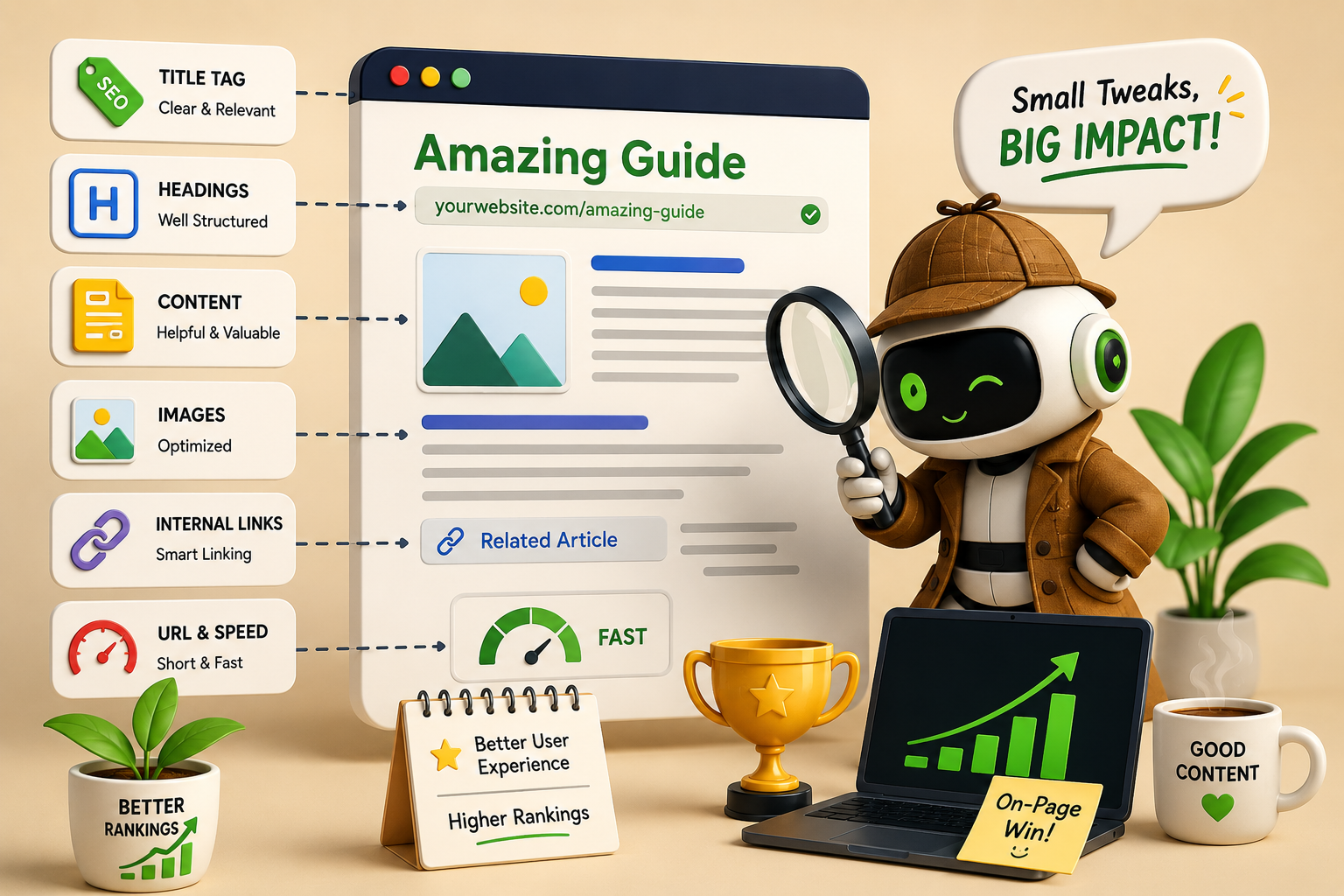
The reason on-page SEO matters is straightforward. Google's job is to return the most relevant and most useful result for any given search query. On-page optimisation is how a page communicates its relevance to Google. A page that fails to signal what it is about, who it is for, and why it deserves to rank is leaving that judgment entirely to Google's interpretation, which is an unreliable strategy when competing against pages that have been deliberately optimised to communicate all of those signals clearly.
On-page SEO sits within the broader discipline of digital marketing alongside off-page SEO and technical SEO. Understanding where each begins and ends is the first step toward deploying each effectively.
On-Page SEO vs Off-Page SEO vs Technical SEO
The three pillars of SEO address completely different aspects of how a website performs in search. Confusing them leads to misdiagnosed problems and misdirected effort. A site that is losing rankings due to a technical crawl issue will not recover from publishing more content. A site that ranks but fails to convert may need on-page improvements, not more backlinks.
Factor On-Page SEO Off-Page SEO Technical SEO What it covers Content, headings, keywords, metadata, internal links, images, page structure Backlinks, brand mentions, social signals, external authority Crawlability, site speed, Core Web Vitals, indexability, structured data Who controls it Fully within your control Largely outside your control Within your control but requires developer involvement Time to see results Weeks to months Months to years Weeks to months after implementation Primary examples Title tags, H1s, keyword placement, content depth, meta descriptions Backlink acquisition, digital PR, guest publishing, brand mentions Page speed, crawl budget, sitemaps, canonical tags, HTTPS Ongoing cost Low once optimised — mainly content creation Continuous investment required Periodic development sprints and monitoring Foundation dependency Requires technical SEO to be sound first Most effective when on-page and technical are already solid Underpins the effectiveness of both other pillars
Advantages and Drawbacks of On-Page SEO
Advantages Drawbacks Fully within the business's control — no dependence on third parties Results take weeks to months to appear after changes are made No ongoing cost per click or impression once optimised — traffic is free Requires significant content creation investment to compete in most niches Improvements compound over time as authority builds around well-optimised pages On-page optimisation alone is insufficient without off-page authority in competitive niches Directly improves user experience alongside search rankings Requires ongoing updates as search intent, algorithm changes, and competitors evolve Faster to implement than off-page link building campaigns Easy to over-optimise, which can trigger keyword stuffing penalties
The Most Important On-Page SEO Elements
On-page SEO is not a single task. It is a collection of distinct elements that each contribute a specific signal to search engines about the relevance, quality, and authority of a page. The priority table below shows each element, what it does for rankings, how difficult it is to implement, and its overall impact.
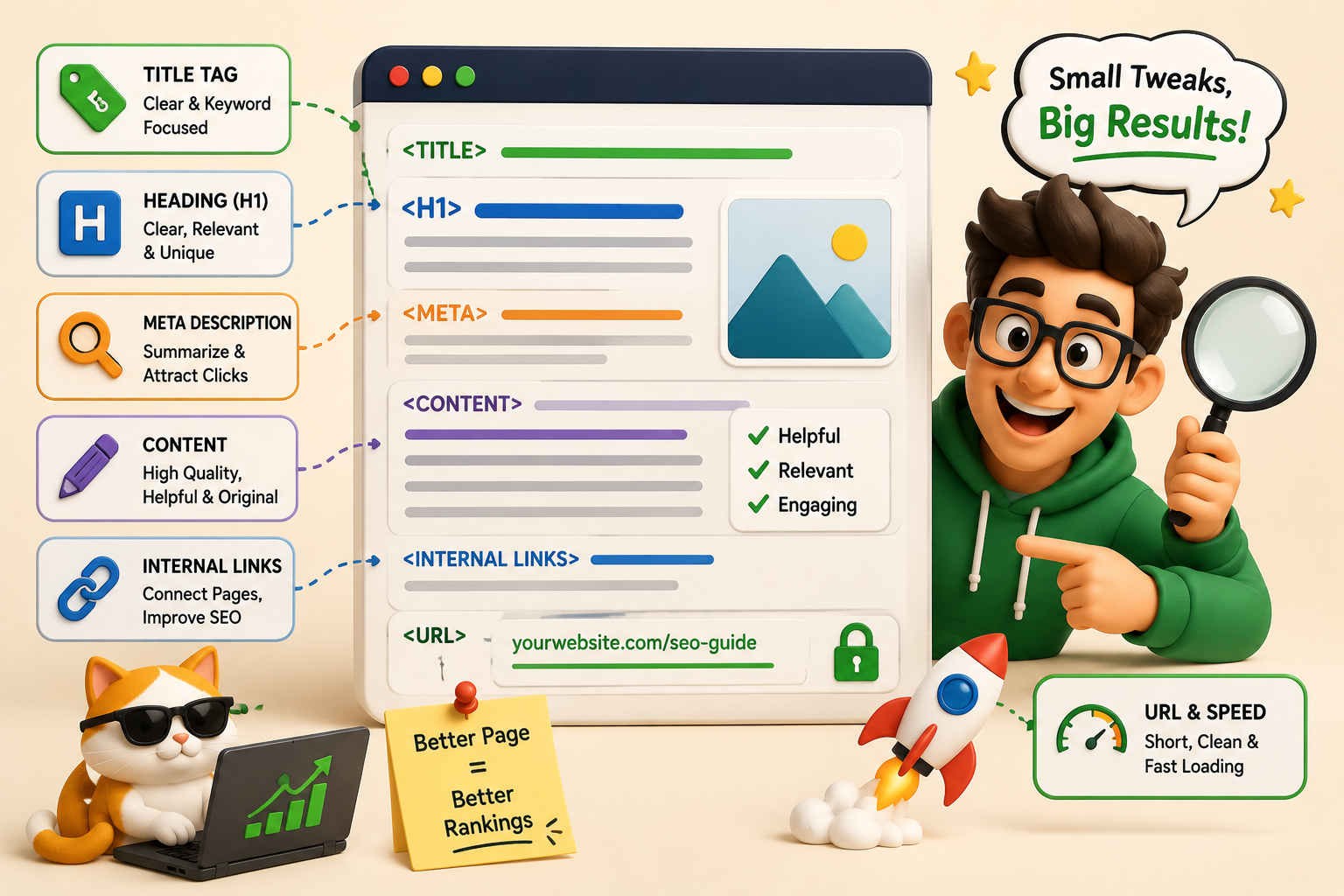
Element What It Does Difficulty Ranking Impact Title tag Primary keyword signal to Google, appears in search results Low High H1 tag Confirms page topic to Google, signals content structure Low High Meta description Influences click-through rate from search results, indirect ranking signal Low Medium URL structure Communicates page topic and hierarchy, affects crawl clarity Low Medium Content quality and depth Signals topical authority and search intent match High Very high Keyword placement Reinforces relevance throughout the page at natural density Medium High Heading hierarchy (H2 to H6) Structures content for crawlers and readers, covers semantic subtopics Low Medium Internal linking Distributes page authority, improves crawl efficiency, guides user journeys Medium High Image optimisation and alt text Improves page speed and provides keyword context to crawlers Low Medium Page speed Confirmed ranking signal, directly affects user experience and bounce rate High — requires developer involvement High Mobile optimisation Google indexes mobile-first, mobile issues directly suppress rankings High — requires developer involvement High
Title Tags
The title tag is the single most important on-page SEO element outside of the content itself. It tells Google what the page is about and appears as the blue clickable headline in search results. The primary keyword should appear naturally near the start of the title, the tag should stay under 60 characters to avoid truncation in search results, and it should be written to encourage clicks as well as signal relevance. A title that says "Web Design Services Pakistan" will rank for that term but convert fewer clicks than "Custom Web Design Services for Growing Businesses in Pakistan."
H1 Tag and Heading Hierarchy
Every page should have exactly one H1 tag that contains the primary keyword and confirms the page topic to both users and search engines. Subsequent headings using H2 through H6 should be used to structure the content into logical sections that cover the subtopics a reader searching for the main query would expect to find addressed. Using H2 headings that incorporate related keyword variations and semantic subtopics strengthens the page's topical coverage without requiring keyword stuffing in the body text.
Meta Descriptions
Meta descriptions are not a direct ranking factor but they influence the click-through rate of a search result, and click-through rate is itself a quality signal that affects ranking over time. A well-written meta description of 140 to 160 characters includes the primary keyword naturally, communicates a clear reason to click the result, and sets an accurate expectation about what the page contains. Google rewrites meta descriptions frequently, but providing a strong one gives the best chance of controlling how the page is represented in search results.
URL Structure
A clean, descriptive URL that includes the primary keyword and reflects the page's position in the site hierarchy communicates relevance to both users and crawlers. A URL like munixstudio.com/learn/seo/what-is-on-page-seo tells a crawler and a user exactly what the page is about and where it sits in the site. A URL like munixstudio.com/page?id=4829 communicates nothing. Keep URLs lowercase, hyphenated, and as short as the content hierarchy allows.
Content Quality and Depth
Content is the foundation on which every other on-page SEO element is built. A page with a perfect title tag, a well-structured heading hierarchy, and clean URLs will not rank if the content itself fails to match the search intent of its target query or provides a shallower answer than the pages it is competing against. Google's Helpful Content system evaluates whether content was written primarily to serve the reader rather than to satisfy a ranking algorithm. First-hand experience, specific detail, clear conclusions, and depth that covers the topic thoroughly are the characteristics of content that earns and holds rankings.
Internal Linking
Internal links from one page to another within the same site distribute page authority, help search engine crawlers discover new content, and guide readers toward related information and conversion actions. Every important page on a site should receive internal links from other relevant pages, with anchor text that describes the destination page's topic rather than generic phrases like click here. Pages with no internal links pointing to them, known as orphan pages, receive minimal crawl attention and minimal authority regardless of how well they are otherwise optimised.
Image Optimisation and Alt Text
Unoptimised images are one of the most common causes of slow page load times, which directly suppress rankings and increase bounce rates. Images should be compressed and served in modern formats like WebP, sized correctly for the context in which they appear, and loaded lazily where they are below the fold. Alt text serves two purposes: it provides a text description of the image for accessibility purposes and for users whose images do not load, and it gives search engines additional keyword context for the page. Alt text should be descriptive and natural. It should describe what is in the image using relevant keywords where they fit genuinely, not stuffed with every target keyword regardless of relevance.
Common On-Page SEO Issues and How to Fix Them
On-page SEO issues are among the most frequently encountered problems on business websites that have been built without SEO as a foundational design constraint. Many of them are easy to fix once identified.
Missing or duplicate title tags — Multiple pages sharing the same title tag create a relevance conflict where Google cannot determine which page should rank for a given query. Every page needs a unique, keyword-relevant title tag. Screaming Frog identifies duplicate title tags across a full site crawl in minutes.
Missing H1 or multiple H1 tags — A page without an H1 gives Google no clear signal about its primary topic. A page with two or more H1 tags creates a diluted signal. Every page should have exactly one H1 containing the primary keyword.
Thin content — Pages with fewer than 300 words of substantive content are unlikely to rank competitively for anything beyond very low-competition queries. Thin content pages that cannot be expanded should be consolidated into more comprehensive pages or redirected to the most relevant existing page.
Keyword stuffing — Repeating the target keyword at unnaturally high frequency, typically more than once per 100 to 150 words, triggers a spam signal that suppresses rather than improves rankings. Write for the reader first and use keyword variations and semantic synonyms to cover the topic naturally.
Missing meta descriptions — Pages without meta descriptions allow Google to generate its own snippet from the page content, which often produces a less compelling or less relevant result than a purpose-written description. Provide unique meta descriptions for all high-priority pages.
Broken internal links — Internal links pointing to 404 pages or redirected URLs waste crawl budget and fail to pass authority to the intended destination. Regular crawls using Screaming Frog identify broken internal links before they accumulate.
Unoptimised images — Images served at their original upload dimensions and without compression are one of the most common causes of poor Core Web Vitals scores. Implement Next.js image optimisation or a CDN-based image processing layer to serve correctly sized, modern format images automatically.
On-Page SEO for Ecommerce Websites
Ecommerce on-page SEO presents challenges that do not exist on standard content sites. The volume of pages is typically much higher, with hundreds or thousands of product pages that each require unique optimisation. The risk of duplicate content is significantly greater because similar products often share nearly identical descriptions. And the commercial intent of the target queries is higher, which means the stakes of ranking or failing to rank are directly measured in revenue.
Product page optimisation should treat each product as a standalone landing page targeting the specific search query a buyer would use when looking for that product. The title tag should include the product name, key specification such as size or material, and the brand where relevant. The product description should go beyond the manufacturer's copy, which is typically duplicated across every retailer selling the same product, and include original content about the product's benefits, use cases, and differentiators. Structured data using Product schema with price, availability, and review ratings improves the rich result appearance of product pages in search and increases click-through rates from search results.
Category page on-page SEO is frequently neglected on ecommerce sites despite category pages often representing the highest commercial value organic search opportunities. A category page targeting a query like running shoes for women needs a unique H1, a short editorial introduction paragraph with the primary keyword present naturally, a well-structured internal linking approach that connects to subcategories and featured products, and Product schema at the page level. Category pages without editorial content are effectively competing as a grid of images, which provides no textual relevance signals for Google to rank.
On-Page SEO for Shopify Stores
Shopify stores face specific on-page SEO constraints that stem from the platform's default URL structure and template system. Shopify appends /products/ and /collections/ to all product and category URLs by default, which cannot be removed without custom development. The platform also historically generated duplicate product URLs when products appeared in multiple collections, though canonical tags now handle most of this automatically.
On a Shopify store, the most impactful on-page SEO actions are writing unique title tags and meta descriptions for every product and collection page through the theme editor rather than relying on auto-generated defaults, adding substantive editorial content to collection page descriptions which Shopify displays above the product grid, optimising all product images through compression and descriptive file names and alt text before uploading, and ensuring the theme is mobile responsive and does not load unnecessary scripts that degrade Core Web Vitals scores. Shopify's built-in blog section is underused by most store owners and represents a significant organic traffic opportunity for informational content that targets buyers in the research phase.
How AI Is Changing On-Page SEO in 2025
AI tools have changed the operational efficiency of on-page SEO significantly but have not changed the underlying principles that determine which pages rank. The most common use cases are content drafting and briefing, bulk metadata generation, semantic keyword research, and content gap analysis. Each of these tasks is faster and cheaper with AI assistance. None of them are fully replaceable by AI without human judgment and quality control.
Factor AI-Assisted On-Page SEO Manual On-Page SEO Speed Very fast — bulk tasks completed in minutes Slow for large volumes of pages Content accuracy Requires human review — AI hallucinates facts High when written by a subject matter expert Cost Low per unit output Higher per unit due to writer or specialist time E-E-A-T signals Weak — AI lacks genuine experience and expertise Strong when written by a credentialed author Best use case First drafts, bulk metadata, outlines, semantic research Final content, YMYL topics, brand voice, expert analysis Risk Generic output indistinguishable from competitors at scale Lower risk of homogeneous content that fails to differentiate
The most effective on-page SEO workflow in 2025 combines AI efficiency for research, outlining, and first drafts with human expertise for accuracy, brand voice, E-E-A-T signals, and the specific insights that come from genuine subject matter knowledge. Content that is entirely AI-generated and published without expert review is increasingly identifiable by Google's quality systems and produces diminishing ranking returns compared to the compounding returns of genuinely useful, human-authored content.
On-Page SEO Metrics to Track
Tracking the right metrics confirms whether on-page SEO improvements are producing measurable results and reveals which pages need further attention. Raw traffic volume tells only part of the story. The metrics below provide a more complete picture of on-page performance.
Organic click-through rate per page — Available in Google Search Console under the Performance report. A low CTR despite a strong ranking position indicates a title tag or meta description that is failing to encourage clicks. Improving the CTR of a page in position four to match the CTR of a typical position two result can double organic traffic without any change in ranking.
Average position for target keywords — Tracking position changes for specific target keywords over time reveals whether on-page changes are moving pages up or down the ranking. Pages sitting in positions six to fifteen represent the highest-return optimisation opportunities because relatively small improvements move them into the top five where click volumes are significantly higher.
Core Web Vitals scores — Available in Google Search Console and PageSpeed Insights. Pages failing the Core Web Vitals thresholds for LCP, INP, or CLS carry a ranking disadvantage against comparable pages that pass. Tracking these per page type identifies where performance investment is needed most.
Bounce rate and time on page — High bounce rates on content pages that should be engaging readers suggest a mismatch between the search intent of the query that brought the visitor and the content the page delivers. Pages that match intent well retain readers, which is itself a quality signal that compounds into stronger rankings over time.
Pages per session from organic — Effective internal linking encourages visitors who arrive from organic search to visit additional pages. A low pages-per-session metric from organic traffic often indicates an internal linking deficit that is leaving potential engagement and conversion unrealised.
On-Page SEO Checklist
The checklist below covers every element that should be reviewed and optimised before a page is published and at regular intervals afterward. Use it for new pages, for existing pages that are underperforming, and as a quality gate in the content production process.
Element Action Required Priority Title tag Primary keyword near the start, under 60 characters, unique across the site Critical H1 tag One per page, contains primary keyword, matches search intent Critical Meta description 140 to 160 characters, includes keyword naturally, unique per page Critical URL Short, lowercase, hyphenated, keyword-inclusive, no stop words Critical Content depth Covers the topic more thoroughly than top-ranking competitors Critical Search intent match Content format and angle match what Google is already ranking for this query Critical Keyword placement Primary keyword in first paragraph, naturally distributed throughout, semantic variations included High Heading structure Logical H2 to H6 hierarchy covering expected subtopics with relevant keyword variations High Internal links 3 to 5 relevant internal links with descriptive keyword anchor text High Image optimisation Compressed, WebP format, descriptive file names, relevant alt text on every image High Page speed Passes Core Web Vitals thresholds on mobile and desktop via PageSpeed Insights High Mobile rendering No mobile usability errors in Google Search Console, readable without zoom High Structured data Appropriate schema type implemented and validated via Rich Results Test Medium External links Links to authoritative external sources where relevant, opens in new tab Medium Content freshness Published and last updated dates accurate, time-sensitive content reviewed regularly Medium
How We Work
At Munix Studio, on-page SEO is treated as a foundational discipline rather than an afterthought. Every page we build for a client is structured with correct heading hierarchy, keyword-relevant metadata, clean URL architecture, optimised images, and internal linking built in from the start. For clients with existing sites, our on-page SEO audit and optimisation service identifies every element that is working against rankings and produces a prioritised fix list with specific implementation instructions.
Our on-page SEO specialists work directly alongside the development team, which means recommendations do not sit in a report waiting for a separate agency to interpret them. Findings are implemented by the same team that understood them, which produces faster results and fewer implementation errors than the standard agency handoff model.
On-Page SEO Services From Munix Studio
On-page SEO is where rankings are won or lost at the page level. Munix Studio provides on-page SEO optimisation, implementation, and ongoing monitoring as part of a complete organic search strategy that connects content quality to technical performance to measurable ranking results.
SEO Optimization — Full on-page SEO audits, optimisation, and ongoing content strategy that improves rankings page by page and compounds organic traffic over time.
Website Development — Websites built on React and Next.js with on-page SEO foundations correct from day one including clean URLs, structured data, optimised images, and server-side rendering for full indexability.
Maintenance and Support — Regular on-page SEO reviews, content freshness updates, and performance monitoring to prevent rankings from eroding as competitors and algorithms evolve.
Dedicated Developers — Dedicated development resource to implement on-page technical fixes including page speed improvements, structured data deployment, and image optimisation at scale.
Frequently Asked Questions
Ready to Get Started?
SEO Optimization
Full on-page SEO audits, optimisation, and ongoing content strategy that improves rankings page by page and compounds organic traffic month over month.
Explore SEO OptimizationWebsite Development
Websites built on React and Next.js with on-page SEO correct from day one including clean URLs, structured data, optimised images, and full server-side rendering for indexability.
Explore Website DevelopmentRelated Articles
Ecommerce SEO: The Complete Guide to Ranking Your Online Store
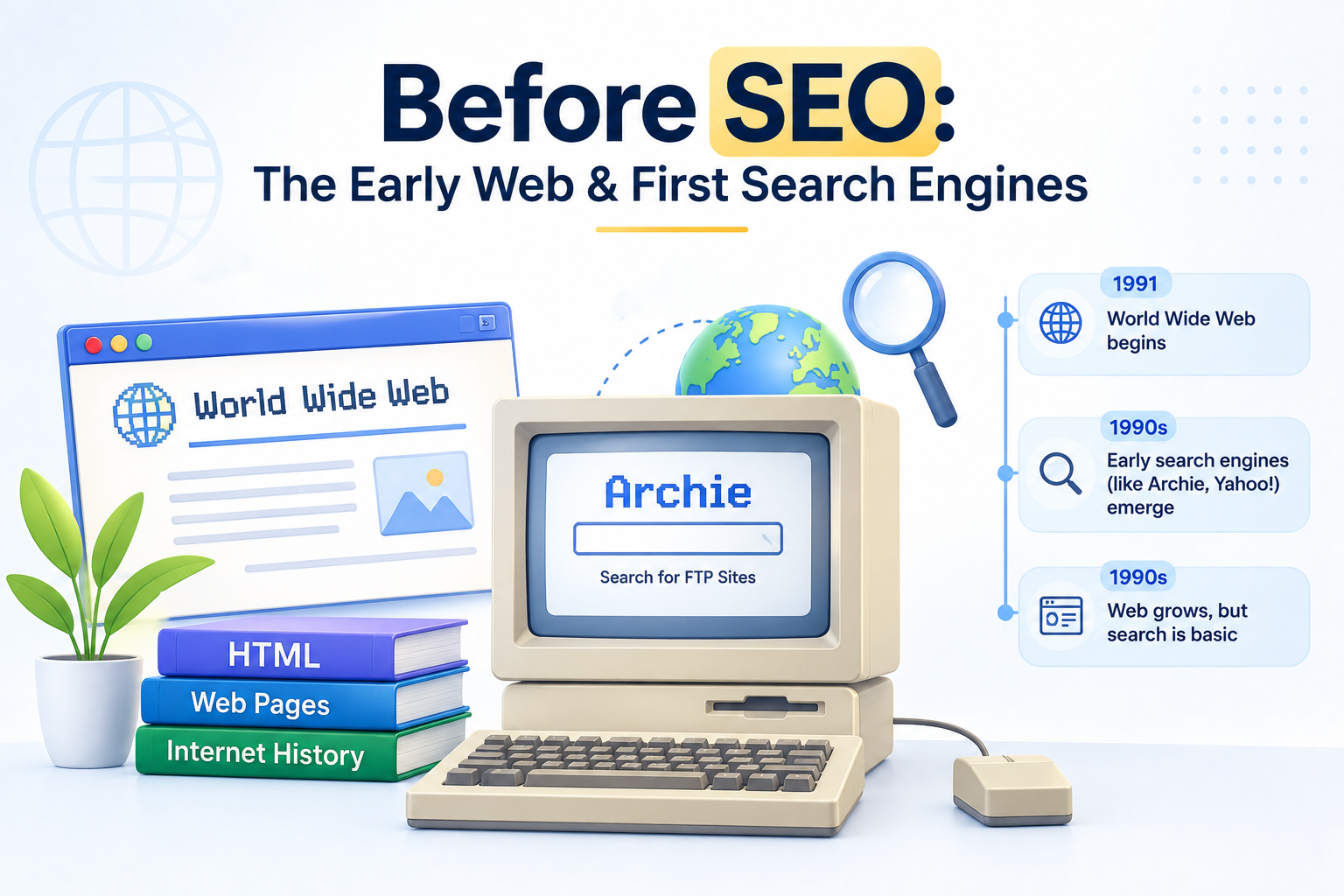
The History of SEO: How Search Engine Optimisation Began
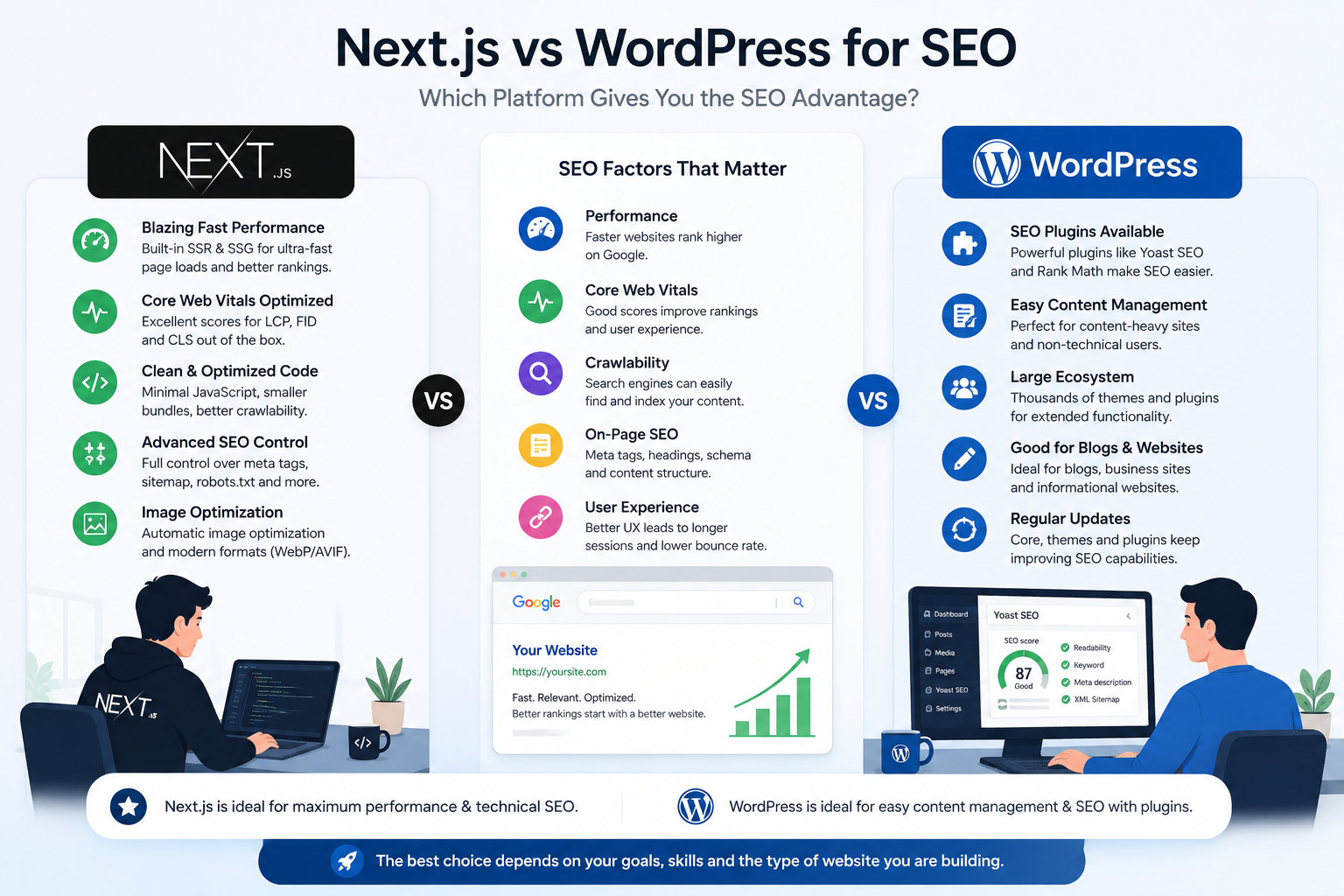
Next.js vs WordPress for SEO: What Matters
Organic SEO Marketing: Build Search Visibility That Compounds
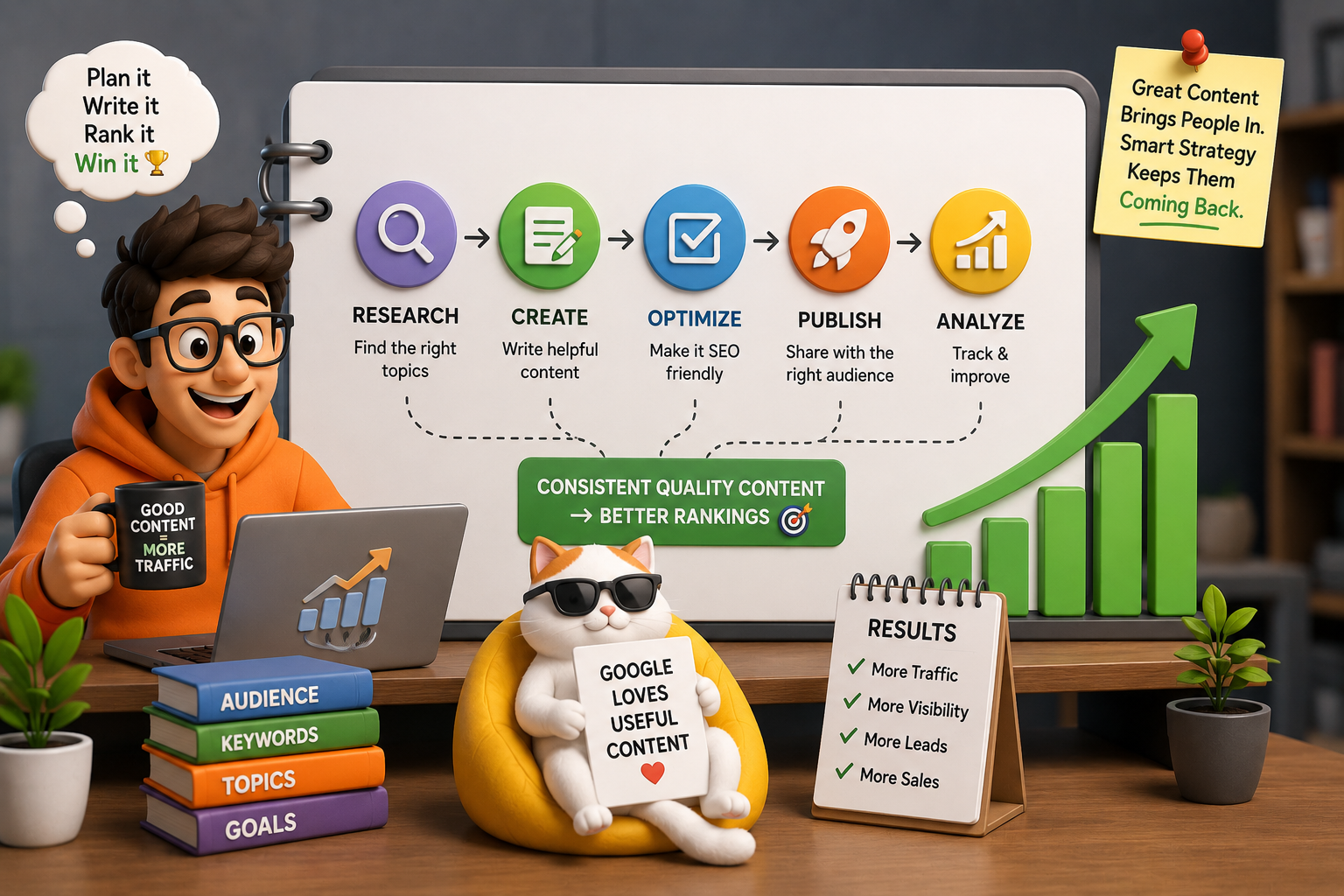
SEO Content Strategy: How to Create Content That Ranks and Converts