Search engine optimisation has been shaping the web for over three decades. From the earliest days of primitive directory-based search engines to today's AI-powered algorithms that evaluate hundreds of signals simultaneously, SEO has gone through more fundamental transformations than almost any other marketing discipline. Understanding that history is not just interesting context. It explains why modern SEO works the way it does, and why the tactics that defined each era either survived or were eliminated.
This guide covers the complete history of SEO: when it started, who drove its early development, how Google changed everything, and how the discipline evolved through algorithm updates, content revolutions, mobile shifts, and the current AI era into what it is today.
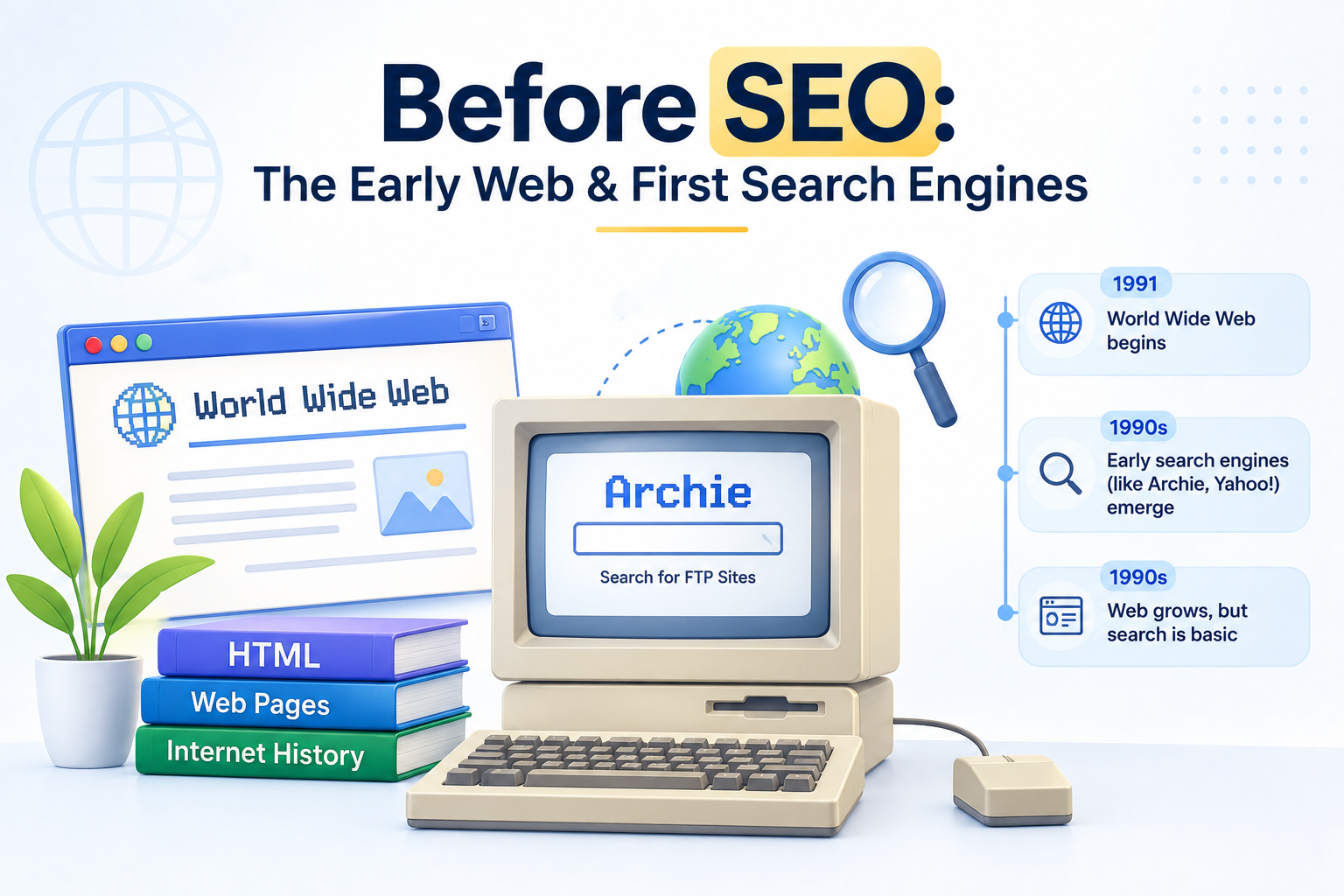
Before SEO: The Early Web and the First Search Engines
To understand when SEO started, you have to understand what the web looked like before it existed. In the early 1990s, the internet was a loosely connected collection of pages with no reliable way to find anything. The first solution was human-curated directories. Sites like Yahoo, which launched in 1994, organised web pages into categories that editors manually reviewed and catalogued. If you wanted your site to be found, you submitted it to the directory and hoped a human decided it was worth listing.
The first automated search engines, including Archie in 1990, Veronica in 1992, and later WebCrawler and Lycos in 1994, used crawlers to index the web automatically. These early engines were primitive by any modern standard. They ranked pages primarily based on how many times a search term appeared in the page text. There was no concept of link authority, user behaviour signals, or content quality evaluation. Whoever mentioned a keyword the most times ranked the highest. That simple mechanic created the first SEO opportunity and the first SEO abuses.
When Did SEO Start: The Mid-1990s Origin
SEO as a recognised practice began in approximately 1991 to 1993, though the term itself was not in common use until the mid to late 1990s. The earliest form of what we now call SEO was simply webmasters manipulating the factors that early search engines used to rank pages, primarily keyword frequency and meta tags. As soon as algorithms could be understood and influenced, people began influencing them.
The year 1997 is often cited as a significant marker in SEO history because it is when the term "search engine optimisation" began appearing in industry discussions and the first dedicated SEO consultancies started forming. Websites like Search Engine Watch, founded by Danny Sullivan in 1997, began publishing systematic guidance on how search engines worked and how to optimise for them. This established the foundation of what would become an entire professional industry.
By the late 1990s, the search engine landscape included AltaVista, Excite, Infoseek, HotBot, and Lycos competing alongside Yahoo for users. Each had different ranking algorithms and each created different optimisation opportunities. The web was growing faster than any human directory could catalogue, and automated search was becoming the primary way people navigated online. This made search visibility increasingly valuable and SEO increasingly important as a commercial discipline.
Who Invented SEO: The Figures Behind the Discipline
SEO does not have a single inventor. It emerged from the intersection of webmaster practices, search engine development, and digital marketing. That said, several individuals shaped its early development in ways that defined the discipline for generations of practitioners.
Bob Heyman, Nat Gertler, and Evan Heyman are sometimes credited with coining or popularising the term "search engine optimisation" in the mid-1990s. Danny Sullivan, through Search Engine Watch and later Search Engine Land, became the most influential educator and chronicler of the SEO industry from the late 1990s onward. His documentation of how search engines worked and how they changed was read by virtually every serious SEO practitioner of that era. Bruce Clay, who founded his SEO consultancy in 1996, was among the first to codify SEO as a professional service and developed frameworks that influenced how the industry approached technical optimisation.
On the search engine side, the two figures whose work most fundamentally shaped what SEO would become are Larry Page and Sergey Brin, the Stanford PhD students who invented PageRank and founded Google in 1998. Their insight that links between pages were a meaningful signal of quality and authority transformed the entire optimisation landscape and made the web's own structure the basis of search rankings.
Who Was the First SEO Company? The Earliest SEO Service Providers
"There is no single, universally agreed 'first' SEO company, but two firms are most commonly credited with pioneering SEO as a paid service."
John Audette's Multi-Media Marketing Group (MMG), founded 1995 in Lake Oswego, Oregon — one of the earliest firms offering web marketing/optimization services commercially. Audette recruited Danny Sullivan to train his staff, and that session is where the term "search engine optimization" may have first been used internally.
Bruce Clay, Inc., founded 1996 — the firm most widely cited today as "the first SEO company" / Bruce Clay as "the father of SEO." He began testing ranking-factor changes against Infoseek, later formalized siloing and published the first SEO Code of Ethics (2001).
One sentence explaining why sources disagree: SEO didn't exist as a defined service category yet — these were web-marketing consultancies that backed into what we'd now call SEO.
The Era of Keyword Stuffing and Early Manipulation (1994 to 1998)
The earliest period of SEO history is characterised by tactics that would be considered absurd and penalised by any modern standard. Because early search engines ranked pages primarily on keyword frequency, the most effective optimisation technique was simply to repeat your target keyword as many times as possible. Webmasters stuffed keywords into page text, meta keywords tags, alt attributes, and even hidden text. White text on a white background was invisible to visitors but readable by crawlers.
Meta keywords tags, an HTML element that allowed webmasters to specify the keywords they wanted a page to rank for, were heavily abused during this period. Sites would include dozens of unrelated keywords in their meta tags to capture traffic from any remotely connected search. AltaVista, which was the dominant search engine of the mid-1990s before Google, became notorious for returning results that bore little relation to what users were actually searching for because of how thoroughly its algorithm had been gamed.
Doorway pages were another defining tactic of this era. These were thin pages stuffed with keywords and designed purely to rank in search results, which then redirected visitors to a completely different destination page. The gap between what search engines showed in results and what users actually found when they clicked was enormous. The degraded search experience this created was the problem that Google was built specifically to solve.
Google Changes Everything: PageRank and the Link Era (1998 to 2003)
Google launched publicly in 1998 with a fundamentally different approach to ranking web pages. Larry Page and Sergey Brin's PageRank algorithm treated links between pages as votes. A link from one page to another was interpreted as a signal that the linking page's author considered the destination worth referencing. Pages that received many links from other credible pages ranked higher than pages with fewer or lower-quality links, regardless of how many times keywords appeared in the text.
This was a revolutionary shift. For the first time, the quality and authority of a page's external profile, not just its on-page keyword density, determined its ranking. Google's results were dramatically better than its competitors almost immediately, and within a few years it had become the dominant search engine worldwide. AltaVista, Excite, and most of the pre-Google search landscape became irrelevant relatively quickly.
SEO adapted quickly. If links were the primary ranking signal, then acquiring links became the primary optimisation activity. The early link-building era saw the rise of link farms, networks of sites that existed purely to generate links, reciprocal link exchange directories, and the first paid link schemes. The fundamental dynamic of the SEO industry was established here. Search engines develop algorithms to reward quality signals, webmasters find ways to manufacture those signals, search engines update their algorithms to discount the manufactured signals, and the cycle continues.
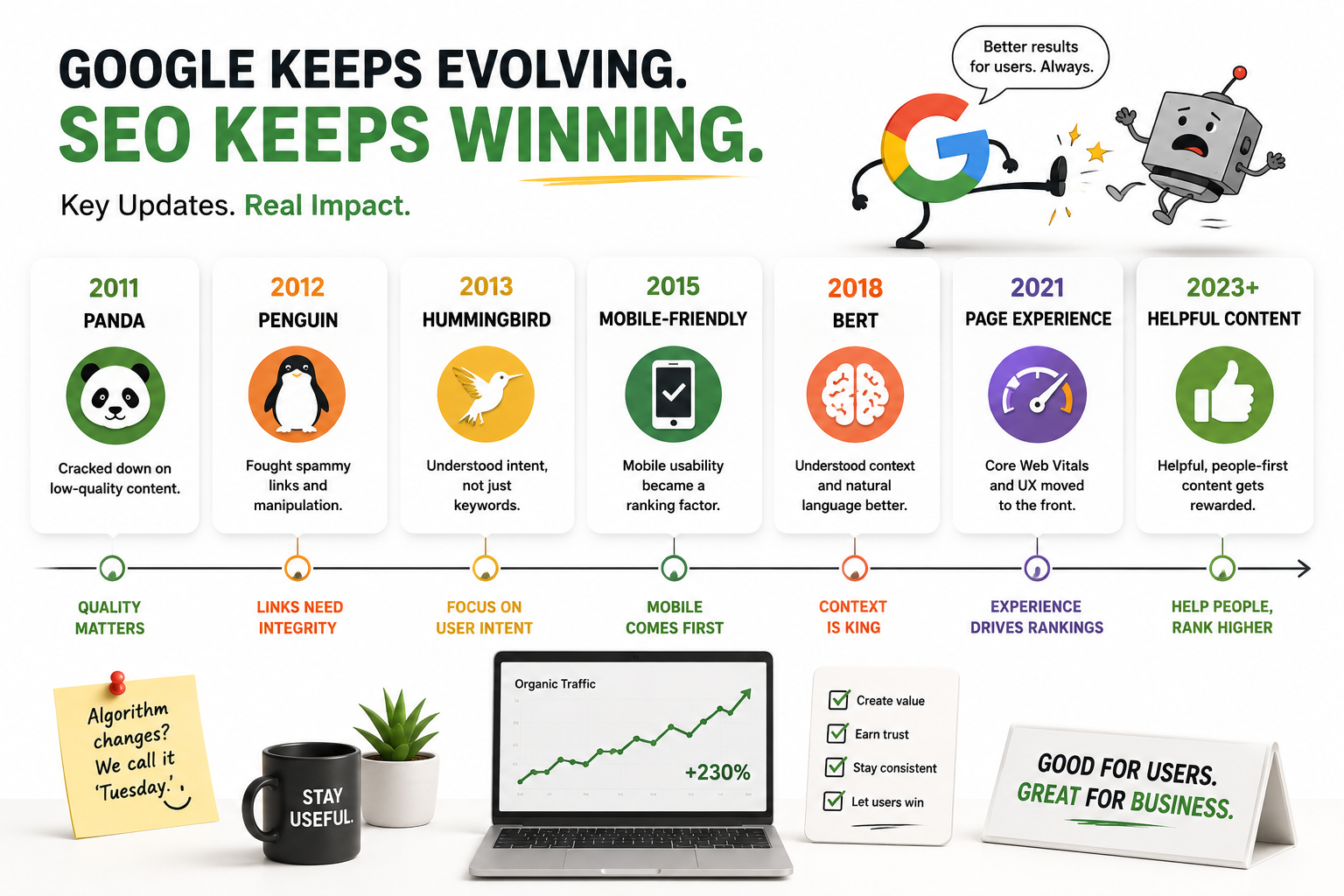
The Major Algorithm Updates That Shaped Modern SEO
The history of SEO from 2003 onward is largely told through the series of major algorithm updates Google released to combat manipulation and improve search quality. Each one eliminated a category of tactics that had previously been effective and redefined what legitimate optimisation looked like.
Update Year What It Targeted Impact on SEO Practice Florida 2003 Keyword stuffing and low-quality over-optimisation First major commercial disruption, many sites lost rankings overnight Jagger 2005 Link farms, reciprocal links, paid links Forced shift toward earning links through content quality Caffeine 2010 Index freshness and speed of content discovery Fresh content became more valuable and the real-time web was indexed faster Panda 2011 Thin content, duplicate content, content farms Content quality became a primary ranking factor for the first time Penguin 2012 Manipulative link building and over-optimised anchor text Eliminated most black-hat link schemes and required natural link profiles Hummingbird 2013 Semantic search and understanding intent rather than just keywords Conversational queries handled better and topic relevance rewarded over keyword matching Mobilegeddon 2015 Non-mobile-friendly websites Mobile responsiveness became a direct ranking signal RankBrain 2015 Machine learning applied to search ranking for the first time Algorithm became self-improving and less predictable BERT 2019 Natural language understanding and context between words Content written for humans ranked better than content written for algorithms Helpful Content 2022 Content created primarily for search engines rather than people People-first content rewarded and SEO-first content without genuine value penalised
SEO History Timeline: Key Milestones Year by Year
a chronological list (not a table this time, so it reads differently from the update table and targets the "timeline" phrasing specifically), each line explicitly naming the year:
1995 — John Audette founds MMG, one of the earliest web-marketing firms
1996 — Bruce Clay founds Bruce Clay, Inc., later called the first dedicated SEO company
1997 — The term "search engine optimization" enters common use; Search Engine Watch launches
1998 — Google launches with PageRank, shifting SEO from keywords to links
2003 — Florida update penalizes keyword stuffing
2005 — Jagger update targets link farms and paid links (directly answers "seo since 2005")
2010 — Caffeine speeds up indexing
2011 — Panda introduces site-wide content-quality signals (directly answers "seo 2011," "seo landscape in 2011")
2012 — Penguin targets manipulative link building (directly answers "seo 2012")
2013 — Hummingbird introduces semantic/intent understanding
2014 — Pigeon overhauls local search ranking (directly answers "seo in 2014," "2014 seo," "search engine optimization 2014" — currently this fact is buried in a Mobile-First paragraph and never stated as its own year)
2015 — Mobilegeddon and RankBrain
2018–2019 — E-A-T emphasis, BERT
2022 — Helpful Content update, E-E-A-T
2024 — AI Overviews
The Content Revolution: Panda and the Rise of Quality (2011 to 2015)
Before Google's Panda update in February 2011, content farms dominated large portions of the search results. Sites like Demand Media's eHow and About.com published hundreds of thousands of short, formulaic articles optimised purely for search visibility. These articles typically answered simple questions with thin, low-effort content that served the search engine but rarely satisfied the person searching. These sites ranked well because their scale and basic keyword targeting exploited the limits of pre-Panda algorithms.
Panda changed the equation by introducing site-wide quality signals into the ranking algorithm. Rather than evaluating individual pages in isolation, Google began assessing the overall quality of a domain. Sites with a high proportion of thin, low-quality, or duplicate content saw their rankings suppressed across all pages, not just the obviously poor ones. Demand Media's stock dropped by half within months of the update. eHow and similar content farms lost between 20 and 50 percent of their organic traffic almost overnight.
The practical consequence for the SEO industry was a fundamental reorientation toward content quality. Publishing thin content at scale stopped working. Producing genuinely useful, substantive, well-researched content became not just an editorial preference but an algorithmic requirement. This shift, more than any other single development in SEO history, is responsible for the modern emphasis on content depth, expertise, and genuine value.
Link Building Under Pressure: Penguin and the End of Manipulation (2012)
While Panda targeted content quality, Google's Penguin update in April 2012 targeted the link manipulation that had defined off-page SEO since the early 2000s. Private blog networks, paid link schemes, link farms, and over-optimised anchor text profiles were the primary targets. Sites that had built their rankings on manufactured link profiles saw dramatic and often catastrophic drops in organic traffic within days of the update.
Penguin was updated several times between 2012 and 2016, with each iteration becoming more precise at identifying unnatural link patterns. In 2016, Google announced that Penguin had been incorporated into the core algorithm and would now run in real time rather than as a periodic update. This meant manipulative links would be devalued continuously rather than catching up to sites in batches. The practical effect was that the risk profile of black-hat link building shifted from a tactic that worked until the next Penguin to one that gets devalued immediately and continuously.
Mobile-First, Local, and User Experience (2015 to 2019)
By 2015, mobile devices had surpassed desktops as the primary way people accessed the internet in most countries. Google responded with the April 2015 mobile-friendly update, widely nicknamed Mobilegeddon, which made mobile usability an explicit ranking signal in mobile search results. Sites that had not invested in responsive design saw their mobile rankings decline immediately. The update was not particularly catastrophic for most sites, but it sent an unmistakable signal about where the algorithm was heading.
Mobile-first indexing, announced in 2016 and rolled out progressively through 2018 to 2020, went further. Google switched to using the mobile version of a site as the primary version for indexing and ranking, rather than the desktop version. This meant that a site whose mobile experience was inferior to its desktop experience would be evaluated on the weaker version. For the SEO industry, this made mobile performance not just a user experience concern but the primary technical SEO consideration.
Local search also matured significantly during this period. Google's Pigeon update in 2014 and subsequent refinements to the local search algorithm made Google Business Profiles central to local search visibility. The emergence of the local map pack, the three-business listing with a map that appears above organic results for local intent queries, created an entirely new optimisation surface that businesses with physical locations needed to manage alongside their organic SEO.
E-E-A-T, Helpful Content, and the Experience Era (2018 to 2023)
Google's search quality evaluator guidelines had referenced E-A-T, standing for Expertise, Authoritativeness, and Trustworthiness, since at least 2014. The concept became central to the SEO industry's understanding of how Google evaluated content quality after the August 2018 core update, which significantly affected health, finance, and YMYL (Your Money or Your Life) categories. Sites in these categories that lacked demonstrable author expertise and institutional credibility saw substantial ranking drops.
In December 2022, Google added a second E to the framework, making it E-E-A-T where the first E stands for Experience. This update acknowledged that first-hand, lived experience with a topic is a distinct and valuable form of content credibility separate from formal expertise. A review written by someone who has actually used a product carries value in a different way from a clinical expert analysis, and Google's quality guidelines began explicitly reflecting this distinction.
The September 2022 Helpful Content update introduced a site-wide signal specifically targeting content created primarily for search engines rather than for people. It was effectively a Panda-style quality filter for the AI content era. The update was refined significantly in subsequent months and became part of Google's core ranking system, where it continues to penalise sites that publish high volumes of low-value content regardless of its technical optimisation.
The AI Era: From RankBrain to AI Overviews (2015 to Present)
Google announced RankBrain in 2015, marking the first application of machine learning to its core ranking algorithm. RankBrain helped Google handle the roughly 15 percent of search queries it had never seen before by interpreting their meaning based on patterns in language rather than exact keyword matching. The significance was not immediately obvious to most SEOs, but in retrospect it marked the beginning of a transition from a rules-based ranking system to an AI-powered one.
BERT, standing for Bidirectional Encoder Representations from Transformers, was introduced in October 2019 and represented a much more significant leap. BERT allowed Google to understand the context and relationships between words in a query rather than treating each word independently. This meant it could parse the nuance of natural language questions and match them to relevant content more accurately than any previous system. The practical effect was that content written conversationally and comprehensively for human readers began ranking better than content constructed primarily around keyword patterns.
The launch of Google's Search Generative Experience, rebranded as AI Overviews in 2024, represents the most significant change to search results pages since the introduction of universal search in 2007. AI-generated summaries now appear at the top of results for a broad range of queries, synthesising answers from multiple sources before the user sees any traditional organic results. This development has reduced click-through rates for informational queries while simultaneously increasing the value of content that requires original expertise, primary research, and depth that AI cannot easily summarise.
How SEO Practice Has Changed Across the Decades
Era Dominant Tactic Primary Ranking Signal Still Effective? 1994 to 1998 Keyword stuffing, meta keyword tags, hidden text Keyword frequency No, actively penalised 1998 to 2003 Link farms, reciprocal links, directory submissions Raw link count via PageRank No, heavily discounted 2003 to 2011 Exact-match anchor text, private blog networks, article spinning Link authority with keyword anchor text No, Penguin eliminated this 2011 to 2015 Content marketing, guest posting, social signals Content quality and earned links Yes, foundation of modern SEO 2015 to 2019 Mobile optimisation, structured data, local SEO, E-A-T signals User experience, expertise, authority, trust Yes, essential practice 2019 to 2022 Core Web Vitals, topical authority, BERT-aligned content Page experience, semantic relevance, depth Yes, current standard 2022 to present E-E-A-T, original research, first-hand expertise, AI-resistant content Genuine helpfulness, experience, authority Yes, defining the current era
What SEO History Teaches Us About Modern Practice
The consistent pattern across three decades of SEO history is that tactics built on manipulating signals rather than genuinely satisfying them have a limited lifespan. Every shortcut that worked, from keyword stuffing to link farms to private blog networks to thin content at scale, was eventually eliminated by an algorithm update. The tactics that have survived and remained effective across every era of SEO are the ones that were never tricks to begin with. Building fast, crawlable websites, creating genuinely useful content, and earning links from sources that consider your content worth referencing have worked in 1998 and they work today.
This is not accidental. Google's commercial incentive is to return the best possible results to searchers, because search quality is what maintains its dominance. Every algorithm update is, at its core, an attempt to make the ranking signals harder to fake and easier to earn legitimately. The SEO practices that endure are those aligned with that goal, not those that find clever ways around it.
For businesses investing in SEO today, the lesson of history is straightforward. Build for people, not algorithms. The algorithm's job is to find what people want and rank it highly. Do that well, and the algorithm becomes your ally rather than an obstacle to be outmanoeuvred.

Related Services
Understanding the history of SEO clarifies why modern best practices exist and what kind of investment produces lasting organic visibility. Munix Studio builds SEO programmes on the principles that have proven durable across every era, including technical excellence, genuine content depth, and authority earned through relevance.
SEO Optimization — Modern SEO strategy and execution grounded in the practices that have survived every algorithm era, covering technical foundations, genuine content quality, and earned authority that compounds over time.
Website Development — Technically sound websites built on React and Next.js that satisfy the technical SEO standards Google has been progressively raising since Caffeine, Mobilegeddon, and Core Web Vitals.
Digital Marketing — Integrated digital marketing that combines organic search with the paid channels that complement it, particularly useful while organic authority is being built.
Maintenance and Support — Ongoing site maintenance that protects your technical SEO investment through platform updates, performance monitoring, and the regular audits that prevent silent technical regressions.
Frequently Asked Questions
Ready to Get Started?
SEO Optimization
Modern SEO strategy and execution grounded in the practices that have proven durable across every algorithm era, covering technical foundations, genuine content quality, and earned authority built for long-term compounding results.
Explore SEO OptimizationWebsite Development
Websites built with the technical foundations Core Web Vitals, clean crawlability, and proper indexing that Google's algorithm has consistently rewarded across its entire history.
Explore Website DevelopmentDigital Marketing
Integrated digital marketing combining organic SEO with complementary channels — designed to build sustainable growth that survives algorithm changes rather than depending on them.
Explore Digital MarketingMaintenance and Support
Ongoing website maintenance keeping the technical SEO foundations that Google has prioritised throughout its history — speed, security, and correct configuration — intact as the algorithm evolves.
Explore Maintenance and SupportRelated Articles

Ecommerce SEO: The Complete Guide to Ranking Your Online Store
Next.js vs WordPress for SEO: What Matters

Organic SEO Marketing: Build Search Visibility That Compounds

SEO Content Strategy: How to Create Content That Ranks and Converts

SEO for B2B Companies: A Complete Strategy Guide