What Is Ecommerce SEO?
This guide uses 'ecommerce SEO' throughout, but the same practices apply regardless of what you call your business: an online store, an online shop, an e-shop, or a digital retailer. Whether you run a large multi-category retail site or a small, curated boutique, the technical, on-page, and content principles covered here scale to fit the size and complexity of what you're selling.
Ecommerce SEO is the practice of optimizing an online store so that its product pages, category pages, and supporting content rank prominently in organic search results. When someone searches for a product on Google, the stores that appear at the top of the unpaid results have invested in ecommerce SEO. Those positions generate consistent, high-intent traffic without the ongoing cost of paid advertising, and unlike ads, they do not stop working when the budget runs out.
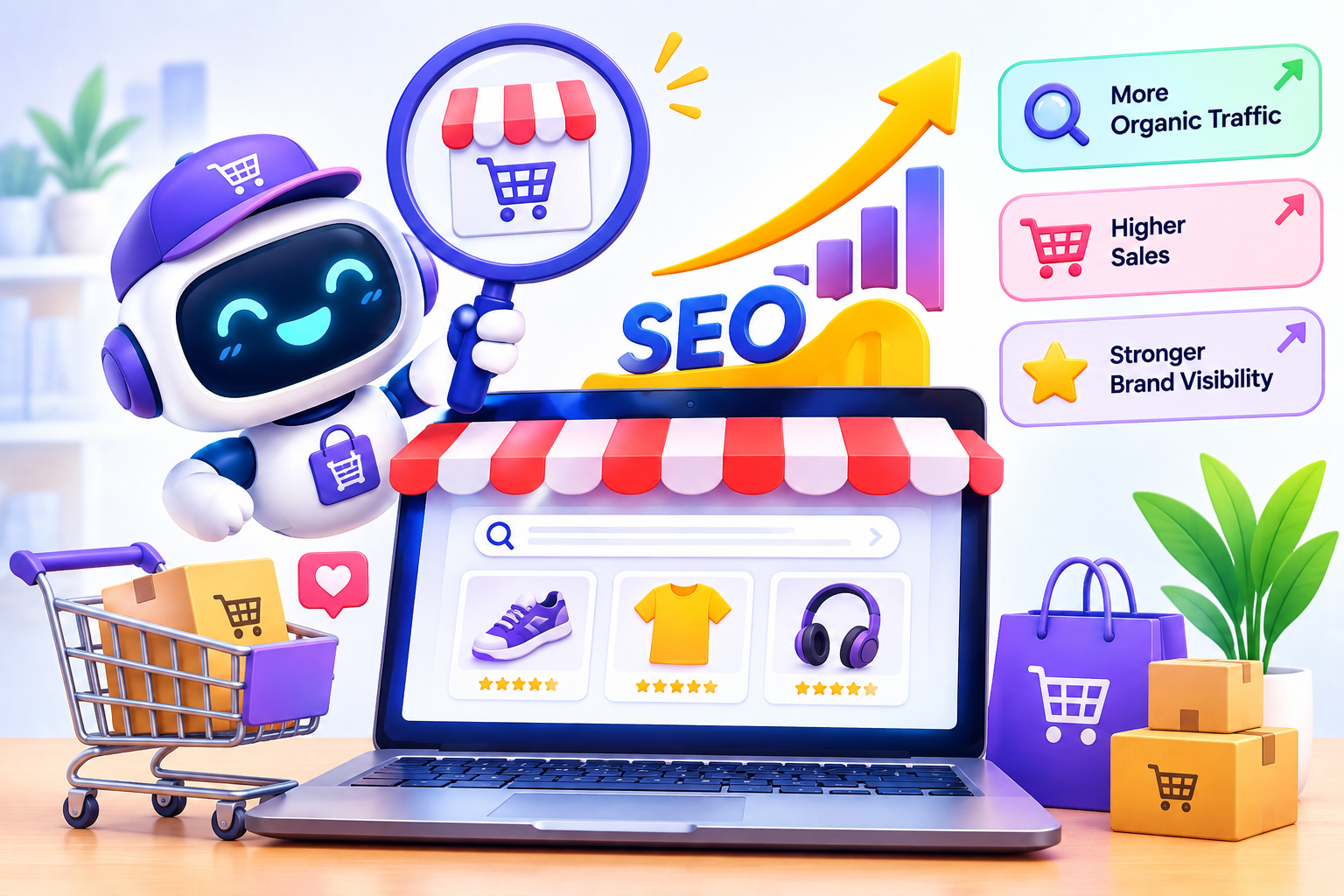
Ecommerce SEO differs from standard website SEO in several important ways. An ecommerce site might have hundreds or thousands of product pages, each of which needs to be individually optimized. Category pages function as landing pages for broad product searches and require a different optimization approach from product pages. Duplicate content from manufacturer descriptions, thin pages with minimal content, and complex URL structures from filtering systems are challenges that are specific to ecommerce and require specific solutions.
Done well, ecommerce SEO builds an organic traffic channel that becomes more valuable with every passing month. The stores that invest in it early consistently outperform competitors who rely exclusively on paid advertising because organic traffic compounds in a way that paid traffic simply cannot.
Why SEO Matters for Ecommerce Businesses
Paid advertising works for ecommerce but it has a fundamental economic problem. The cost per click on product-related keywords has increased significantly across every major category as more retailers compete for the same ad placements. A business that relies entirely on paid traffic is locked into an advertising cost structure that grows as competition increases, with no accumulating asset to show for the spend once the campaigns stop.
Organic search traffic from SEO behaves differently. A product page that ranks on page one for a relevant search query generates clicks every day without an ongoing cost per visit. As the store publishes more optimized content and earns more backlinks, its overall domain authority increases, which makes new pages rank faster and existing pages rank higher. This compounding effect is what makes ecommerce SEO one of the highest-return long-term investments available to online retailers.
Organic search also captures shoppers at a more commercially valuable moment than most other channels. Someone searching "buy waterproof hiking boots size 10" on Google is ready to purchase. Reaching that person through organic search rather than paid advertising means the same conversion happens at a fraction of the acquisition cost once the SEO foundation is established.
The Benefits of Ecommerce SEO
Lower customer acquisition cost over time. Once pages rank, each organic visitor costs nothing to acquire regardless of how many months or years the page continues generating traffic.
Higher purchase intent traffic. Organic search captures shoppers who are actively looking for specific products, making them significantly more likely to convert than cold advertising audiences.
Compounding returns. Each new optimized page and each earned backlink increases the store's overall authority, making subsequent pages rank faster and existing pages rank higher.
Reduced dependence on advertising platforms. A strong organic presence reduces vulnerability to ad platform policy changes, algorithm shifts in paid auctions, and rising cost-per-click rates that affect every advertiser in a category simultaneously.
Brand visibility across the full buyer journey. Informational content reaches shoppers in the research phase while product and category pages capture those ready to buy, creating multiple touchpoints across the entire purchase decision process.
Ecommerce SEO Strategy: The Core Areas
A complete ecommerce SEO strategy covers five interconnected areas. Neglecting any one of them limits what the others can achieve. The most common mistake is focusing exclusively on content or keywords while ignoring the technical foundation that determines whether any of that content gets crawled and indexed in the first place.
Area What It Covers Priority Impact Timeline Technical SEO Site speed, crawlability, URL structure, duplicate content, structured data Critical foundation Weeks to months Keyword research Product, category, and informational keyword mapping by intent Critical foundation 3 to 6 months On-page optimization Product titles, descriptions, category content, meta tags, internal linking High 1 to 4 months Off-page SEO Backlink acquisition, digital PR, brand mentions, authority building High 6 to 12 months Content marketing Buying guides, blog posts, comparison content, product tutorials High 3 to 9 months
Technical SEO for Ecommerce Websites
Technical SEO is the foundation that everything else is built on. A store with excellent product descriptions and well-researched keywords will still underperform if the technical infrastructure prevents Google from efficiently crawling and indexing its pages. Ecommerce sites face specific technical challenges that standard websites rarely encounter at the same scale.
Duplicate content is one of the most pervasive technical problems in ecommerce. It arises when product filtering systems create multiple URLs for the same or very similar content, when manufacturer descriptions are used across multiple products or copied from supplier sites, and when pagination creates near-duplicate versions of category pages. Canonical tags tell Google which version of a page is the authoritative one, preventing the same content from competing against itself in search results.
Site speed is a direct ranking factor for ecommerce sites and one that most stores underinvest in. Large uncompressed product images are the single most common cause of slow ecommerce page loads. Modern image formats like WebP, lazy loading, and a content delivery network that serves images from locations geographically close to the visitor all contribute meaningfully to load time improvements. For stores built on Next.js, image optimization is handled automatically through the framework's built-in image component, which is one of the significant technical advantages of modern stack development over template-based platforms.
Product schema markup is another technical element that ecommerce sites should implement from day one. Adding structured data to product pages tells Google exactly what the page contains, enabling rich results in search that display price, availability, ratings, and review counts directly in the search results. These rich results generate significantly higher click-through rates than standard blue-link listings for the same ranking position, effectively multiplying the value of whatever organic visibility the page already has.
On-Page SEO for Ecommerce Product Pages
Product pages are the commercial core of an ecommerce site and the pages that most directly drive revenue from organic search. Each product page needs to be treated as an individual SEO asset with its own keyword target, its own unique content, and its own optimization checklist.
The product title is the most important on-page element. It appears in the browser tab, the search result title, and at the top of the page, making it the primary signal Google uses to understand what the product is. A well-optimized product title includes the primary keyword naturally, specifies the product clearly, and includes differentiating attributes like size, color, or material where relevant to the search behavior in that category. Generic titles like "Blue T-Shirt" consistently underperform compared to specific ones like "Men's Organic Cotton Crew Neck T-Shirt in Navy Blue."
Product descriptions need to be unique and genuinely useful rather than copied from manufacturer specifications. Google penalizes duplicate content and ignores thin pages that provide no value beyond what the user could find elsewhere. A strong product description answers the questions a buyer would have before purchasing, highlights the benefits rather than just the features, and naturally incorporates relevant keywords that a potential buyer might use when searching for that type of product.
Image alt text on product images serves both accessibility and SEO purposes. Descriptive alt text that accurately describes the image while naturally including relevant keywords helps the page rank in image search, which is a meaningful traffic source for visually driven product categories like fashion, home decor, and furniture.
Category Page SEO Best Practices
Category pages are often the highest-traffic pages on an ecommerce site from an organic search perspective because they target broader, higher-volume queries. Someone searching "women's running shoes" is looking for a category page, not a specific product. Ranking well for these broader queries requires treating category pages with the same optimization rigor applied to product pages, which many stores fail to do.
A well-optimized category page includes a unique title tag and meta description targeting the category's primary keyword, a descriptive heading that matches what the category contains, introductory content at the top of the page that provides context and naturally incorporates relevant keywords, and a logical internal linking structure that connects to subcategories and featured products. The introductory content is particularly important because category pages with only a product grid and no supporting text are consistently outranked by competitors whose category pages include genuine informational value alongside the product listings.
Faceted navigation, which allows users to filter products by attributes like size, color, price, and brand, creates significant technical SEO challenges for category pages. Each filter combination typically generates a new URL, which can produce thousands of near-duplicate pages that dilute crawl budget and create duplicate content issues. The standard solution is to use canonical tags on filtered pages pointing back to the main category URL, or to use JavaScript-based filtering that changes the displayed products without creating new indexable URLs.
Off-Page SEO for Ecommerce Stores
Off-page SEO for ecommerce is primarily about building the domain authority that allows product and category pages to compete for high-volume commercial keywords. Backlinks from relevant, authoritative websites signal to Google that the store is a credible and trustworthy source, which is one of the most significant factors in whether pages rank on page one or page five for competitive product queries.
Ecommerce backlink acquisition is typically more challenging than for content sites because product pages rarely earn links naturally. The most effective approaches for ecommerce stores are publishing genuinely useful buying guides and resource content that other sites naturally link to, working with relevant bloggers and content creators for product reviews and features, pursuing digital PR that earns coverage in industry publications, and building relationships with complementary brands for mutual linking where relevant.
Ecommerce SEO backlinks from high-authority retail publications, industry blogs, and relevant review sites carry significantly more weight than links from generic directories or unrelated websites. Quality consistently matters more than quantity in link building for ecommerce, and ten well-placed links from genuinely relevant sources will outperform a hundred low-quality links from sites with no topical connection to the store's products.
Keyword Research for Ecommerce
Ecommerce keyword research operates across three distinct levels of search intent that require different content and optimization approaches. Understanding these levels prevents the common mistake of targeting only high-volume transactional keywords while missing the informational and navigational searches that represent the earlier stages of the buyer journey.
Intent Level Example Query Best Page Type Conversion Potential Informational "how to choose a hiking boot" Blog post or buying guide Low to medium Navigational "waterproof hiking boots" Category page Medium Transactional "buy Salomon X Ultra hiking boots size 10" Product page Very high
The best keywords for ecommerce are not necessarily the ones with the highest search volume. A keyword with 200 monthly searches from people who are ready to buy a specific product is more valuable than a keyword with 10,000 monthly searches from people still in the early research phase. Balancing volume, competition, and commercial intent is what separates ecommerce keyword research that drives revenue from research that drives traffic without conversions.
WooCommerce SEO: Specific Considerations
WooCommerce is one of the most widely used ecommerce platforms globally and comes with specific SEO considerations that differ from custom-built stores and other platforms. The Yoast SEO plugin or Rank Math are commonly used to manage on-page optimization across a WooCommerce store, providing title tag and meta description control, XML sitemap generation, and breadcrumb implementation without custom development.
WooCommerce product SEO requires particular attention to the URL structure that the platform generates by default. WordPress permalink settings should be configured to produce clean, keyword-rich URLs for product pages rather than the default query string format. Product category URLs should reflect the site hierarchy logically, and tag archive pages that create near-duplicate content should be noindexed to prevent them from competing with or diluting the authority of the main category pages.
Page speed is a consistent challenge for WooCommerce stores because WordPress with multiple plugins carries significant overhead that slows load times. Caching plugins, image optimization plugins, and a content delivery network address most of this overhead, but a WooCommerce store will almost always be slower than a comparable store built on a modern framework like Next.js, which handles these performance optimizations at the framework level rather than through add-on plugins.
Google Shopping SEO
Google Shopping displays product listings with images, prices, and store names at the top of search results for product queries, and these listings can appear through both paid Shopping ads and free organic Shopping listings. Optimizing for organic Google Shopping requires a well-configured Google Merchant Center account with an accurate and complete product feed, and product pages on the website that support the feed data with matching information and proper structured data markup.
Product titles in the Google Merchant Center feed are one of the most impactful optimization levers for Shopping visibility. The same principles that apply to on-page product title optimization apply to feed titles: include the primary keyword, specify the product clearly, and add differentiating attributes that match how shoppers search in that category. A feed title that matches the search query precisely consistently outperforms a generic title in both organic and paid Shopping placements.
Ecommerce SEO Checklist
Area Action Required Priority Technical Implement canonical tags on filtered and paginated pages Critical Technical Add product schema markup to all product pages Critical Technical Optimize page speed and compress all product images Critical Technical Submit XML sitemap to Google Search Console Critical Product pages Write unique descriptions for every product Critical Product pages Optimize title tags to include primary keyword and key attributes Critical Product pages Add descriptive alt text to all product images High Category pages Add unique introductory content above the product grid Critical Category pages Noindex or canonicalize filtered category URLs Critical Content Publish buying guides targeting informational keywords in your category High Off-page Build backlinks through product reviews, digital PR, and resource content High Google Shopping Configure Google Merchant Center with an optimized product feed High
Best SEO Tools for Ecommerce
The right tools make ecommerce SEO significantly more manageable, particularly for stores with large product catalogs where manual auditing is impractical. The following are the most widely used and genuinely useful tools for ecommerce SEO work.
Tool Primary Use Free or Paid Best For Google Search Console Performance monitoring, indexing status, query data Free Every ecommerce store, non-negotiable baseline Semrush Keyword research, competitor analysis, site audit Paid Keyword and competitor research at scale Ahrefs Backlink analysis, keyword research, content gaps Paid Backlink auditing and link building research Screaming Frog Site crawling, technical SEO auditing, duplicate content detection Free up to 500 URLs, then paid Technical audits on large product catalogs Google Merchant Center Product feed management for Google Shopping Free All stores targeting Google Shopping visibility PageSpeed Insights Core Web Vitals assessment, speed optimization recommendations Free Diagnosing page speed issues on product and category pages
Choosing an Ecommerce SEO Agency
The ecommerce SEO agency market is crowded and the quality variance between providers is significant. Choosing the wrong partner does not just fail to improve rankings. It can actively damage them through poor technical decisions, black hat link building, or content that violates Google's quality guidelines.
When evaluating ecommerce SEO companies, ask for specific examples of organic traffic and ranking improvements achieved for ecommerce clients in comparable categories. Ask how they handle the specific ecommerce challenges of duplicate content, faceted navigation, and product page optimization at scale. Ask what metrics they report on monthly and how those metrics connect to revenue rather than just rankings. Agencies that can answer these questions specifically and transparently are significantly more likely to deliver results than those offering generic promises.
Option Cost Range Best For Key Consideration Freelance consultant $500 to $2,500/month Small stores with limited budgets Limited capacity, single point of failure Specialist ecommerce SEO agency $2,000 to $8,000/month Growing stores with serious ranking ambitions Verify ecommerce specific experience Full-service digital agency $3,000 to $15,000/month Stores needing SEO alongside paid and social channels SEO may not be the core specialization In-house SEO team Salary plus tools cost Large stores with significant ongoing SEO requirements High fixed cost, slower to scale up or down

Grow Your Ecommerce Store With Munix Studio
At Munix Studio we build and optimize ecommerce websites that rank in organic search and convert the traffic they generate. From technically sound development on React and Next.js to SEO strategy, content production, and ongoing optimization, we help online retailers build the organic growth channel that reduces dependence on paid advertising over time.
SEO Optimization — Ecommerce-specific SEO strategy covering keyword research, product and category page optimization, technical audits, and link building tailored to online retail.
Website Development — Custom ecommerce websites built on React and Next.js with performance optimization, structured data, and SEO-friendly architecture built in from day one.
UI/UX Design — Ecommerce interfaces designed to reduce friction, showcase products compellingly, and convert organic search traffic into completed purchases.
Maintenance and Support — Ongoing technical management that keeps your ecommerce site fast, secure, and properly indexed as your catalog grows and the platform evolves.
Frequently Asked Questions
Ready to Get Started?
SEO Optimization
Ecommerce-specific SEO strategy covering keyword research, product and category page optimization, technical audits, and link building tailored to the specific challenges of online retail.
Explore SEO OptimizationWebsite Development
Custom ecommerce websites built on React and Next.js with performance optimization, product schema markup, and SEO-friendly architecture built in from day one rather than added as an afterthought.
Explore Website DevelopmentMaintenance and Support
Ongoing technical management that keeps your ecommerce site fast, secure, and properly indexed as your product catalog grows and the platform evolves over time.
Explore Maintenance and SupportRelated Articles
The History of SEO: How Search Engine Optimisation Began
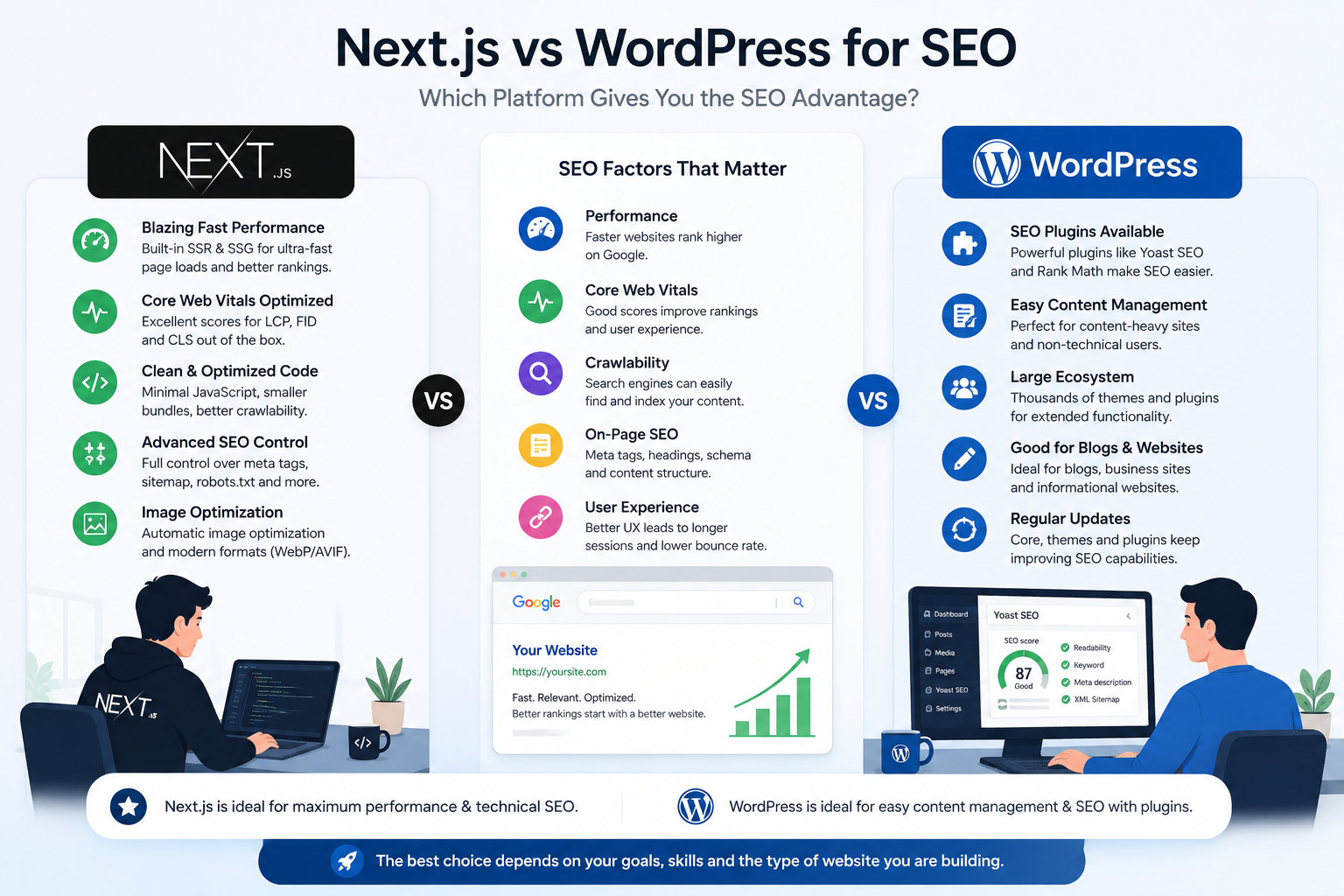
Next.js vs WordPress for SEO: What Matters
Organic SEO Marketing: Build Search Visibility That Compounds
SEO Content Strategy: How to Create Content That Ranks and Converts
SEO for B2B Companies: A Complete Strategy Guide