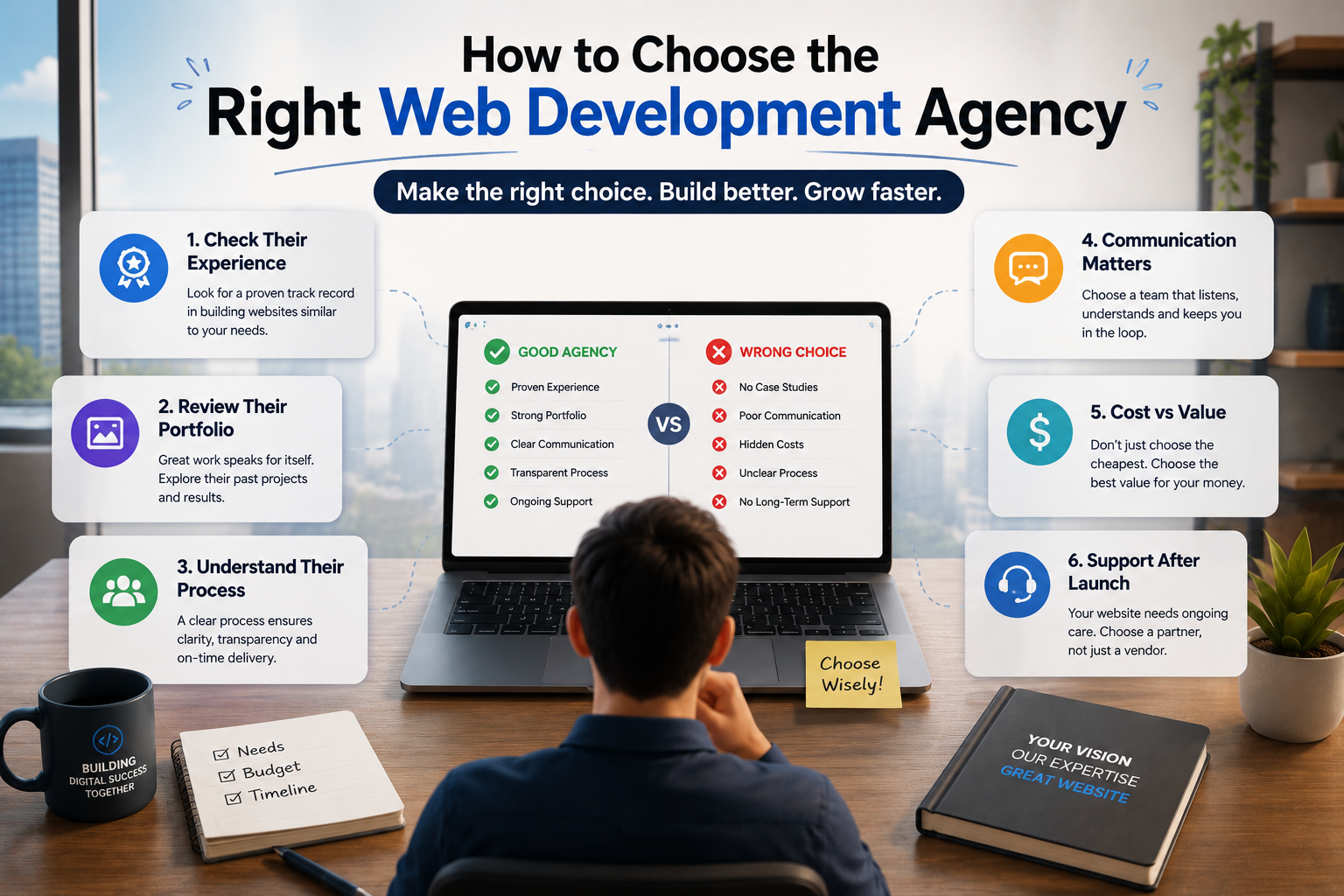
Why the Question Has No Single Answer
When someone asks what a website should cost and gets answers ranging from free to fifty thousand dollars, the spread is not evasion or confusion. It reflects the fact that the word website describes genuinely different things at different price points. A one-page placeholder built on a free Wix plan and a custom ecommerce platform handling five thousand SKUs are both websites. Expecting them to cost similar amounts is the misunderstanding that generates most of the frustration in these discussions.
The more useful question is not what a website costs but what your specific website needs to do, who needs to update it, and what it needs to produce commercially. Once those are clear, the right cost range becomes obvious. This page breaks down the actual cost stack, explains what is routinely missing from cheap quotes, and gives you the questions to ask before you commit to any proposal.
The short version before we go deeper
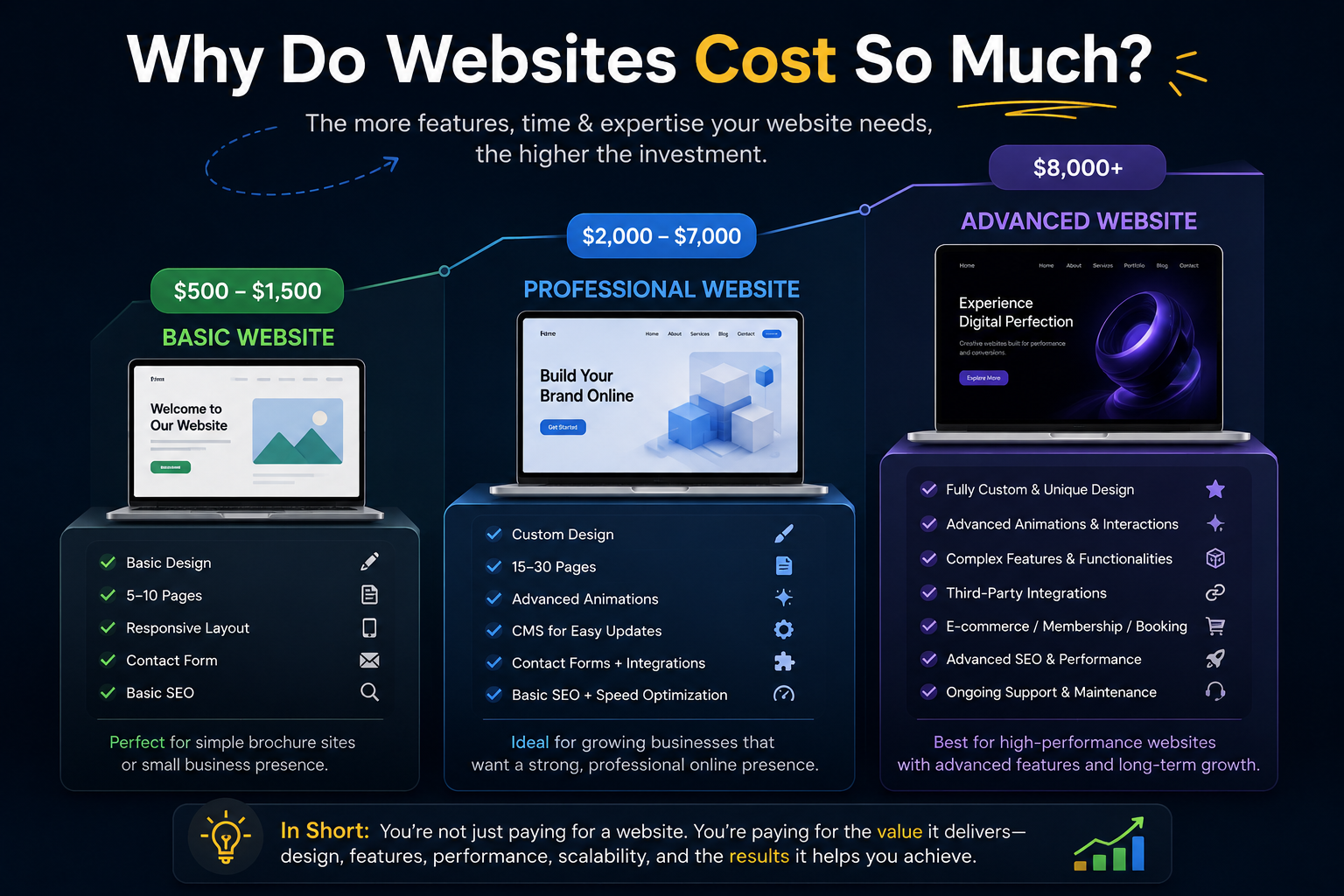
For a small business in 2026: a DIY builder runs $200 to $600 per year all-in. A professionally built 5 to 10 page site from a freelancer runs $2,000 to $8,000. An agency build for the same scope starts around $5,000 and goes up significantly with functionality. Ecommerce starts around $5,000 to $8,000 and scales with product count and custom requirements. Ongoing costs of $50 to $400 per month apply to professionally maintained sites and are routinely missing from initial quotes.

The Real Cost Stack: What You Are Actually Paying For
Most website quotes you receive present a single number: the build cost. That number is real, but it is one layer of a stack that includes recurring costs most buyers only discover after the site is live. Breaking the stack into its actual components is the first step toward a budget that does not surprise you six months after launch.
Cost Layer What It Is Typical Range Frequency Domain name Your web address, registered through a registrar $10 to $30 Per year Hosting Server space where the site files live $5 to $250 per month depending on traffic and type Monthly SSL certificate The padlock, encrypts data between browser and server $0 to $75 (often included in hosting) Per year Build cost Design, development, and initial setup $0 (DIY) to $50,000+ depending on scope One-time Plugin and theme licences Annual renewals for premium WordPress plugins or paid themes $0 to $800 per year Per year Maintenance and support Updates, backups, security, edits, and support $0 to $400 per month Monthly Content writing Copywriting for pages, if not supplied by the client $500 to $3,000+ for a full site, often excluded from quotes One-time SEO foundations Technical SEO setup, metadata, sitemaps, schema Included in some builds, excluded from many cheap quotes One-time setup
The number that matters for budgeting is not the build cost alone. It is the annual total cost of ownership: build cost amortised over two to three years, plus hosting, domain, licences, and maintenance. A $3,000 WordPress build with $1,200 per year in hosting, plugins, and maintenance has a three-year cost of roughly $6,600. A $10,000 Next.js build with $240 per year in hosting and lower maintenance requirements has a comparable three-year cost depending on how much support is needed. Neither of those is the wrong answer. They are different answers for different situations.
What a Cheap Quote Often Does Not Include
This is the section most cost guides skip, and it is the one that generates the most expensive surprises. A quote in the $300 to $800 range is not necessarily dishonest. But what it covers and what it leaves out are worth understanding clearly before you sign anything.
Hosting and domain renewal. Many cheap builds hand you a finished site but do not include or clearly explain the ongoing hosting cost. Twelve months later you get an invoice, or worse, the site goes offline because the hosting payment lapsed. Before accepting any quote, confirm whether hosting is included, for how long, and what the renewal cost is.
Content writing. The vast majority of fixed-price website quotes assume the client provides all text and images. A designer builds the structure. You fill it. If you hand over placeholder copy, you get a placeholder website. Professional content writing for a five to eight page site adds $500 to $2,500 to the real project cost, and it is usually the highest-return investment in the whole build.
SEO foundations. A site can look complete in the browser and be effectively invisible to Google. Basic technical SEO: correct metadata, an XML sitemap submitted to Search Console, structured data, and page speed optimisation are frequently absent from budget builds. You will not notice they are missing for weeks, by which point the developer is long gone.
Post-launch support. What happens when something breaks three months after launch? When you want to add a page, update a price, or fix a form that stopped working? Many cheap quotes cover build and handoff only. Any subsequent change is charged at an hourly rate you were not told about upfront. Ask specifically: what is included after the site goes live, and for how long?
Ownership of the site. This is the one that genuinely catches business owners off guard. Some providers, particularly subscription-model agencies, retain ownership of the design, codebase, or both. If you cancel, you lose the site. A legitimate build transfers full ownership of the domain, the code, and the design to you. If the contract does not say this explicitly, ask before signing.
Mobile optimisation. Not the same as a responsive layout. A site that displays on a phone is not necessarily one that works well on a phone. Touch target sizing, load time on mobile connections, and the mobile-first indexing Google uses for rankings all require deliberate attention. They are sometimes included, sometimes not. Worth confirming.
How Much Should a Small Business Website Cost?
For a small business website in 2026, the realistic cost range depends on which path you take and what the site needs to do. Here is an honest breakdown across the three main routes, including the ongoing costs most pricing guides present separately or omit entirely.
Route Upfront Cost Ongoing Monthly 3-Year Total Est. Best For DIY builder (Wix, Squarespace) $0 $16 to $50 $600 to $1,800 Startups and sole traders needing a presence fast Freelancer build (5 to 10 pages) $2,000 to $8,000 $30 to $150 hosting plus extras $3,000 to $14,000 Small businesses wanting custom design without agency overhead Agency build (small business) $5,000 to $25,000 $100 to $400 on a care plan $8,600 to $39,400 Businesses where the website is a serious commercial asset Ecommerce build $5,000 to $30,000+ $150 to $500 including platform fees $10,400 to $48,000+ Product businesses selling online with catalogue management needs Corporate or complex build $20,000 to $150,000+ $400 to $2,000+ Project-specific Enterprises with custom integrations, portals, or platform scale
Why Do Website Quotes Vary So Much?
A $500 quote and a $15,000 quote for what looks like the same five-page website are not actually pricing the same thing. The gap usually comes from a combination of five factors that quotes rarely surface clearly.
Who is doing the work
A developer in a lower cost-of-living market charging $30 per hour produces a different quote than a senior designer in London or New York charging $150. Neither is fraudulent. They reflect genuinely different labour costs. The relevant question is not which is cheaper but which combination of experience, communication, and deliverable quality is right for the commercial outcome you are buying the site to produce.
What is actually in scope
A quote that assumes you provide content, images, domain, and hosting, and that excludes SEO setup, post-launch support, and any revision rounds beyond two is a genuinely smaller project than it appears. A quote that includes discovery, copywriting, custom photography direction, SEO foundations, a content management system, and six months of support is a much larger one. Reading the scope carefully, and asking about everything that is not mentioned, resolves most of the apparent price confusion.
Build from template vs build from scratch
A developer applying a purchased WordPress theme with your logo and text can complete a site in a day or two. A designer building a custom visual system from a blank canvas, translating it into a component library, and implementing it in Next.js is doing fundamentally different work. Both produce a website. Only one produces something that looks and performs like no other site in your space.
Is a Cheap Website Builder Good Enough for a Small Business?
Sometimes, honestly yes. If you are a sole trader who needs a web presence this week, you have no marketing budget, and the site's job is to confirm you are a real business and provide contact details: a builder template at $20 per month beats no site by a wide margin. The important distinction is expectation. At that price point you are buying a digital business card. You are not buying a site engineered to generate leads, rank in competitive search results, or perform differently from every other business on the same template.
The cost of a builder also compounds in ways that are not obvious upfront. A Wix or Squarespace subscription never ends. Over five years, the $25 per month plan costs $1,500 with nothing to show at the end in terms of owned assets. A professionally built site on your own hosting, by contrast, is an owned digital asset you can sell, transfer, or rebuild on top of. Both models are legitimate. Neither is hidden. But understanding which one you are signing up for before you commit matters.
What Does Website Maintenance Actually Cost?
Maintenance is the cost category most buyers discover only after the site launches. It covers several distinct activities that are sometimes bundled into a care plan, sometimes charged hourly, and sometimes simply not offered at all by the original builder.
Maintenance Activity What It Involves Typical Cost CMS and plugin updates Keeping WordPress core and plugins updated to avoid security vulnerabilities Often included in care plans, $50 to $100/month standalone Backups Regular automated backups to a separate location so a crash does not mean total loss Often included in managed hosting, $10 to $30/month separately Content updates Text changes, new pages, image swaps, price updates $75 to $150/hour if not on a plan, or $100 to $300/month on a retainer Security monitoring Scanning for malware, responding to intrusion attempts, certificate renewal $20 to $100/month depending on tool and coverage Performance monitoring Tracking uptime, page speed, Core Web Vitals, and fixing regressions Sometimes included in care plans, $50 to $150/month standalone Emergency support Site down, broken form, payment failure — someone who answers quickly $100 to $200/hour if no retainer, or included in a care plan
A site with no maintenance plan is not a site that needs no maintenance. It is a site whose maintenance is being deferred until something breaks, at which point it costs significantly more to fix than a monthly plan would have cost over the same period. For businesses where the website is a revenue-generating asset, treating maintenance as optional is roughly equivalent to not servicing a commercial vehicle you depend on daily.
How Much Does an Ecommerce Website Cost?
Ecommerce builds cost more than standard informational sites for reasons that are straightforward once you look at the scope. A product catalogue with filtering and search, a checkout flow with payment gateway integration, inventory management, order confirmation emails, customer account portals, returns handling, and tax configuration are all features with real development time attached to them. None of that exists on a standard business site.
For a small ecommerce site with fewer than 200 products and standard checkout requirements, a realistic build range in 2026 is $5,000 to $15,000 depending on the platform and the level of custom design. Sites with hundreds of products, complex variant logic, integration with a warehouse management system, or subscription billing start considerably higher. You can use our website cost calculator to get a more specific estimate based on your actual requirements rather than a generic range.
DIY vs Freelancer vs Agency: The Honest Comparison
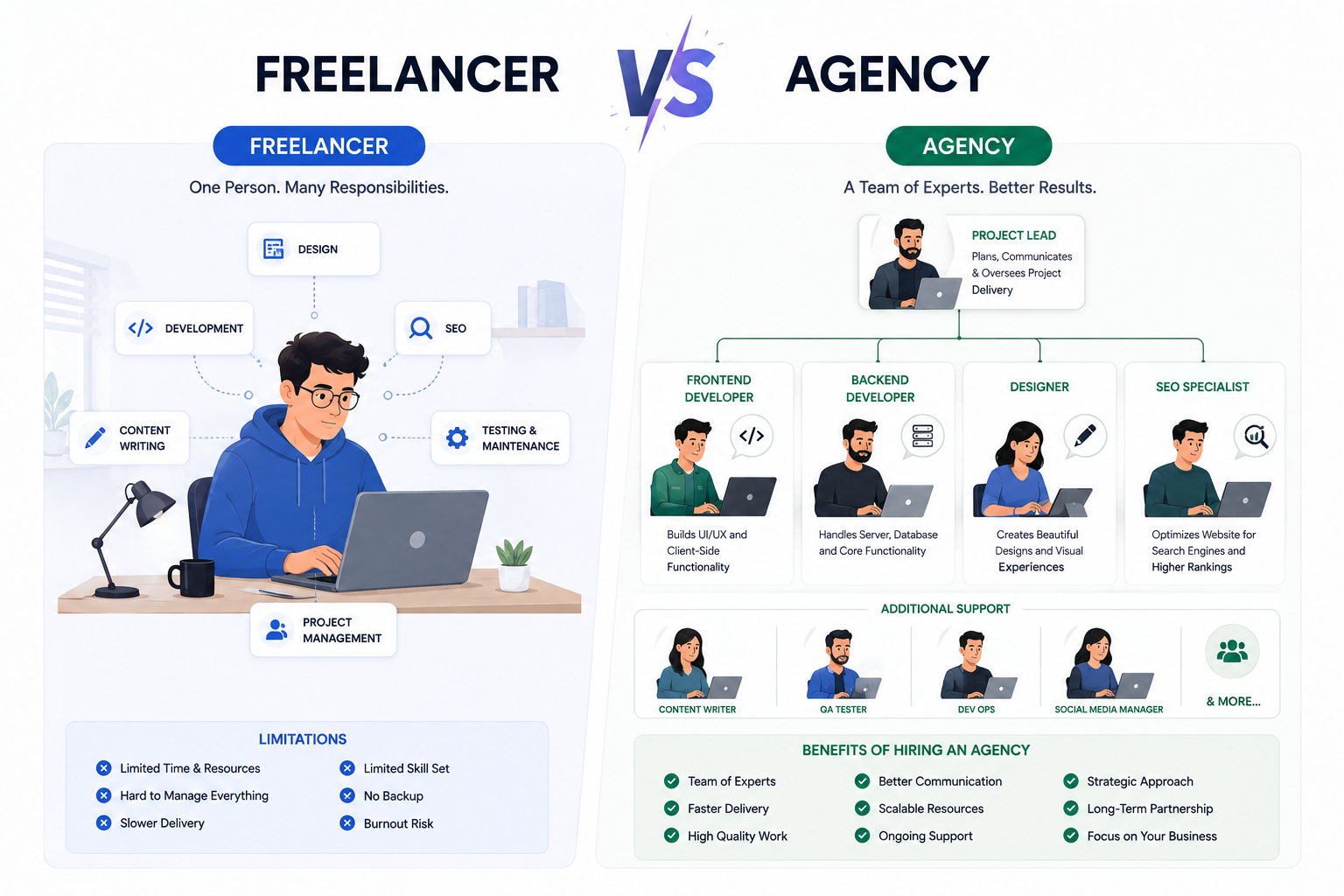
Factor DIY Builder Freelancer Agency Speed to launch Days 2 to 6 weeks 4 to 16 weeks Design quality ceiling Template limited Good to excellent depending on experience Highest, fully custom Content editing without a developer Yes, built in Depends on what was set up Depends on CMS included in build Site ownership Platform owns, you lose site if you cancel You own, check contract You own, check contract SEO foundations Basic, platform-limited Variable, ask specifically Included in a quality build Post-launch support Platform support only Often limited or hourly Usually a care plan option Performance and speed Platform ceiling, not optimised Good when done well Highest when built on a modern stack
What Munix Studio Charges and Why
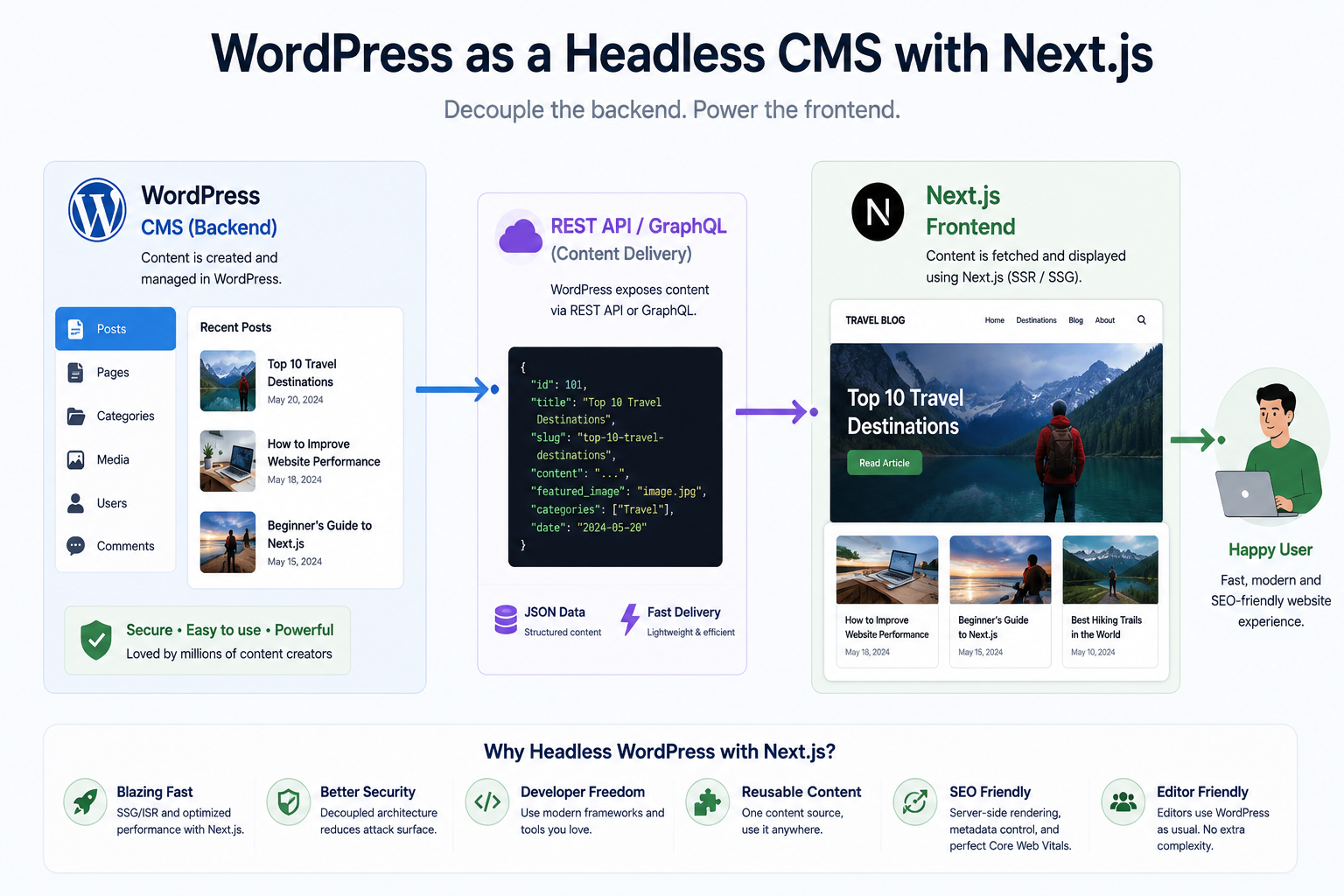
We build on React and Next.js. Our small business builds start from a few thousand dollars depending on scope and include a headless CMS so the client can update content without us, SEO foundations configured before launch, Core Web Vitals optimisation, and a handoff that leaves the client with a fully owned asset on their own hosting. We are not the cheapest option in the market. We are also not building template sites.
If you want a specific estimate for your project rather than a generic range, the most useful starting point is our website cost calculator, which walks through the actual scope factors that drive cost and produces a realistic range based on your requirements. If you are also considering a mobile app alongside your website, our app development cost calculator gives you the same transparency for that side of the budget.
Questions to Ask Any Provider Before You Commit
Regardless of which route you take, these questions surface the information most buyers wish they had asked before signing. Save this list and use it with every quote you evaluate.
Does this quote include hosting and domain, or are those billed separately? What will they cost per year?
Is content writing included? If not, what format do you need it in and when?
What SEO setup is included? Will the site have correct metadata, a sitemap, and schema markup at launch?
Who owns the domain, the code, and the design when the project is complete? Can I transfer everything to a new provider if I need to?
What happens after launch? How do I request changes, what do they cost, and who do I contact if something breaks?
How many rounds of revision are included, and what counts as a revision versus a new request?
Can a non-technical member of my team update content after launch without calling you?
What does the site look like on mobile, and how was that tested?
What platform is it built on, and what are the ongoing costs specific to that platform?
Services From Munix Studio
If you have a clearer picture of budget and scope after reading this, these are the services most relevant to where businesses in this conversation tend to land.
Website Development — Custom websites on React and Next.js with SEO foundations, headless CMS, and full ownership transferred to you on delivery.
SEO Optimization — Technical SEO and content strategy for sites that need to do more than look good, including the foundations that cheap builds routinely skip.
Maintenance and Support — Ongoing care plans covering updates, backups, performance monitoring, and content edits so you are not paying emergency rates when something breaks.
UI/UX Design — Custom design systems built from your brief rather than adapted from a purchased theme, for businesses where the site is a genuine commercial differentiator.
Frequently Asked Questions
Related Articles
Freelancer vs Agency: What Reddit Users Recommend

Choosing a Web Design Agency: Reddit's View
Headless CMS vs WordPress: The Honest Take
WordPress to Next.js Migration: What Happens
React vs WordPress for Small Business