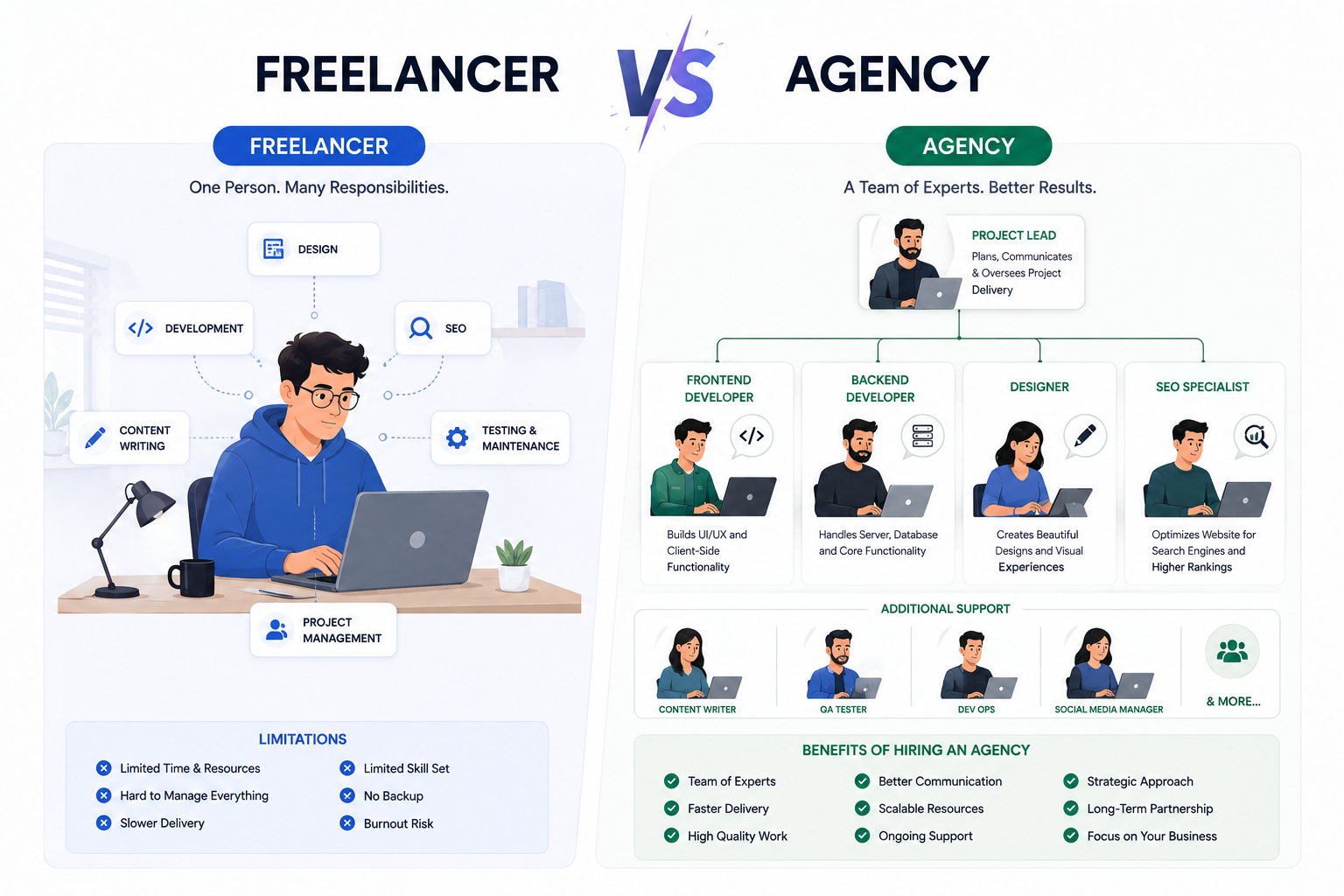
This is one of the first real decisions a founder makes after deciding to build something. You have a product idea, a rough budget, and two options in front of you: find a freelancer on Upwork or Toptal, or call an agency. Both will take your money. Both will promise results. The question is which one is actually right for where you are right now, not where you hope to be in six months.
This page does not pitch one over the other. It lays out what founders who have been through both actually report, what the real cost gap looks like, where each option breaks down, and a simple framework for matching the hire to your stage. If you are an agency, some of this will be uncomfortable to read. That is intentional.
The Quick Verdict
If you are pre-funding and testing whether your idea has legs, a freelancer is almost always the right starting point. The budget math alone justifies it. If you have raised money, have real users, and need a product that can scale reliably without depending on one person being available, an agency starts making more sense. If you have steady, ongoing development needs that show no sign of ending, hiring in-house is eventually the right move. The mistake most founders make is choosing the wrong option for the wrong stage.
What Founders Actually Say When They Ask This Question
A pattern that comes up consistently in founder discussions on Reddit, Blind, and startup communities is the same sequence of events. Start with a freelancer to build a proof of concept cheaply. Get the thing working well enough to show investors or early users. Then, once there is traction or funding, bring in an agency or start building a team for the next phase.
The advice is not "freelancers are better than agencies." It is "match the choice to where you actually are." A bootstrapped founder with $8,000 and an unvalidated idea has no business paying agency retainer rates to build something that might get scrapped after the first ten user interviews. That same founder, six months later, with $300,000 in seed funding and a product that real people are using, has a genuinely different problem that a more structured team can solve better.
Another pattern that surfaces often: founders who went straight to an agency on their first build sometimes feel they lost control of the process. Agencies have their own workflows, timelines, and internal priorities. You are one of several clients. With a freelancer you are often communicating directly with the person writing the code, which means faster decisions, faster iteration, and a working relationship that can develop into something long-term. That proximity is genuinely valuable in the early stages of a product.
Is It Cheaper to Hire a Freelancer or an Agency?
The rate gap is real and it is larger than most people expect. A commonly cited breakdown in founder-advice writing puts agency billing rates at $125 to $250 per hour, while the individual developer actually doing the work earns closer to $25 to $75 per hour. The difference between those two numbers is not profit. It covers project management, account management, QA, overhead, tooling, and the agency's own margin. Whether that markup is worth it depends entirely on how much you actually need those things.
Cost Factor Freelancer Agency Typical hourly rate (US market) $25 to $75 per hour $125 to $250 per hour Typical MVP project cost $5,000 to $20,000 $25,000 to $80,000 Project management included Usually no, you manage it Yes, built into the rate QA and testing included Rarely, unless specified Usually yes Contract flexibility High, stop anytime Lower, often minimum commitments Access to multiple specialists No, one person Yes, team of designers, devs, QA Risk if person becomes unavailable High, single point of failure Low, team covers continuity
Should a Startup Use a Freelancer for Their MVP?
For most pre-seed startups, yes. The purpose of an MVP is to test an assumption as cheaply and quickly as possible. You are not building the final product. You are building enough to learn whether the final product is worth building at all. Paying agency rates to validate an idea that might be wrong is a poor allocation of early capital.
A skilled freelancer with the right specialisation can build a functional MVP for a fraction of what an agency would charge. If the idea does not gain traction, you have spent $8,000 to find that out instead of $50,000. If it does gain traction, you have a working codebase, real user data, and a much clearer brief for whoever builds version two.
The caveat is that a bad freelancer can cost you more than an agency in the long run. A poorly written codebase that needs to be thrown out and rebuilt six months later is not a saving. Vetting matters as much as the model you choose. Check actual code samples if you can, speak to previous clients, and be cautious of anyone who does not ask enough questions about your product before agreeing to build it.
The Risk Nobody Mentions in Agency Sales Pages
The single point of failure problem with freelancers is real and worth taking seriously. If the one person who built your product becomes unavailable, whether through illness, a better opportunity, or simply going quiet, your project stops. There is no team to hand over to. No documentation system that another developer can pick up quickly. No account manager to call. This is the most cited reason founders graduate from freelancers to agencies or in-house teams once the product has users depending on it.
On the agency side, the risk that rarely gets mentioned is founder detachment. When your project is one of eight an agency is running simultaneously, you are not always their most urgent problem. Mid-project communication slows down. Decisions that should take an hour take a week because they are routed through an account manager who routes them to a project manager who routes them to the developer. For founders who need to iterate quickly based on user feedback, this lag can be genuinely damaging.
Neither of these risks disqualifies either option. They are just the honest version of what each choice actually involves, which most comparison articles written by agencies skip over entirely.
What Are the Risks of Hiring a Freelancer vs an Agency?
Risk Area Freelancer Risk Agency Risk Availability Disappears with no replacement Team continuity maintained Communication speed Direct, fast, no middleman Routed through layers, slower Code quality consistency Varies widely, harder to vet More consistent, internal standards Scope creep control Depends on the individual Better systems but still possible Priority among clients You can be their main focus One of many, not always urgent Post-launch support No guarantee, informal Usually structured into contract
When Should You Switch From a Freelancer to an Agency?
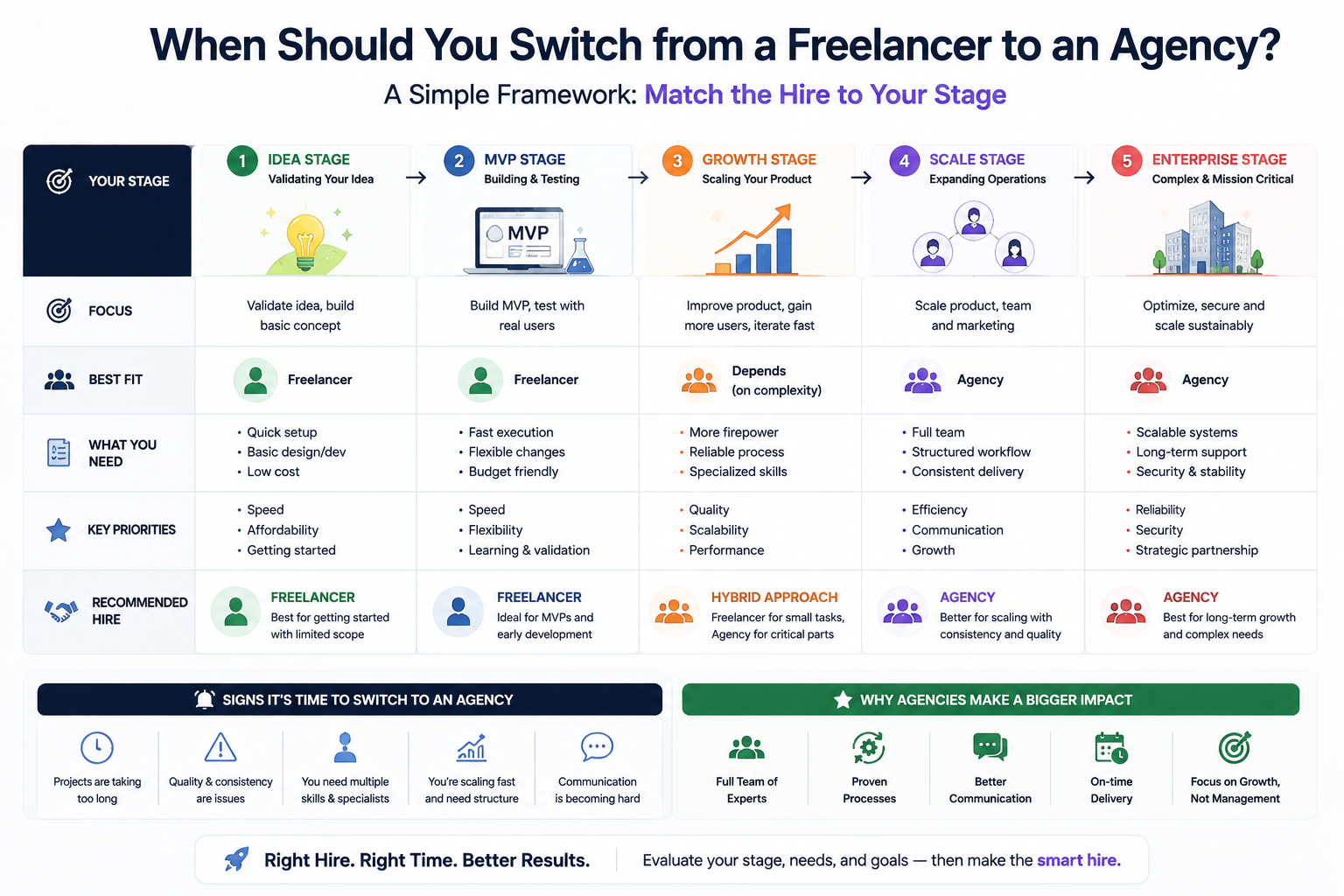
There are four signals that consistently indicate a founder has outgrown the freelancer model and needs a more structured setup.
The first is when reliability becomes non-negotiable. If your product has paying customers who depend on it, the single point of failure risk stops being theoretical. A freelancer taking two weeks off without warning is a minor inconvenience on an MVP. It is a serious problem on a live product with users.
The second is when you need more than one specialist simultaneously. Building a feature that requires a backend developer, a frontend developer, and a designer working in parallel is hard to coordinate across three separate freelancers. An agency structures that coordination for you.
The third is after funding. Pre-seed, conserving cash matters more than almost anything. Post-seed, the cost of a bad hire or a slow build often costs more than the price difference between a freelancer and a structured team.
The fourth is when you no longer have the bandwidth to manage the work yourself. Freelancers require founder involvement in project management. When a founder's time becomes too scarce to manage that effectively, delegating the management layer to an agency makes operational sense.
A Simple Framework: Match the Hire to Your Stage
Stage Situation Right Choice Why Pre-validation Idea unproven, bootstrapped, building PoC Freelancer Lowest cost to test before committing Post-validation, pre-funding Traction proven, still bootstrapped Freelancer or small studio Cash still tight, but reliability matters more now Funded and scaling Seed or Series A, real users, growth targets Agency or dedicated team Reliability, speed, and structure now justify the cost Mature product Steady ongoing development, no end in sight In-house team Long-term cost per output becomes lower than agency rates
How Much Does a Freelance Developer Cost vs an Agency?
In the US market, a mid-level freelance web developer typically charges between $50 and $100 per hour. Senior developers with strong portfolios and specialist skills charge $100 to $150. These are the rates for someone you find and vet yourself through platforms like Toptal, Upwork, or direct referral networks.
US-based agencies typically start at $125 per hour for junior-heavy teams and reach $250 or more for senior-led boutique shops. For a typical startup web or app project, a freelancer might quote $8,000 to $20,000 where an equivalent agency would quote $35,000 to $80,000. The difference is not all margin. It covers coordination, quality assurance, project management, and the operational infrastructure that means things keep moving even when one team member is unavailable.
Offshore agencies, particularly those based in South Asia and Eastern Europe, offer a middle path that many founders land on. You get the team structure and reliability of an agency at rates closer to senior freelancer pricing, typically $25 to $75 per hour depending on the location, team seniority, and the agency's positioning. The tradeoff is timezone overlap and communication overhead, both of which well-run offshore studios have systems for managing.
Where Munix Studio Fits Into This
We are an offshore digital product studio. We build websites, web apps, and mobile applications for startups and growing businesses, primarily clients in the US, UK, and EU. We are a good fit if you have a validated idea and need a full team covering design, development, and QA, but you do not want to pay Western agency rates to get it. We are not the right fit if you need someone to maintain a five-page WordPress site or make minor tweaks to an existing codebase. That is a freelancer job and we would tell you that directly.
If you are at the stage where the freelancer-versus-agency question is becoming real, you can get a rough cost estimate using our app development cost calculator or our website cost calculator before committing to any conversation. No form, no sales call required to get a number.
Related Services
Whether you are at the freelancer stage or ready for a structured team, the services below are where Munix Studio can be a genuine fit for your next build.
Dedicated Developers — Hire a dedicated developer or small team from Munix Studio who works exclusively on your product, combining the direct communication of a freelancer with the reliability of a structured team.
Website Development — Custom website and web app development for startups that have validated their idea and need a production-quality build without paying US agency rates.
App Development — iOS, Android, and cross-platform app development for founders moving from MVP to a product that real users depend on daily.
Frequently Asked Questions
Related Articles

Choosing a Web Design Agency: Reddit's View
Headless CMS vs WordPress: The Honest Take
WordPress to Next.js Migration: What Happens
React vs WordPress for Small Business

How Much Should a Website Cost in 2026