What Is Cross Platform App Development?
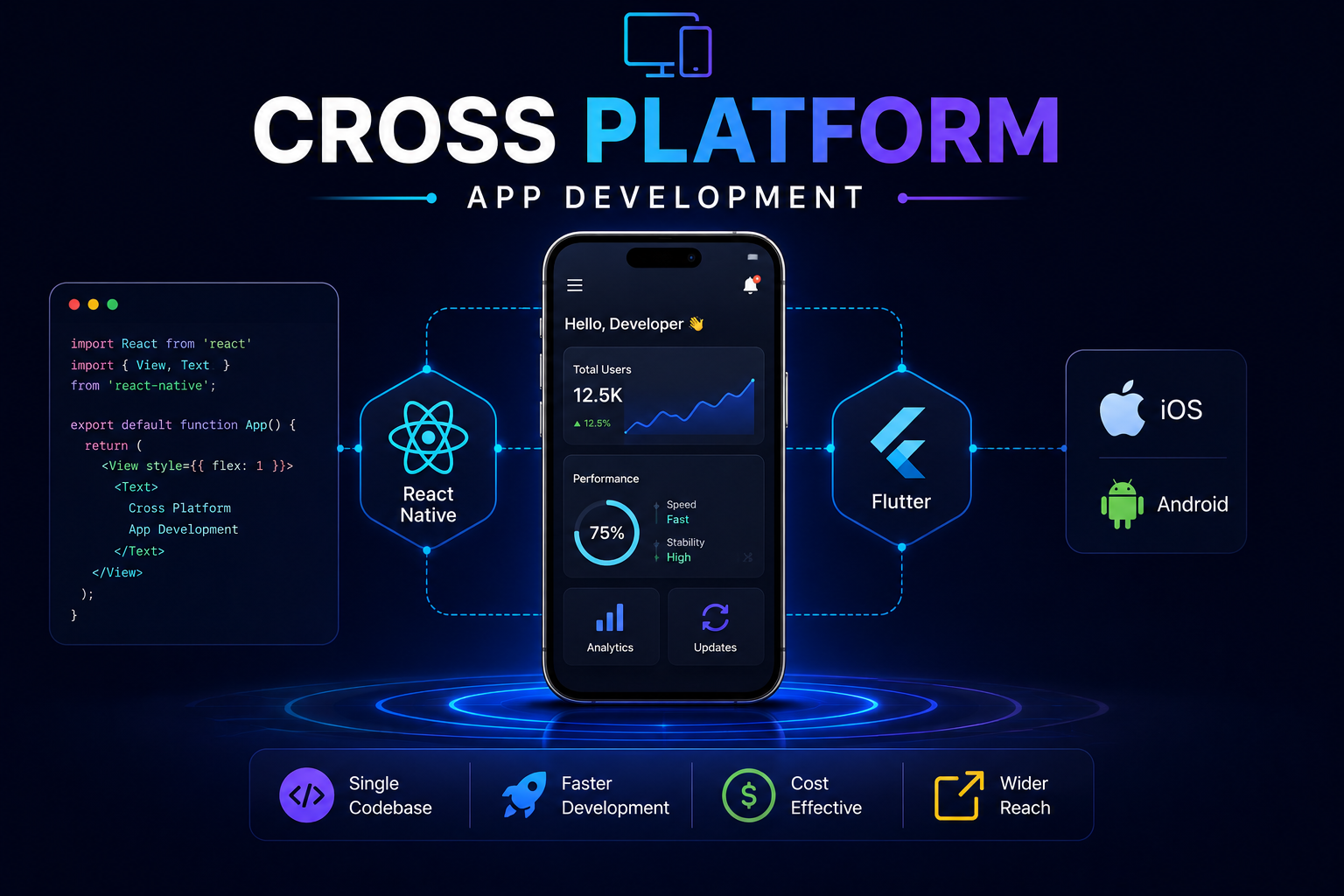
Cross platform app development is the practice of building a single mobile application that runs on multiple operating systems, most commonly iOS and Android, from one shared codebase. Instead of writing separate applications for each platform using platform-specific languages and tools, a cross platform approach allows developers to write the code once and deploy it across both app stores simultaneously.
This approach has become the default choice for the majority of business mobile app projects because it reduces development time, lowers cost, and simplifies ongoing maintenance without sacrificing the performance and user experience that modern frameworks like React Native and Flutter deliver. A business that previously needed two separate development teams and two separate budgets to cover iOS and Android can now achieve both with a single unified team and a single codebase.
The distinction between cross platform and hybrid app development is worth clarifying upfront. Hybrid apps are built using web technologies like HTML, CSS, and JavaScript wrapped inside a native container, which typically produces a slower and less polished experience. Modern cross platform frameworks like React Native and Flutter compile to native components directly, which is why they consistently outperform older hybrid approaches and why the two terms are no longer interchangeable in professional development contexts.
Cross Platform vs Native App Development
The choice between cross platform and native app development is the most consequential technology decision in any mobile project. Both approaches have genuine strengths and real limitations, and the right answer depends on the specific requirements, budget, and timeline of each project rather than on a universal rule.
Native development means building separate applications for each platform using platform-specific languages. iOS apps are built using Swift or Objective-C. Android apps are built using Kotlin or Java. Each app has direct access to every device API, renders using the platform's own UI components, and performs at the maximum capability of the hardware. The trade-off is that maintaining two separate codebases doubles the development and maintenance cost and requires two teams with different technical specializations.
Cross platform development uses a single shared codebase that targets both platforms simultaneously. Modern frameworks like React Native and Flutter have eliminated most of the performance gap that existed between cross platform and native in earlier years. For the vast majority of business applications, the difference in performance is imperceptible to real users. The cases where native still has a meaningful advantage are applications that require intensive graphics processing, augmented reality, complex animations at very high frame rates, or deep integration with platform-specific APIs that are not yet supported by cross platform frameworks.
Factor Cross Platform Native Development Development cost Lower, single codebase for both platforms Higher, two separate codebases required Time to market Faster, one team builds both platforms simultaneously Slower, parallel teams or sequential builds needed Performance Very good for most business apps Maximum, direct OS access UI consistency Very good, minor platform differences possible Perfect native look per platform Device feature access Most features available via libraries Full access to all device APIs Maintenance overhead Lower, one codebase to maintain Higher, two codebases to update and maintain Team requirements Single team with one skill set Separate iOS and Android specialists Best for Most business apps, startups, MVPs, budget-conscious projects Games, AR/VR, performance-critical apps, complex platform integrations
The Main Cross Platform App Development Frameworks
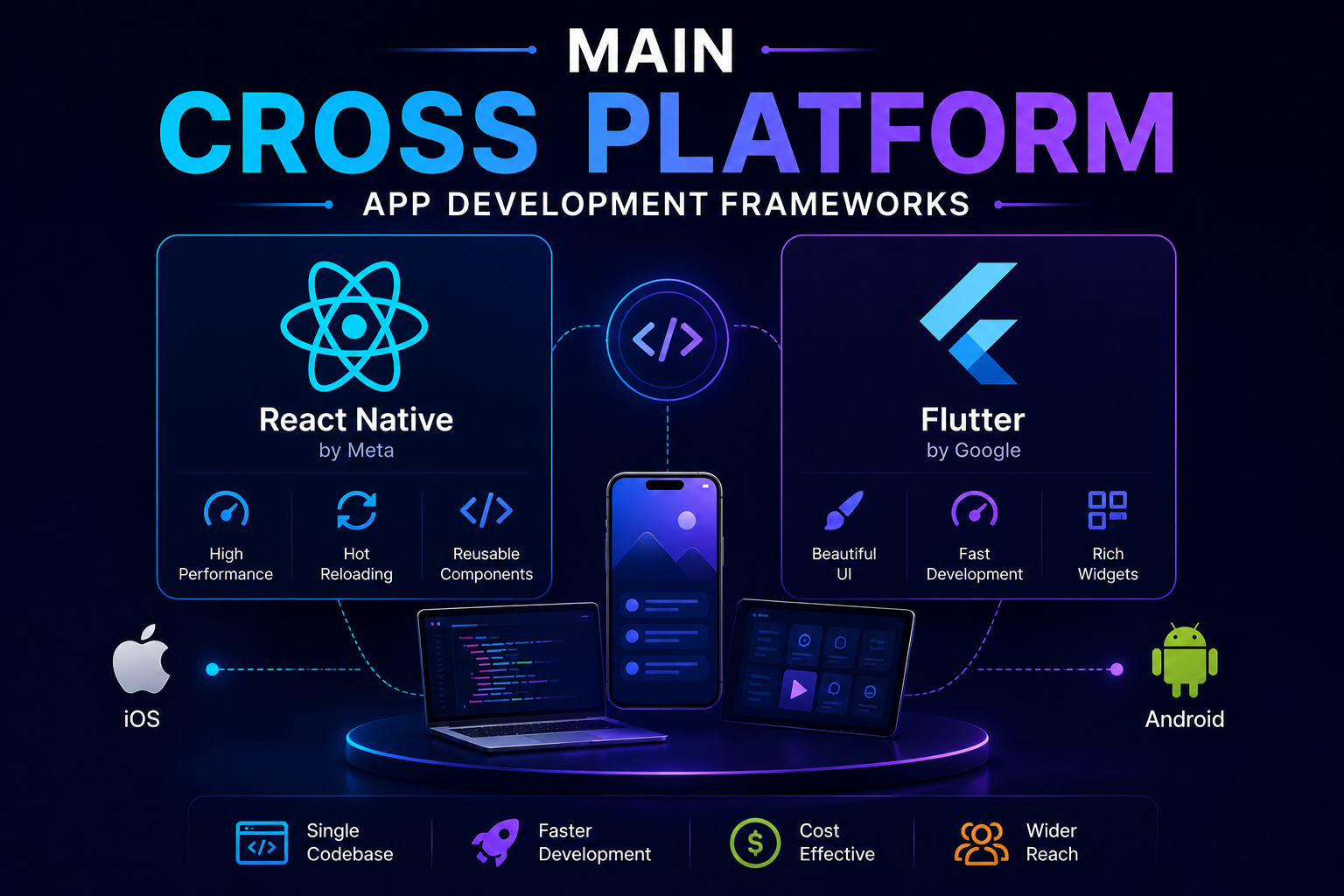
The cross platform framework landscape has consolidated significantly over the past few years. React Native and Flutter now account for the overwhelming majority of professional cross platform development, with Xamarin maintaining a presence in enterprise Microsoft environments and Ionic serving the hybrid web app segment.
Framework Language Performance UI Approach Best For Backed By React Native JavaScript / TypeScript Excellent Native platform UI components Business apps, JS/React teams, most use cases Meta (Facebook) Flutter Dart Excellent Custom rendered widgets Highly custom UI, pixel-perfect design, web plus mobile Google Xamarin C# Good Native platform UI components Microsoft and .NET enterprise environments Microsoft (transitioning to MAUI) Ionic HTML / CSS / JavaScript Moderate Web components in a native shell Web developers building simple hybrid apps Ionic team
React Native for Cross Platform Development
React Native is the most widely adopted cross platform framework and the one most professional development agencies including Munix Studio use as their primary tool for mobile app projects. Built by Meta and used in production by companies including Facebook, Shopify, Microsoft, and Discord, React Native renders using actual native UI components rather than web views, which is why its performance is indistinguishable from native for the vast majority of business applications.
The significant advantage of React Native for teams already working with React on the web is that the programming model is near-identical. A team building a web application in React and a mobile application in React Native can share business logic, state management patterns, and significant portions of the codebase between platforms. This code reuse across web and mobile is one of the strongest economic arguments for React Native in full-stack projects that need both a website and a mobile application.
Flutter for Cross Platform Development
Flutter, developed by Google, takes a different architectural approach from React Native. Rather than using native UI components, Flutter renders its own widget layer using the Skia graphics engine, which means the visual output is pixel-perfect and identical across both platforms. This makes Flutter particularly strong for applications with highly custom visual designs where pixel-perfect consistency across iOS and Android is more important than platform-native visual conventions.
Flutter's language, Dart, has a steeper onboarding curve for teams coming from JavaScript backgrounds compared to React Native. However, for teams working on projects that also need a web version, Flutter's ability to compile to web, desktop, iOS, and Android from a single codebase provides coverage that React Native's web story does not yet fully match. Flutter is growing rapidly in adoption and is an excellent choice for the right project profile.
Xamarin Cross Platform App Development
Xamarin allows developers to build iOS and Android applications using C# and the .NET ecosystem. It is the natural choice for organizations whose development teams are primarily .NET engineers and whose backend infrastructure runs on Microsoft Azure. Microsoft is actively transitioning Xamarin to .NET MAUI, which is its successor and extends cross platform support to Windows and macOS desktop in addition to mobile. For teams already invested in the Microsoft ecosystem, Xamarin and MAUI represent a coherent cross platform path with strong enterprise tooling support.
Kotlin Multiplatform for Cross Platform Development
Kotlin Multiplatform, which Google officially endorsed in May 2024, takes a different approach from React Native, Flutter, and Xamarin: rather than sharing the UI layer across platforms, it shares business logic, networking, and data layer code while leaving the UI fully native on each platform, written in Swift/SwiftUI for iOS and Kotlin/Jetpack Compose for Android. This gives teams a middle path between full native development and full cross platform frameworks — the parts of an app that don't need to look or feel platform-specific (API calls, data models, validation logic) are written once, while the UI retains complete native performance and platform-appropriate design conventions.
Compose Multiplatform, JetBrains' extension of Kotlin Multiplatform, now also supports sharing the UI layer itself across Android, iOS, and desktop, closing much of the gap with Flutter for teams that want that option without leaving the Kotlin ecosystem. Kotlin Multiplatform is a particularly strong fit for existing Android teams that already have significant Kotlin expertise and want to extend into iOS without adopting an entirely different language and framework, or for products where native-feeling UI on each platform matters more than a single shared visual layer.
No-Code and Low-Code Cross-Platform App Builders
Everything covered above assumes a development team writing code in React Native, Flutter, Xamarin, or Kotlin Multiplatform. For simpler apps, internal tools, or early-stage validation before committing to a full build, a no-code or low-code platform is a legitimate alternative worth understanding.
Bubble, Adalo, and Glide let a functional cross-platform app be built through a visual interface, with the platform handling both iOS and Android deployment from a single visual project rather than a shared codebase in the traditional sense. FlutterFlow takes a slightly different position: it's a visual builder that generates actual Flutter code underneath, which means a project can start in FlutterFlow's drag-and-drop editor and later be exported and handed to a development team for custom extension, an easier transition than fully proprietary no-code platforms allow.
The tradeoff is the same one that applies to no-code platforms across every category covered elsewhere on this site: significantly faster and cheaper to launch, in exchange for hard ceilings on custom functionality, backend complexity, and performance once an app needs to do something the platform wasn't designed for. For an MVP validating demand, an internal tool with a small user base, or a simple app with standard functionality, a no-code builder can be the right call. For any app expected to scale, integrate custom backend systems, or eventually need App Store-level polish and performance, the frameworks covered above remain the more durable investment, and starting there directly avoids the migration cost of outgrowing a no-code platform later.
Advantages of Cross Platform App Development
Significantly lower development cost. Building one codebase that targets both iOS and Android typically costs 30 to 50 percent less than building and maintaining two separate native applications. For startups and businesses with defined budgets, this cost difference is often the deciding factor.
Faster time to market. A single team building one codebase ships both platforms simultaneously rather than sequentially. For businesses where speed to market is a competitive advantage, this acceleration is genuinely impactful.
Simplified maintenance. Bug fixes, feature additions, and updates are made once in the shared codebase and deployed to both platforms simultaneously. Maintaining two separate native apps doubles the effort required for every change made after launch.
Consistent user experience across platforms. A shared codebase ensures that feature parity between iOS and Android is maintained by default. Native development frequently results in one platform receiving features or updates ahead of the other due to different team priorities or resource constraints.
Larger talent pool. React Native developers come from the JavaScript ecosystem, which is by far the largest developer community in the world. Finding and hiring React Native developers is significantly easier than finding experienced Swift or Kotlin specialists.
Code reuse with web applications. For businesses building both a web application and a mobile app, React Native allows significant business logic and state management code to be shared between the web and mobile codebases, reducing total engineering effort across the full product.
Cross-Platform App Development for TV and Connected Devices
Cross platform development isn't limited to phones and tablets. Both major frameworks extend to television and connected-device platforms, an increasingly relevant category as streaming and media apps expand beyond mobile.
React Native supports TV development through react-native-tvos, a fork maintained specifically for Apple TV (tvOS) and Android TV, allowing a substantial portion of an existing React Native mobile codebase to extend to the living room with platform-specific navigation and remote-control input handling layered on top. Flutter similarly supports Android TV natively and has growing tvOS support, using the same widget-based rendering approach already covered in this guide's Flutter section, adapted for D-pad navigation instead of touch input.
TV app development introduces distinct UX requirements that don't apply to phone and tablet builds: navigation must work entirely through a remote control's directional pad rather than touch gestures, focus states need to be clearly visible since there's no cursor or tap feedback, and layouts need to account for viewing distances of ten feet or more rather than the twelve to eighteen inches typical of phone use. A cross-platform codebase shared between mobile and TV still requires this TV-specific interaction layer to be built and tested separately, even when the underlying business logic and API integration are fully reused from the mobile app.
For a business already building a cross-platform mobile app in React Native or Flutter, extending into Android TV and Apple TV is a meaningfully smaller lift than building native TV apps from scratch, since the data layer, authentication, and core business logic typically transfer directly — the additional work is concentrated in the TV-specific interface and navigation layer rather than a full second application.
Disadvantages of Cross Platform App Development
Performance ceiling for demanding use cases. Applications that require intensive graphics processing, augmented reality, complex custom animations at sustained high frame rates, or deep integration with the latest platform-specific APIs will consistently hit performance ceilings that native development does not impose. For these specific use cases, native is still the correct choice.
Dependency on framework updates. When Apple or Google releases a major iOS or Android update with new APIs or UI components, the cross platform framework must update to support them before developers can access them. This creates a lag between platform capability and cross platform availability that native developers do not experience.
Platform-specific nuances require additional effort. While most of the codebase is shared, certain UI behaviors, navigation patterns, and interaction conventions differ between iOS and Android. Implementing these correctly in a cross platform app requires platform-specific code for those components, which adds complexity beyond the purely shared portions.
Larger app bundle size. Cross platform apps typically include the framework runtime as part of the application package, which results in a larger download size compared to a lean native app. For users in markets with limited storage or slow data connections, this can affect adoption rates.
Third-party library availability. While both React Native and Flutter have extensive library ecosystems, some specialized native libraries may not have cross platform equivalents, requiring custom native modules to be written and maintained separately for each platform.
Cross Platform vs Native: Which Should You Choose?
The answer depends on four key factors: budget, timeline, performance requirements, and the nature of the app's core functionality. For the vast majority of business applications, cross platform is the right choice. For a small category of performance-critical or highly platform-specific applications, native remains the better option.
Your Situation Recommended Approach Reason Startup building an MVP for both platforms Cross platform Lower cost, faster launch, easier to iterate Business app with standard UI and backend integration Cross platform No meaningful performance advantage to native for this use case 3D game or AR/VR application Native Requires maximum GPU performance and direct platform API access App needing latest iOS or Android features immediately Native Cross platform frameworks lag behind new platform API releases Enterprise app for internal teams on both platforms Cross platform Single codebase dramatically reduces ongoing maintenance cost for internal tools App requiring highly custom pixel-perfect UI Flutter Custom rendering engine gives complete visual control on both platforms Team already working in React on the web React Native Shared skills and codebase across web and mobile maximizes efficiency
Cross Platform App Development Tools
Beyond the core framework, a cross platform development project uses a consistent set of supporting tools for code editing, testing, deployment, and performance monitoring. The following are the most commonly used tools in professional cross platform development workflows.
Tool Purpose Used With VS Code Primary code editor with React Native and Flutter extensions React Native, Flutter Expo Development toolchain and build service for React Native, simplifies setup significantly React Native Android Studio Android emulator and debugging environment React Native, Flutter, Xamarin Xcode iOS simulator, app signing, and App Store submission React Native, Flutter, Xamarin Firebase Authentication, database, push notifications, analytics, crash reporting React Native, Flutter Fastlane Automated build and deployment to both app stores React Native, Flutter Jest / Detox Unit testing and end-to-end testing for React Native applications React Native
Cross Platform App Development for Regulated Industries
A common concern about cross platform development in highly regulated industries such as healthcare, financial services, and legal is whether the technology can meet the security and compliance requirements those sectors impose. The short answer is yes, with appropriate architecture and implementation decisions.
Security in a cross platform app is determined by the architecture of the backend systems the app communicates with, the encryption standards applied to data in transit and at rest, the authentication mechanisms implemented, and the handling of sensitive data within the app itself. None of these security properties are inherent to the choice of cross platform versus native. A well-architected React Native application with proper encryption, certificate pinning, secure storage, and a HIPAA or PCI-compliant backend is fully capable of meeting the requirements of regulated industries.
How Much Does Cross Platform App Development Cost?
Cross platform app development costs vary based on the complexity of the application, the number of features required, the backend infrastructure needed, and the experience level of the development team. The following ranges reflect professional agency development with a structured process including design, development, testing, and deployment.
App Complexity Features Included Timeline Cost Range Simple MVP Basic UI, limited screens, no custom backend 4 to 8 weeks $5,000 to $15,000 Medium complexity Authentication, database, API integration, push notifications 2 to 4 months $15,000 to $50,000 Complex application Real-time features, payments, complex backend, offline functionality 4 to 8 months $50,000 to $150,000 Enterprise application Custom backend, compliance requirements, high scalability, complex integrations 6 months plus $150,000 and above
Build Your Cross Platform App With Munix Studio
At Munix Studio we build cross platform mobile applications using React Native, giving our clients iOS and Android coverage from a single professionally engineered codebase. Every project follows a structured process from discovery and design through to app store submission and post-launch support, with a technology stack chosen to match the specific requirements of each project.
App Development — Cross platform iOS and Android applications built with React Native, engineered for performance, reliability, and a seamless user experience on every device.
UI/UX Design — Mobile-first interface design that maps every user journey across both platforms, validates flows through interactive prototypes, and delivers screens that feel intuitive from the first interaction.
Website Development — Custom web applications built on React and Next.js that share business logic and design systems with your React Native mobile app for maximum development efficiency.
DevOps and Cloud — Backend infrastructure, API hosting, database management, and CI/CD pipelines that keep your cross platform app reliable and scalable as your user base grows.
Maintenance and Support — Ongoing app updates for OS compatibility, security patches, performance improvements, and new feature development to keep your application current on both platforms after launch.
Frequently Asked Questions
Ready to Get Started?
App Development
Cross platform iOS and Android applications built with React Native, engineered for performance, reliability, and a seamless user experience on every device from a single shared codebase.
Explore App DevelopmentUI/UX Design
Mobile-first interface design covering every user journey across both platforms, validated through interactive prototypes before a single line of production code is written.
Explore UI/UX DesignDevOps and Cloud
Backend infrastructure, API hosting, database management, and CI/CD pipelines that keep your cross platform app reliable, secure, and scalable as your user base grows.
Explore DevOps and Cloud