What Is Digital Marketing?
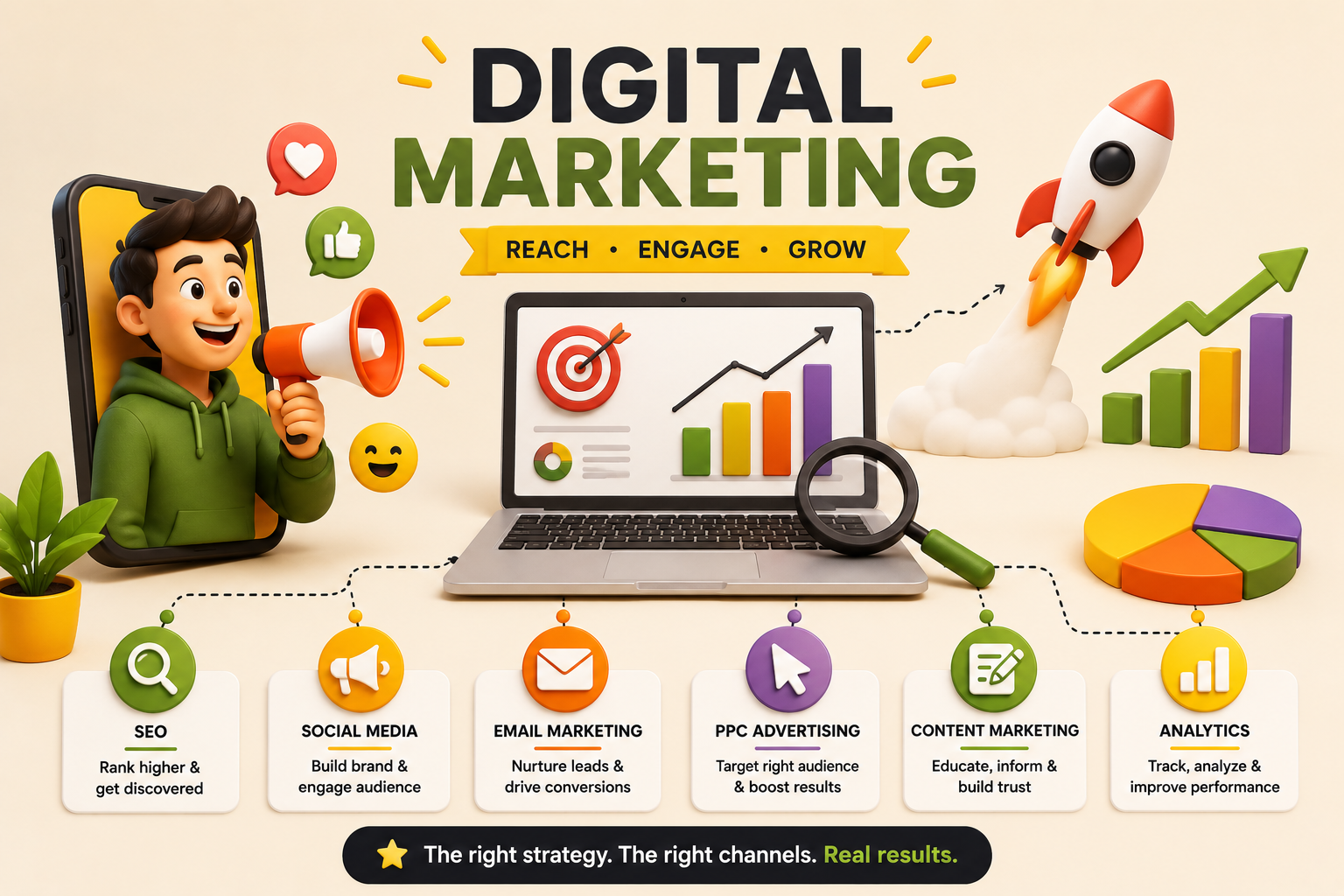
Digital marketing is the promotion of products, services, or brands through digital channels and technologies, including search engines, social media platforms, email, websites, mobile applications, and paid advertising networks. It is how businesses reach the people they want to serve at the exact moment those people are looking, browsing, or deciding — online.
In digital marketing, every action is measurable. Unlike a billboard or a television commercial where impact can only be estimated, a digital campaign tells you precisely how many people saw it, how many clicked, what they did afterward, and what it cost to acquire each one. This data loop is what makes digital marketing the dominant advertising model for businesses of every size in 2026.
What is digital marketing in the context of a real business? It is the full system a business uses to be found online, to build trust with its audience, and to convert that audience into customers. A local restaurant using Google Ads and managing its Google Business Profile is doing digital marketing. A SaaS company publishing SEO-optimised blog posts and running LinkedIn ads is doing digital marketing. A creator earning affiliate commissions through a YouTube channel is doing digital marketing. The channels differ. The goal is always the same: connect a specific audience with a specific offer, profitably and measurably.
Digital Marketing vs Traditional Marketing
What is traditional versus digital marketing, and does the distinction still matter? Traditional marketing uses offline channels like television, radio, print newspapers, magazines, direct mail, and outdoor billboards to reach an audience. Digital marketing uses online channels to do the same. The two are not in opposition. Many businesses run both simultaneously. But the practical differences in cost, targeting, measurability, and speed of results are significant enough that most growth-focused businesses prioritise digital first and supplement with traditional where the audience demands it.
Factor Traditional Marketing Digital Marketing Audience targeting Broad, demographic-based Precise — by interest, intent, location, behaviour Measurability Estimated reach, difficult to attribute Precise — impressions, clicks, conversions, revenue Cost to start High — TV, print, outdoor are expensive Low — campaigns can start for any budget Speed of results Weeks to months Hours to days for paid, weeks to months for organic Two-way interaction One-directional broadcast Interactive — comments, shares, replies, reviews Adjustability Fixed once published — difficult to change Adjustable in real time based on performance data Geographic reach Regional or national, expensive for global Global from day one at any budget level Word of mouth amplification Slow — organic referral only Rapid — viral sharing, reviews, social proof
The digital version of word-of-mouth marketing is one of the most powerful forces in digital marketing today. Online reviews, social media shares, influencer recommendations, and user-generated content all serve the same function as a personal recommendation between friends, but at a scale that traditional word of mouth could never reach.
The Main Types of Digital Marketing
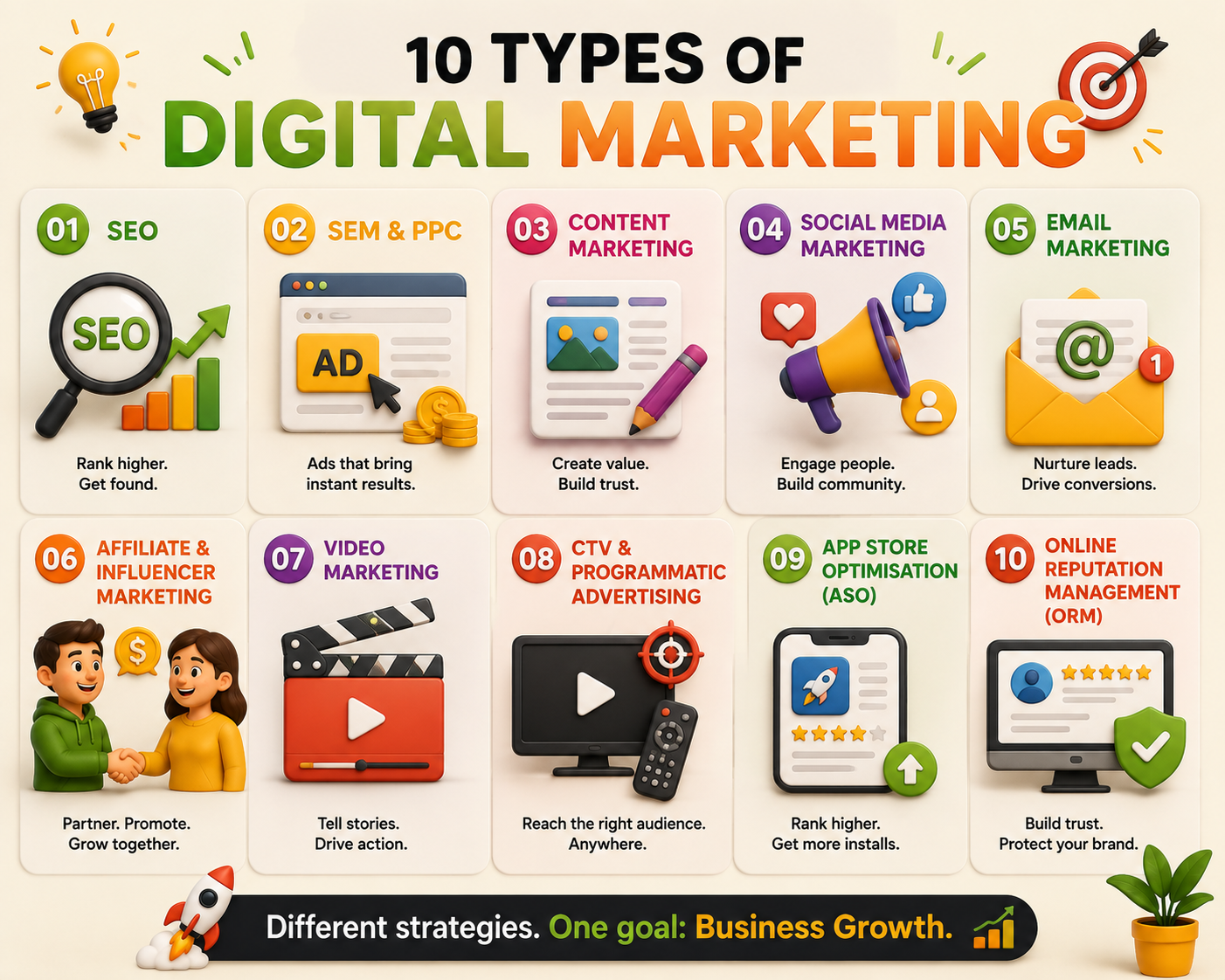
Digital marketing is not a single activity. It is an ecosystem of channels and disciplines that each serve different purposes, reach different audiences, and operate on different timescales. Understanding each type gives businesses the foundation to build a strategy that combines the right channels for their specific goals rather than chasing every platform simultaneously.
1. Search Engine Optimisation (SEO)
SEO is the process of optimising a website so that it ranks higher in organic search results on platforms like Google and Bing. What is SEO in digital marketing in practical terms? When someone types a search query into Google, the pages that appear are ranked by an algorithm that evaluates hundreds of signals including content relevance, page speed, backlinks, mobile optimisation, and structured data. SEO is the discipline of optimising every one of those signals so that the right pages rank for the right queries.
SEO produces long-term, compounding organic traffic that does not require a payment every time someone clicks. It is divided into three areas: on-page SEO, which covers content, keywords, and page structure; off-page SEO, which covers backlinks and authority; and technical SEO, which covers crawlability, site speed, and indexability. What is on-page SEO in digital marketing? It is the specific optimisation of each individual page's content and structure to match the intent of the search queries it is meant to rank for.
2. Search Engine Marketing (SEM) and Pay-Per-Click (PPC)
What is SEM in digital marketing? Search engine marketing refers to paid advertising on search engines, most commonly through Google Ads and Bing Ads. What is SEO and SEM in digital marketing when used together? SEO builds organic visibility over time while SEM provides immediate paid visibility at the top of search results. The two complement each other: SEM captures immediate commercial intent while SEO compounds into lower-cost organic traffic over time.
What is SEO and PPC in digital marketing when viewed as a combined strategy? Businesses use PPC to dominate paid positions on high-intent queries while their organic SEO efforts work toward the same positions at zero cost per click. When both are working simultaneously, the brand occupies multiple positions on the same search results page, which increases both visibility and click share significantly. PPC advertising operates on a pay-per-click model, meaning the business pays only when a user clicks the ad, with bid prices determined by keyword competition and Quality Score.
3. Content Marketing
Content marketing is the creation and distribution of valuable, relevant content to attract and retain a clearly defined audience. Blog posts, guides, whitepapers, videos, infographics, podcasts, case studies, and webinars are all content marketing formats. What is an example of digital marketing through content? A law firm publishing a monthly guide to employment law changes is doing content marketing. So is a software company producing weekly video tutorials for its product category.
Content marketing is the fuel for SEO. Search engines need content to rank, and audiences need content to make informed purchasing decisions. What is keyword research in digital marketing? It is the process of identifying the specific search queries an audience uses so that content can be built around the topics they are actually searching for rather than the topics a business assumes they care about. What is content syndication in digital marketing? It is the republication of existing content on third-party platforms to extend its reach beyond the original audience.
4. Social Media Marketing (SMM)
What is SMM in digital marketing? Social media marketing is the use of social platforms to build brand awareness, engage with an audience, drive traffic, and generate leads or sales. It operates across both organic and paid formats. Organic social involves publishing content directly to a brand's social media profiles. Paid social involves running targeted advertising campaigns on platforms like Meta, LinkedIn, TikTok, Instagram, and Pinterest.
What is digital marketing on TikTok specifically? TikTok's short-form video algorithm surfaces content to users based on engagement signals rather than follower count, which gives brands the opportunity to reach enormous audiences with a single piece of well-executed organic content without requiring an existing following. TikTok advertising also offers highly specific targeting by interest, behaviour, and demographic, making it a viable paid channel for brands targeting younger consumer demographics.
5. Email Marketing
Email marketing is one of the highest-ROI channels in digital marketing. It allows businesses to communicate directly with a list of subscribers who have opted in to receive messages, with personalisation and segmentation capabilities that no other channel matches at the same cost. What is digital performance marketing in the context of email? It is the use of measurable metrics like open rates, click-through rates, and revenue per send to optimise every campaign for commercial outcome rather than vanity metrics.
Email marketing supports every stage of the buyer journey. Welcome sequences introduce new subscribers to a brand. Nurture sequences build trust and educate leads over time. Promotional campaigns drive immediate revenue. Re-engagement sequences recover inactive subscribers. And post-purchase sequences build loyalty and generate repeat business. What is a CMS with digital marketing? A content management system with email and marketing integrations allows teams to manage content, list segments, and campaign automations from a single platform rather than switching between disconnected tools.
6. Affiliate and Influencer Marketing
What is digital and affiliate marketing when combined? Affiliate marketing is a performance-based model in which publishers, bloggers, or content creators earn a commission for driving traffic or sales to another business through tracked links. The advertiser only pays when a defined result is achieved, which makes affiliate marketing one of the most cost-efficient customer acquisition channels available.
What is the difference between digital marketing and affiliate marketing? Digital marketing is the broader discipline. Affiliate marketing is one specific model within it. A business can run SEO, PPC, social media, and email campaigns without any affiliate component, but a business that adds an affiliate programme extends its marketing reach through a network of independent publishers who promote it at no upfront cost. What is PLR in digital marketing? Private Label Rights content is pre-written material that buyers can legally rebrand and publish as their own, often used by affiliate marketers to populate content sites quickly.
7. Video Marketing
Video is the fastest-growing content format in digital marketing. YouTube remains the second-largest search engine in the world, and video content on every platform consistently generates higher engagement rates than static images or text. Short-form video on TikTok, Instagram Reels, and YouTube Shorts has reshaped content consumption habits across virtually every demographic, making video a mandatory component of any comprehensive digital marketing strategy rather than an optional enhancement.
8. Connected TV and Programmatic Advertising
What is CTV in digital marketing? Connected TV advertising refers to video ads delivered through internet-connected television devices including smart TVs, streaming sticks, and gaming consoles. As audiences shift from traditional broadcast television to streaming platforms, CTV has become an increasingly important paid channel that combines the visual impact of television advertising with the precise targeting and measurability of digital. What is media buying in digital marketing? It is the strategic purchase of advertising placements across channels including CTV, display, and social to maximise reach and conversion at the lowest cost.
9. App Store Optimisation (ASO)
What is ASO in digital marketing? App Store Optimisation is the SEO equivalent for mobile applications. It involves optimising an app's listing in the Apple App Store and Google Play Store to rank higher in app store search results and drive more organic installs. Elements optimised in ASO include the app title, keyword field, description, screenshots, ratings, and review volume.
10. Online Reputation Management (ORM)
What is ORM in digital marketing? Online Reputation Management is the practice of monitoring, influencing, and managing what appears when someone searches for a business or individual online. It involves responding to reviews, managing negative search results, generating positive content, and building the brand's digital presence across authoritative platforms. What is reputation management in digital marketing at a strategic level? It is the long-term programme of ensuring that the information available about a business online accurately reflects its value, quality, and trustworthiness.
Key Digital Marketing Terms Explained
Digital marketing uses a vocabulary that is specific to each channel and discipline. The glossary table below covers the most commonly encountered terms, what they mean, and where they apply.
Term Full Name What It Means Where It Applies SEO Search Engine Optimisation Improving a website's ranking in organic search results Google, Bing, YouTube SEM Search Engine Marketing Paid advertising on search engines, primarily Google Ads Google Ads, Bing Ads PPC Pay-Per-Click Advertising model where the advertiser pays per click received Google Ads, Meta Ads, LinkedIn SMM Social Media Marketing Organic and paid marketing through social media platforms Instagram, LinkedIn, TikTok, Facebook CPA Cost Per Acquisition Total spend divided by the number of conversions generated All paid advertising channels CPM Cost Per Mille (Thousand) Cost per thousand impressions served. What is cost per impression in digital marketing — it is the price paid for each single ad view Display, CTV, social advertising CTR Click-Through Rate Percentage of people who saw an ad or result and clicked it Ads, email, organic search SERP Search Engine Results Page What is SERP in digital marketing? The page Google displays in response to a search query, containing organic results, paid ads, featured snippets, and knowledge panels SEO and SEM Impression Ad or content view What is an impression in digital marketing? Each time an ad or piece of content is displayed to a user, regardless of whether it is clicked All paid and organic channels Impression Share Share of available impressions won What is impression share in digital marketing? The percentage of total available impressions your ads actually received in a given auction Google Ads, SEM ORM Online Reputation Management Managing what appears about a brand in search and on review platforms SEO, reviews, PR CTV Connected TV Video advertising delivered through internet-connected televisions and streaming devices Streaming platforms, smart TVs ASO App Store Optimisation SEO equivalent for mobile apps to rank higher in app store searches Apple App Store, Google Play PLR Private Label Rights Pre-written content that can be legally rebranded and published as the buyer's own Content marketing, affiliate sites PMax Performance Max What is PMax in digital marketing? Google's AI-driven campaign type that automatically places ads across all Google channels from a single campaign Google Ads Web Analytics Traffic and behaviour measurement What is web analytics in digital marketing? The collection and analysis of website data including traffic, sessions, bounce rates, conversions, and user behaviour Google Analytics 4, all sites Visitor Engagement Audience interaction depth What is visitor engagement in digital marketing? The measure of how actively users interact with content including time on page, scroll depth, and actions taken Content marketing, UX, SEO
What Is a Sales Funnel in Digital Marketing?
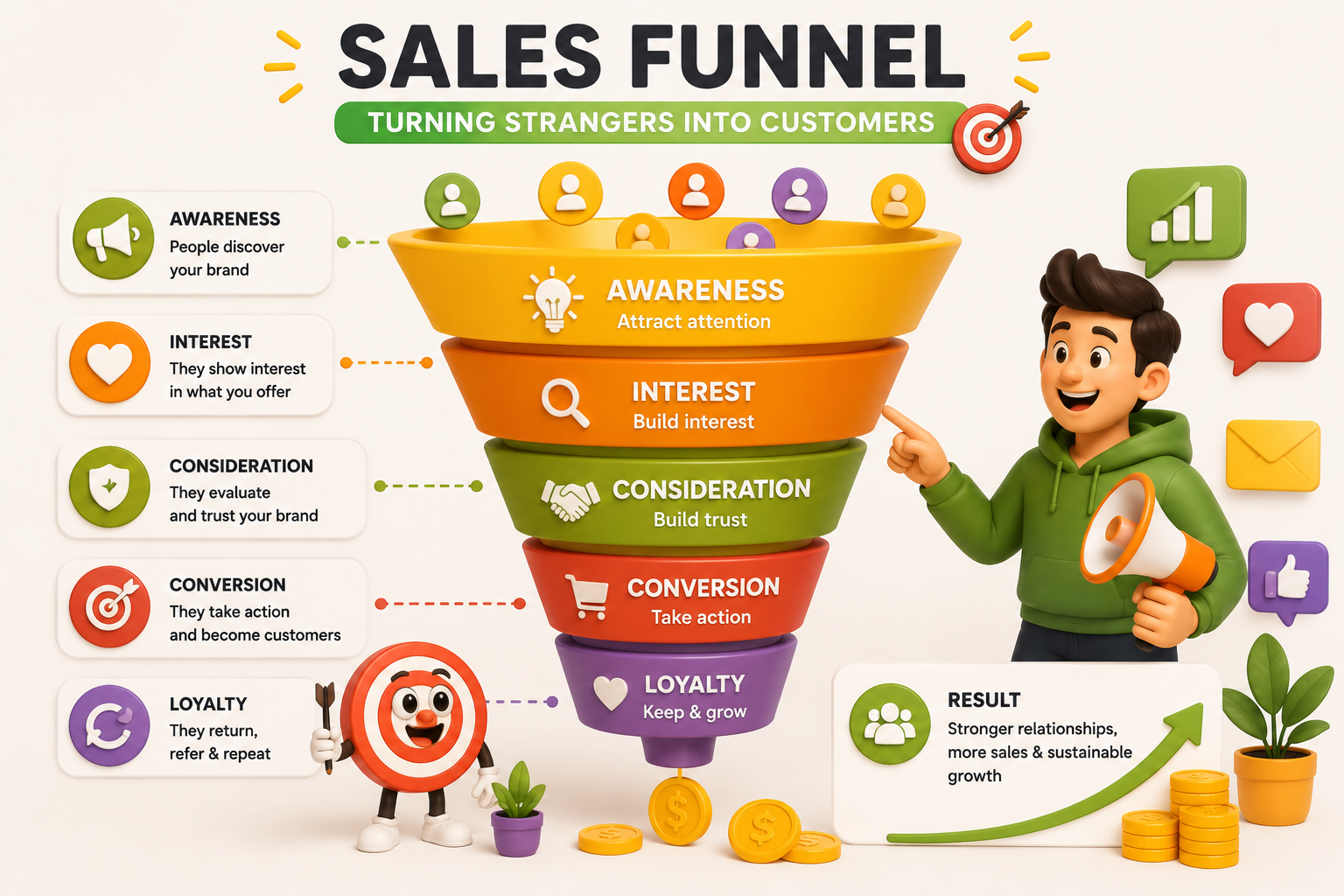
What is a sales funnel in digital marketing? A sales funnel is the structured journey a potential customer takes from first becoming aware of a business through to making a purchase and potentially becoming a repeat customer. Digital marketing maps specific channels and content types to each stage of this funnel to move prospects forward rather than hoping they self-navigate to a purchase decision.
Funnel Stage Audience State Best Digital Marketing Channels Goal Awareness Does not know the brand yet SEO, social media, video, display, influencer Get in front of the target audience Consideration Aware of the brand, evaluating options Content marketing, email, retargeting, webinars Build trust and demonstrate value Decision Ready to buy, choosing between options PPC, landing pages, case studies, reviews Convert interest into purchase Retention Has purchased, potential repeat customer Email, loyalty programmes, social, SMS Drive repeat purchases and loyalty Advocacy Loyal customer who recommends the brand Referral programmes, reviews, UGC, social sharing Generate word-of-mouth and social proof
What is the best marketing funnel for a digital agency or service business? The most effective funnels combine SEO and content marketing to drive awareness-stage organic traffic, retargeting and email to nurture consideration-stage leads, and conversion-optimised landing pages with strong social proof to close decision-stage prospects. A holistic digital marketing strategy addresses all five stages rather than over-investing in one and neglecting the others.
Digital Marketing for Ecommerce
What is the difference between ecommerce and digital marketing? Ecommerce is the selling of products or services online. Digital marketing is the system of channels used to drive traffic, awareness, and conversions for that ecommerce operation. Every ecommerce business needs digital marketing. Not every digital marketing effort involves ecommerce.
Ecommerce digital marketing operates across several high-priority channels simultaneously. What is ecommerce on-page SEO? It is the optimisation of product pages and category pages specifically for the commercial search queries buyers use when they are ready to purchase, including product-specific keywords, pricing and availability in structured data, unique product descriptions, and optimised page speed that prevents high-intent buyers from abandoning a slow-loading product page.
Google Shopping campaigns, dynamic retargeting ads that follow potential customers after they have viewed a product, abandoned cart email sequences, and influencer partnerships that introduce products to targeted audiences are all core ecommerce digital marketing strategies. For Shopify stores specifically, on-page SEO on collection and product pages, the Shopify blog for content marketing, and Google and Meta ad integration are the primary digital marketing levers that drive organic and paid traffic to the store.
B2B Digital Marketing
What is a B2B digital marketing agency and how does B2B digital marketing differ from B2C? Business-to-business digital marketing targets other businesses as the buyer rather than individual consumers. The sales cycle is longer, the decision involves multiple stakeholders, the content needs to be more technical and evidence-based, and the channels that work best are different from consumer-focused campaigns.
LinkedIn is the dominant social channel for B2B digital marketing because it provides precise targeting by job title, company size, industry, and seniority. Content marketing through whitepapers, case studies, and webinars builds the authority and trust that B2B buyers require before committing to a vendor. SEO targeting commercial investigation queries like best CRM for manufacturing companies captures buyers at high-intent research stages. And email nurture sequences over months-long buying cycles maintain brand presence until the prospect is ready to engage a sales conversation.
What Is a Digital Marketing Manager and What Does the Role Cover?
What is a digital marketing manager in practical terms? A digital marketing manager is the senior individual responsible for planning, executing, and optimising a business's digital marketing strategy across channels. The role covers channel strategy and budget allocation, content planning and approval, campaign performance analysis, team management, and reporting on commercial outcomes from digital marketing investment. What is a digital marketing job at the entry level? It typically involves executing within a specific channel such as social media management, email campaign deployment, PPC ad creation, or SEO content writing, with strategy direction coming from the manager or director.
What is a digital marketing firm and how does it differ from an in-house team? A digital marketing firm is an external agency that provides digital marketing services to client businesses. What is a full-service digital marketing agency? It is one that covers every major digital channel under a single partnership, including SEO, paid advertising, content marketing, social media, email, and analytics, rather than specialising in a single discipline.
How to Build a Digital Marketing Strategy
What is a digital marketing framework for a business that is starting from scratch or rebuilding its approach? A practical framework follows six sequential steps that connect business goals to measurable digital actions.
Define your commercial goals — Every digital marketing strategy starts with a specific business objective. Increase revenue by 30 percent. Generate 200 qualified leads per month. Grow the email list to 10,000 subscribers. Without a specific goal, channel selection and budget allocation have no foundation.
Define your audience — Who buys from you, where they spend time online, what problems they are searching for solutions to, and what content they consume and trust. Audience definition determines channel selection more than any other factor.
Choose your primary channels — Select the two or three channels that best match the audience and the commercial goal rather than trying to be active on every platform simultaneously. A local B2B services firm likely prioritises LinkedIn, SEO, and email. A consumer ecommerce brand likely prioritises Google Shopping, Meta ads, and Instagram.
Plan your content and messaging — Every channel requires content. SEO requires articles and landing pages. Social requires posts and videos. Email requires sequences and newsletters. Plan the content calendar, the creative assets, and the messaging that aligns with each stage of the sales funnel before any campaigns go live.
Execute and measure — Launch campaigns, set up tracking in Google Analytics 4 and the relevant ad platforms, and define the specific metrics that indicate progress toward the commercial goal. What is web analytics in digital marketing for this purpose? It is the data infrastructure that connects marketing activity to business outcomes.
Optimise continuously — Review performance data weekly, identify what is working and what is not, and redirect budget and effort toward the channels and content types that are producing the best results. Digital marketing is an iterative discipline, not a one-time launch.
What Is the Digital Marketing Mix?
The digital marketing mix is an adaptation of the classic marketing mix — traditionally the four Ps of Product, Price, Place, and Promotion — applied to the specific dynamics of digital channels. Understanding it as a framework, rather than just a list of channels, helps explain why the channel-selection step in the strategy framework above matters as much as it does.
Product in a digital context extends beyond the physical or service offering to include the digital experience surrounding it — the website, the app, the content that explains and supports it. A product with a poor digital presentation underperforms a comparable product with a strong one, even when the underlying offering is identical.
Price in digital marketing is shaped by visible competitive comparison in a way physical retail rarely was. A buyer researching a purchase online typically has direct, instant access to every competitor's pricing, which makes pricing strategy and the messaging that justifies it a more active, visible part of digital marketing than it was in pre-digital retail.
Place has been transformed most dramatically by digital channels. Where "place" once meant physical distribution and retail locations, digital place means the channels where a business is discoverable at all: search engines, social platforms, app stores, and marketplaces. A product's "place" today is determined by SEO rankings, app store visibility, and social media presence as much as by physical shelf space.
Promotion is the piece most people associate with "digital marketing" directly — the actual channels and tactics covered throughout this guide, from SEO and paid search through to email, social, and content marketing.
Some modern frameworks extend this to seven Ps by adding People (the team and customer service experience), Process (how a customer moves through the buying journey), and Physical Evidence (the trust signals — reviews, case studies, testimonials — that substitute for physically inspecting a product before purchase online). In practice, "getting the digital marketing mix right" for a specific business means the same thing as the channel-selection and audience-definition steps covered in the strategy framework above: matching the right combination of these elements to a specific audience and commercial goal, rather than assuming a fixed formula applies identically to every business.
AI in Digital Marketing in 2026
Artificial intelligence has become embedded in digital marketing across every channel. Google's Performance Max campaigns use AI to allocate budget across channels automatically. Meta's Advantage Plus campaigns use machine learning to find converting audiences without manual targeting. Email platforms use AI for send-time optimisation and subject line testing. SEO tools use AI to identify content gaps and keyword opportunities. And content production has been accelerated by AI drafting tools, though the best-performing content still reflects genuine human expertise and first-hand experience that AI cannot replicate.
What is a holistic digital marketing strategy in the AI era? It is one that uses AI tools to accelerate execution and improve efficiency while maintaining the human judgment, creativity, and brand voice that differentiate a business from its competitors. Businesses that use AI purely to produce volume at the expense of quality consistently underperform those that use it to augment the capability of skilled human marketers.
How We Work
At Munix Studio, digital marketing is treated as a revenue system, not a collection of disconnected tactics. We build the technical foundations that make digital marketing effective — websites that load fast, rank in search, and convert visitors — and connect them to digital marketing strategies that drive qualified traffic from the channels that matter most to each client's specific audience and commercial goals.
Every engagement starts with a clear understanding of the business goal, the target audience, and the competitive landscape. Channel selection, content strategy, and performance metrics are built around that understanding rather than applied generically. We measure what matters: qualified traffic, leads generated, revenue attributed, and cost per acquisition across every channel we manage.
Digital Marketing Services From Munix Studio
Digital marketing performance starts with the right technical and strategic foundations. Munix Studio provides the full stack of services that connect digital marketing strategy to measurable commercial outcomes.
Digital Marketing — Full-channel digital marketing strategy and execution covering SEO, paid advertising, content marketing, social media, and email, built around your specific commercial goals and target audience.
SEO Optimization — Technical SEO, on-page optimisation, and content strategy that builds the organic search visibility and topical authority that compound into sustainable traffic growth over time.
Website Development — Custom websites built on React and Next.js with the speed, SEO architecture, and conversion design that digital marketing campaigns need to perform at their full potential.
Graphic and Branding — Brand identity, creative assets, and visual content that give digital marketing campaigns the consistent, professional presentation that builds trust and recognition across every channel.
Maintenance and Support — Ongoing technical support and performance monitoring to ensure the digital infrastructure underpinning your marketing efforts remains fast, reliable, and fully optimised at all times.
Frequently Asked Questions
Ready to Get Started?
Digital Marketing
Full-channel digital marketing strategy and execution covering SEO, paid advertising, content, social media, and email, built around your specific commercial goals and target audience.
Explore Digital MarketingGraphic and Branding
Brand identity, creative assets, and visual content that give digital marketing campaigns the consistent, professional presentation that builds trust across every channel.
Explore Graphic and Branding